
[Paper Review] MusicRL: Aligning Music Generation to Human Preferences
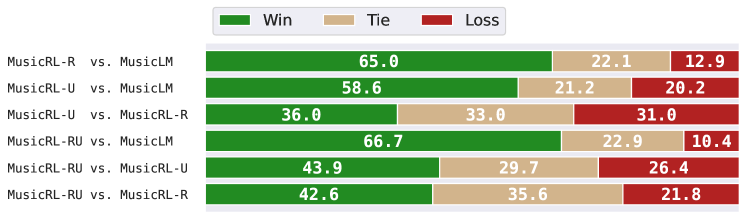
MusicRL is the first text-to-music generation model fine-tuned via reinforcement learning from human feedback (RLHF), improving alignment with human preferences. It combines reward signals for text adherence, audio quality, and user preferences—collected from 300,000 pairwise comparisons—resulting in a model (MusicRL-RU) that outperforms both baseline and prior RL-fine-tuned variants in human evaluations.
We propose MusicRL, the first music generation system finetuned from human feedback. Appreciation of text-to-music models is particularly subjective since the concept of musicality as well as the specific intention behind a caption are user-dependent (e.g. a caption such as "upbeat work-out music" can map to a retro guitar solo or a techno pop beat). Not only this makes supervised training of such models challenging, but it also calls for integrating continuous human feedback in their post-deployment finetuning. MusicRL is a pretrained autoregressive MusicLM (Agostinelli et al., 2023) model of discrete audio tokens finetuned with reinforcement learning to maximise sequence-level rewards. We design reward functions related specifically to text-adherence and audio quality with the help from selected raters, and use those to finetune MusicLM into MusicRL-R. We deploy MusicLM to users and collect a substantial dataset comprising 300,000 pairwise preferences. Using Reinforcement Learning from Human Feedback (RLHF), we train MusicRL-U, the first text-to-music model that incorporates human feedback at scale. Human evaluations show that both MusicRL-R and MusicRL-U are preferred to the baseline. Ultimately, MusicRL-RU combines the two approaches and results in the best model according to human raters. Ablation studies shed light on the musical attributes influencing human preferences, indicating that text adherence and quality only account for a part of it. This underscores the prevalence of subjectivity in musical appreciation and calls for further involvement of human listeners in the finetuning of music generation models.
Motivation & Objective
- Address the subjectivity of musical appreciation, which limits supervised training of text-to-music models.
- Overcome the lack of musicality bias in autoregressive audio generation by incorporating human feedback.
- Develop a scalable method to align music generation with human preferences using reinforcement learning.
- Investigate whether user feedback contains signals beyond text adherence and audio quality.
- Create a system that improves music generation through continuous human feedback post-deployment.
Proposed method
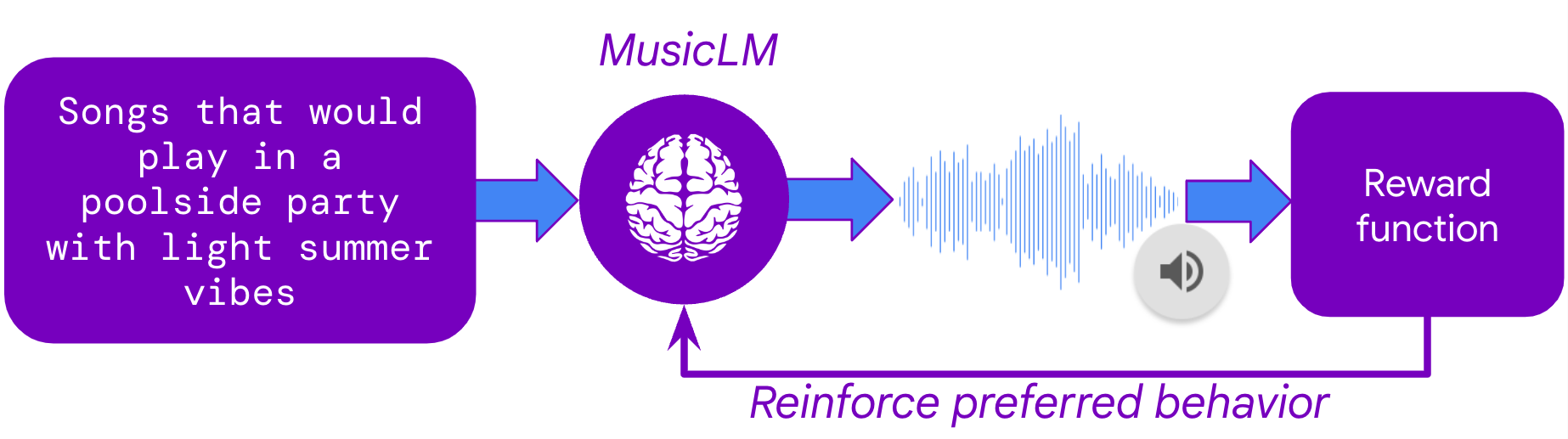
- Fine-tune a pretrained autoregressive MusicLM model using reinforcement learning to maximize sequence-level rewards.
- Design reward functions based on text adherence (e.g., MuLan Cycle Consistency) and audio quality (e.g., Fréchet Audio Distance) using feedback from selected raters.
- Deploy MusicLM to users and collect 300,000 user-generated caption-audio pairs with pairwise preference annotations via a web interface.
- Train a reward model on the collected user preference data to guide further RL fine-tuning.
- Apply RLHF to train MusicRL-U using the user preference reward model, and combine it with prior reward signals in MusicRL-RU.
- Use on-policy data collection in future iterations to close the distribution gap between feedback and deployment.
Experimental results
Research questions
- RQ1Can reinforcement learning from human feedback (RLHF) effectively improve text-to-music generation beyond automatic metrics?
- RQ2To what extent do user preferences in music generation align with objective metrics like text adherence and audio quality?
- RQ3How does combining multiple reward signals—text adherence, audio quality, and user preferences—affect model performance?
- RQ4What musical attributes influence human preference beyond text adherence and audio quality?
- RQ5Can large-scale user feedback collected in the wild be effectively used to train robust reward models for music generation?
Key findings
- MusicRL-RU, which combines quality, text adherence, and user preference rewards, is preferred over both MusicRL-R and MusicRL-U in human evaluations.
- MusicRL-U, trained on 300,000 user pairwise preferences, significantly outperforms the pretrained MusicLM baseline.
- The quality predictor achieved 53.3% accuracy in predicting which clip was preferred, indicating that audio quality is a moderate but not dominant signal in human preference.
- User preferences contain information beyond text adherence and audio quality, suggesting that musicality involves subjective, complex attributes.
- Ablation studies show that while text adherence and quality improve performance, they do not fully explain human preference, underscoring the role of subjective musicality.
- The model trained on user feedback (MusicRL-U) marginally improved on the quality score, indicating that user feedback captures additional, non-trivial aspects of preference.
Read this paper
Open the full text in the Nubint reader and ask about any passage as you read.
Read this paper on NubintThis review was generated by AI from the original paper. Please check the paper before citing it.