
[Paper Review] MVDiffusion: Enabling Holistic Multi-view Image Generation with Correspondence-Aware Diffusion
MVDiffusion generates consistent multi-view images in parallel using correspondence-aware diffusion, enabling panorama extrapolation and depth-conditioned multi-view texturing with a frozen pre-trained SD model.
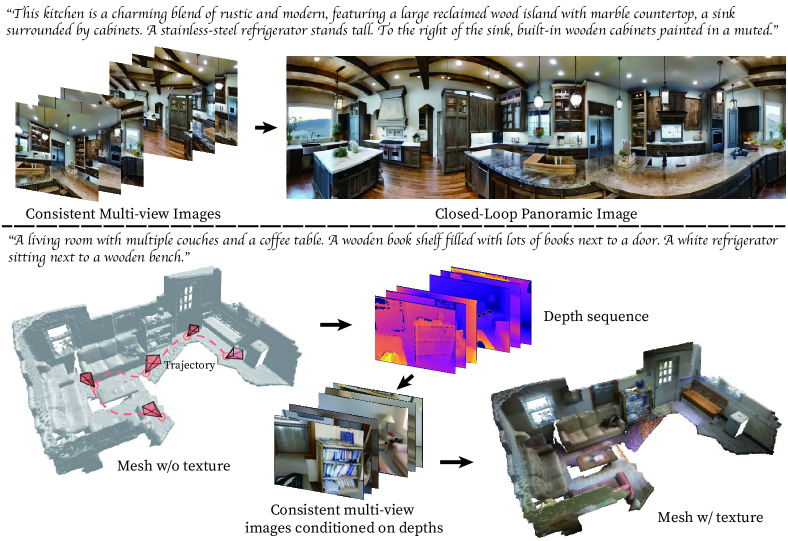
This paper introduces MVDiffusion, a simple yet effective method for generating consistent multi-view images from text prompts given pixel-to-pixel correspondences (e.g., perspective crops from a panorama or multi-view images given depth maps and poses). Unlike prior methods that rely on iterative image warping and inpainting, MVDiffusion simultaneously generates all images with a global awareness, effectively addressing the prevalent error accumulation issue. At its core, MVDiffusion processes perspective images in parallel with a pre-trained text-to-image diffusion model, while integrating novel correspondence-aware attention layers to facilitate cross-view interactions. For panorama generation, while only trained with 10k panoramas, MVDiffusion is able to generate high-resolution photorealistic images for arbitrary texts or extrapolate one perspective image to a 360-degree view. For multi-view depth-to-image generation, MVDiffusion demonstrates state-of-the-art performance for texturing a scene mesh.
Motivation & Objective
- Motivate holistic multi-view generation to prevent error accumulation in autoregressive view-by-view methods.
- Leverage a frozen pretrained diffusion model with light, cross-view correspondence attention to enforce consistency.
- Enable panorama generation and 3D scene texturing from depth/pose data without training a new large model.
- Demonstrate state-of-the-art performance on panorama generation and multi-view depth-to-image generation.
Proposed method
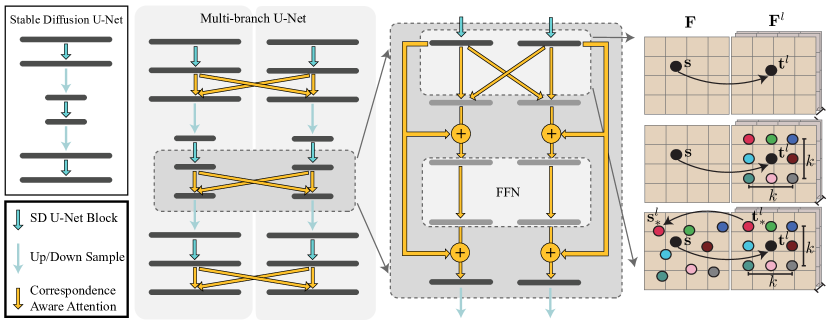
- Use multiple branches of a standard text-to-image diffusion model with a shared UNet to generate several views in parallel.
- Introduce correspondence-aware attention (CAA) blocks after each UNet block to fuse cross-view information and enforce multi-view consistency.
- Freeze the original Stable Diffusion weights to preserve pre-trained capabilities while training only the added CAA blocks.
- Panorama generation uses eight 512×512 perspective views (90° FoV, 45° overlap) generated jointly with CAA for consistency.
- For panorama extrapolation, reuse inpainting to extend a single perspective image to a 360° panorama with CAA-based conditioning.
- Depth-to-image generation conditions on multi-view depth/poses and densifies key frames via an interpolation module that shares the same CAA-based UNet.
Experimental results
Research questions
- RQ1Can a single diffusion model generate consistent multi-view images in parallel given pixel-to-pixel correspondences?
- RQ2Does correspondence-aware attention improve cross-view consistency for panoramas and depth-to-image sequences compared with view-by-view or inpainting-based methods?
- RQ3How well does multi-view diffusion generalize to domains beyond the training panoramas (e.g., outdoor or cartoon styles) while freezing the base model?
Key findings
- On panorama generation, MVDiffusion achieves FID 21.44, IS 7.32, and CLIP Score 30.04, outperforming baselines including Text2Light and standard SD panoramas.
- On multi-view depth-to-image generation, MVDiffusion attains FID 23.10, IS 7.27, and CLIP Score 29.03, surpassing RePaint and depth-conditioned ControlNet baselines.
- The method yields improved multi-view consistency as shown by PSNR ratios of 0.67 (panorama) and 0.76 (depth-to-image) relative to ground-truth upper bounds.
- Training requires relatively modest data (panoramas from a 10k-panoramas dataset) and preserves SD generalization via weight freezing.
- MVDiffusion can extrapolate to 360° panoramas from a single perspective image and generate diverse outdoor/cartoon-like results despite indoor-only training.
Read this paper
Open the full text in the Nubint reader and ask about any passage as you read.
Read this paper on NubintThis review was generated by AI from the original paper. Please check the paper before citing it.