
[Paper Review] MVDream: Multi-view Diffusion for 3D Generation
MVDream proposes a multi-view diffusion model trained on 3D-rendered and 2D data to generate consistent multi-view images from text; it serves as a 3D prior for SDS-based 3D generation and supports DreamBooth-style 3D personalization.
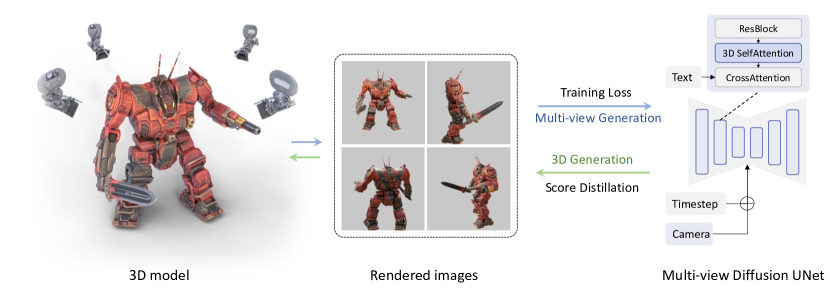
We introduce MVDream, a diffusion model that is able to generate consistent multi-view images from a given text prompt. Learning from both 2D and 3D data, a multi-view diffusion model can achieve the generalizability of 2D diffusion models and the consistency of 3D renderings. We demonstrate that such a multi-view diffusion model is implicitly a generalizable 3D prior agnostic to 3D representations. It can be applied to 3D generation via Score Distillation Sampling, significantly enhancing the consistency and stability of existing 2D-lifting methods. It can also learn new concepts from a few 2D examples, akin to DreamBooth, but for 3D generation.
Motivation & Objective
- Motivate and address the lack of cross-view consistency in 2D diffusion–based 3D generation.
- Propose a multi-view diffusion model that preserves 2D diffusion generalizability while ensuring multi-view consistency.
- Demonstrate improved stability and quality for 3D generation using the multi-view prior in SDS-based pipelines.
- Enable few-shot 3D personalization by extending the model with a DreamBooth-style adaptation.
Proposed method
- Convert a standard 2D text-to-image diffusion backbone into a multi-view diffusion model by introducing 3D cross-view attention and camera embeddings.
- Train on a mixture of 3D-rendered multi-view data and large-scale 2D text–image data to inherit generalizability while enforcing cross-view consistency.
- Use multi-view diffusion as a 3D prior in Score Distillation Sampling (SDS) to drive 3D NeRF-style representations, with camera parameters fed as inputs.
- Adopt an x0 reconstruction loss and techniques like time-step annealing, negative prompts, and CFG rescale to stabilize multi-view SDS and improve texture/lighting realism.
- Extend the MV diffusion model to a DreamBooth-like setup (MV DreamBooth) for few-shot personalization with a preservation loss to maintain multi-view consistency.

Experimental results
Research questions
- RQ1How can diffusion models be extended to generate consistent multi-view images from a single text prompt?
- RQ2Can a multi-view diffusion model serve as a robust, generalizable 3D prior for SDS-based 3D generation across diverse prompts and views?
- RQ3Does incorporating camera conditioning and shared 3D attention improve cross-view consistency and reduce content drift in generated multi-view sets?
- RQ4Can multi-view diffusion enable effective 3D DreamBooth-style personalization without compromising multi-view coherence?
Key findings
- The proposed MV diffusion model achieves multi-view consistency and comparable or better texture/structure quality across views compared to single-view diffusion baselines.
- Quantitative results show FID, IS, and CLIP scores that are competitive with training data and improve CLIP/IS when a text-to-image dataset is added (LAION).
- In SDS-based 3D generation, MV-SDS yields more stable and higher-quality 3D assets than several 2D-lifting baselines (DreamFusion, Magic3D, Text2Mesh, ProlificDreamer).
- A DreamBooth-style fine-tuning (MV DreamBooth) preserves multi-view consistency while enabling identity-specific 3D customization.
- A user study indicates about 78% of participants preferred MV DreamBooth outputs over baselines, supporting robustness and quality.
Read this paper
Open the full text in the Nubint reader and ask about any passage as you read.
Read this paper on NubintThis review was generated by AI from the original paper. Please check the paper before citing it.