
[Paper Review] MVSplat: Efficient 3D Gaussian Splatting from Sparse Multi-View Images
MVSplat introduces a cost-volume based, feed-forward 3D Gaussian splatting model that learns Gaussian centers and parameters from sparse multi-view images, achieving state-of-the-art rendering quality with far fewer parameters and faster inference than prior methods.
We introduce MVSplat, an efficient model that, given sparse multi-view images as input, predicts clean feed-forward 3D Gaussians. To accurately localize the Gaussian centers, we build a cost volume representation via plane sweeping, where the cross-view feature similarities stored in the cost volume can provide valuable geometry cues to the estimation of depth. We also learn other Gaussian primitives' parameters jointly with the Gaussian centers while only relying on photometric supervision. We demonstrate the importance of the cost volume representation in learning feed-forward Gaussians via extensive experimental evaluations. On the large-scale RealEstate10K and ACID benchmarks, MVSplat achieves state-of-the-art performance with the fastest feed-forward inference speed (22~fps). More impressively, compared to the latest state-of-the-art method pixelSplat, MVSplat uses $10 imes$ fewer parameters and infers more than $2 imes$ faster while providing higher appearance and geometry quality as well as better cross-dataset generalization.
Motivation & Objective
- Motivate efficient 3D scene reconstruction and novel view synthesis from very sparse multi-view inputs.
- Leverage a 3D Gaussian splatting representation to enable fast, differentiable rendering.
- Introduce a cost volume based depth and geometry learning module to localize Gaussian centers.
- Predict Gaussian parameters (opacity, covariance, color) jointly with centers under photometric supervision.
- Demonstrate strong cross-dataset generalization and efficiency compared to prior methods.
Proposed method
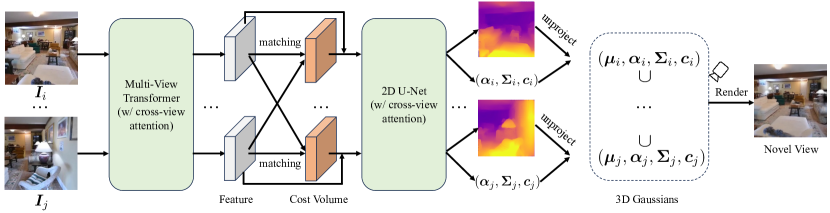
- Build a cost volume via plane sweeping in 3D to capture cross-view feature similarities for depth candidates.
- Use a multi-view Transformer to extract and fuse features across views, enabling view-consistent depth prediction.
- Refine cost volumes with a lightweight 2D U-Net and cross-view attention to handle texture-less regions.
- Unproject depth maps to obtain 3D Gaussian centers and predict opacity, covariance (scale and rotation) and color (spherical harmonics).
- Render novel views by differentiable 3D Gaussian splatting using the predicted parameters.
- Train end-to-end with photometric loss between rendered and ground-truth images.
Experimental results
Research questions
- RQ1Can a cost-volume driven, feed-forward model improve geometry and appearance quality for scene-scale reconstruction from sparse views?
- RQ2Does learning 3D Gaussian centers and parameters jointly through cross-view cost volumes yield better cross-view consistency and generalization?
- RQ3How does MVSplat compare to state-of-the-art methods in accuracy, speed, and parameter efficiency on RealEstate10K, ACID, and DTU?
- RQ4What is the impact of components such as the cost volume, cross-view attention, and refinement U-Net on final performance?
Key findings
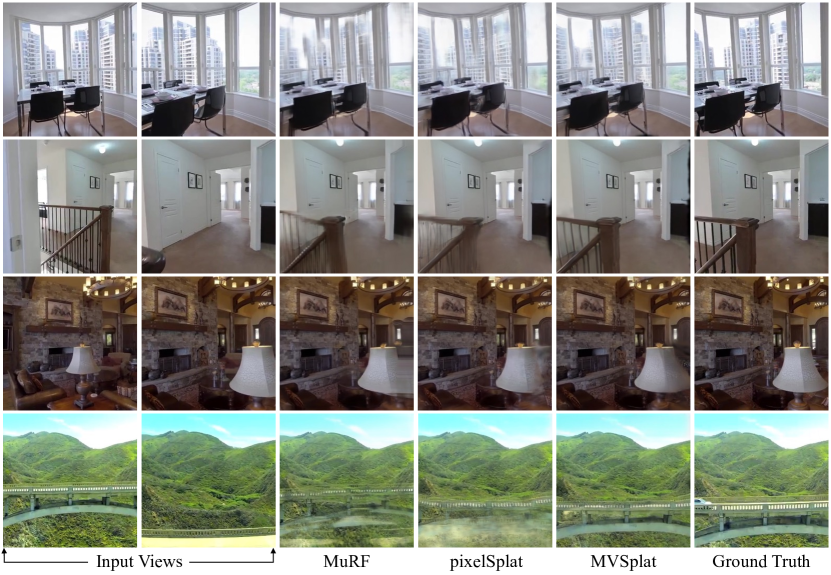
- Achieves state-of-the-art rendering quality on RealEstate10K and ACID benchmarks across PSNR, SSIM, and LPIPS.
- Runs at 22 fps for feed-forward inference, with about 12.0M parameters, outperforming pixelSplat in speed and efficiency.
- Uses up to 10x fewer parameters and over 2x faster inference than pixelSplat while delivering better appearance and geometry quality.
- Cost-volume based encoder is critical; removing it significantly degrades performance (e.g., PSNR drop >3dB).
- Cross-view attention and 2D U-Net refinement substantially improve geometry and handle challenging regions.
- Zero-shot cross-dataset generalization is stronger for MVSplat than pixelSplat, with better LPIPS and robustness to domain shifts.
Read this paper
Open the full text in the Nubint reader and ask about any passage as you read.
Read this paper on NubintThis review was generated by AI from the original paper. Please check the paper before citing it.