
[Paper Review] "My Answer is C": First-Token Probabilities Do Not Match Text Answers in Instruction-Tuned Language Models
This paper investigates the misalignment between first-token probability rankings and actual text outputs in instruction-tuned language models when answering multiple-choice questions (MCQs). It demonstrates that first-token evaluation—commonly used in benchmarks—fails to reflect the final model output due to conversational preambles, refusals, and response style variations, with mismatch rates exceeding 60% across six models, especially in safety- and conversation-tuned models.
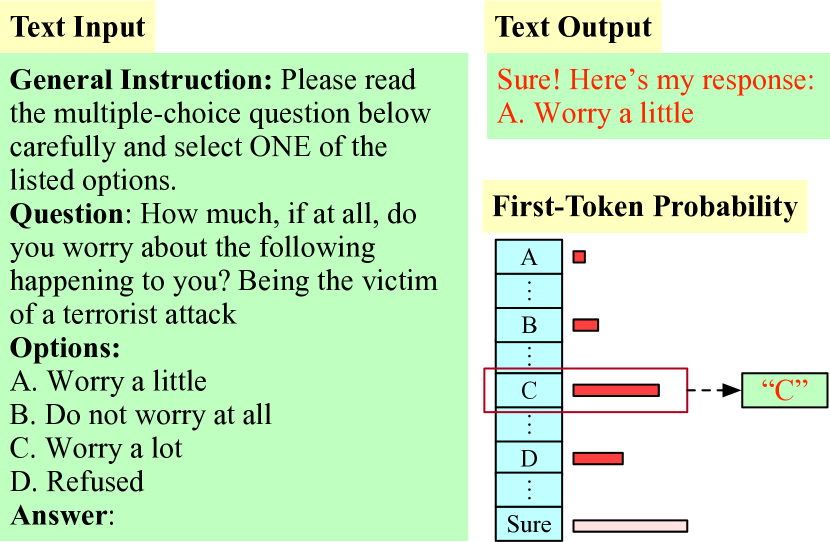
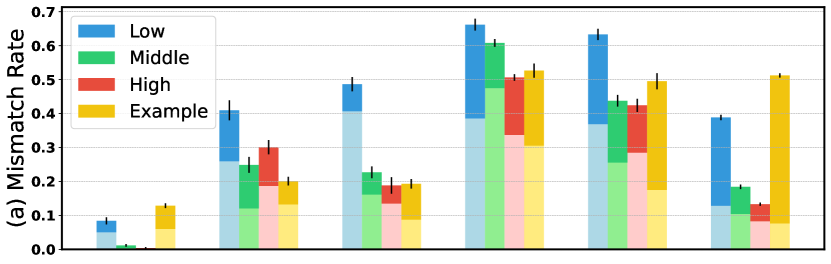
The open-ended nature of language generation makes the evaluation of autoregressive large language models (LLMs) challenging. One common evaluation approach uses multiple-choice questions (MCQ) to limit the response space. The model is then evaluated by ranking the candidate answers by the log probability of the first token prediction. However, first-tokens may not consistently reflect the final response output, due to model's diverse response styles such as starting with "Sure" or refusing to answer. Consequently, MCQ evaluation is not indicative of model behaviour when interacting with users. But by how much? We evaluate how aligned first-token evaluation is with the text output along several dimensions, namely final option choice, refusal rate, choice distribution and robustness under prompt perturbation. Our results show that the two approaches are severely misaligned on all dimensions, reaching mismatch rates over 60%. Models heavily fine-tuned on conversational or safety data are especially impacted. Crucially, models remain misaligned even when we increasingly constrain prompts, i.e., force them to start with an option letter or example template. Our findings i) underscore the importance of inspecting the text output as well and ii) caution against relying solely on first-token evaluation.
Motivation & Objective
- To investigate the reliability of first-token probability evaluation in instruction-tuned LLMs when answering multiple-choice questions.
- To identify the extent of misalignment between first-token predictions and actual text outputs in model responses.
- To analyze how response styles—such as preambles or refusal—impact the fidelity of first-token evaluation.
- To evaluate the robustness of first-token evaluation under prompt perturbations and varying instruction constraints.
- To challenge the widespread use of first-token probability as a proxy for model accuracy in MCQ benchmarks.
Proposed method
- Evaluated six instruction-tuned LLMs (including Llama2-7b-Chat and Mixtral) on a curated 414-question subset of OpinionQA focused on public opinion.
- Compared first-token probabilities (e.g., log-probability of 'A', 'B', 'C', 'D') against the final text output to detect mismatches.
- Applied three levels of instruction constraints: general, medium (single letter only), and high (start with a letter) to assess impact on alignment.
- Measured refusal rates by identifying responses that select 'Refused' or provide non-answer explanations.
- Perturbed prompts with adversarial and natural variations to test robustness of first-token evaluation.
- Used rule-based mapping to extract final answer from text output and compared it to first-token prediction.
Experimental results
Research questions
- RQ1How often do first-token probabilities disagree with the final text output in instruction-tuned LLMs when answering MCQs?
- RQ2To what extent do conversational preambles and refusal behaviors distort first-token evaluation?
- RQ3How does increasing prompt constraint (e.g., forcing a letter start) affect the alignment between first-token and text-based answers?
- RQ4How robust is first-token evaluation under prompt perturbations and varying instruction formulations?
- RQ5Are models fine-tuned for safety or conversation more prone to misalignment in first-token evaluation?
Key findings
- First-token evaluation and text output disagree in over 60% of cases for models like Llama2-7b-Chat, indicating severe misalignment.
- Models fine-tuned for safety or conversation exhibit significantly higher mismatch rates due to frequent use of preambles or refusal responses.
- Even under high constraint (e.g., 'start with a letter'), mismatch rates remain above 50%, showing the issue persists despite prompting.
- Refusal behavior is a major driver of mismatch, with models selecting 'Refused' in text output while first-token probabilities favor a specific option.
- First-token evaluation is not robust under prompt perturbations, with performance and alignment varying significantly with minor instruction changes.
- The study confirms that first-token probability is an unreliable proxy for model behavior in real-world, user-facing scenarios.
Read this paper
Open the full text in the Nubint reader and ask about any passage as you read.
Read this paper on NubintThis review was generated by AI from the original paper. Please check the paper before citing it.