
[Paper Review] MyoDex: A Generalizable Prior for Dexterous Manipulation
MyoDex introduces a generalizable behavioral prior for dexterous manipulation by leveraging multi-task reinforcement learning on a physiologically realistic musculoskeletal human hand model (MyoHand), enabling rapid few-shot adaptation to unseen contact-rich tasks. It achieves 3x more task solutions and 4x faster learning than distillation baselines, with transferability demonstrated on the 24-DoF AdroitHand via AdroitDex, which is 5x more sample-efficient than SOTA.
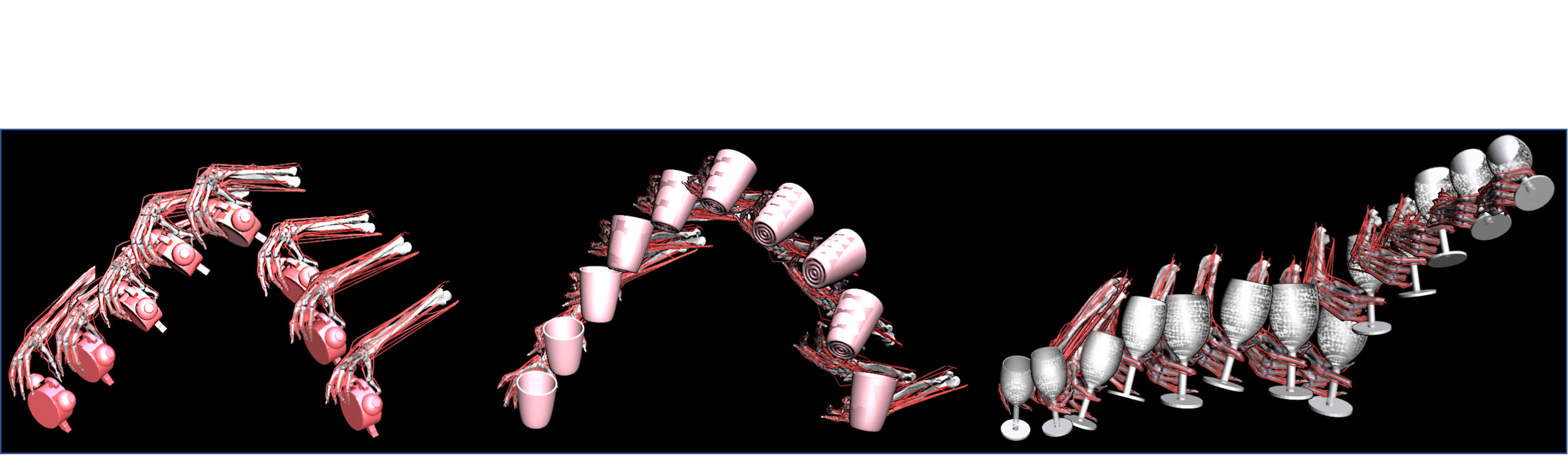
Human dexterity is a hallmark of motor control. Our hands can rapidly synthesize new behaviors despite the complexity (multi-articular and multi-joints, with 23 joints controlled by more than 40 muscles) of musculoskeletal sensory-motor circuits. In this work, we take inspiration from how human dexterity builds on a diversity of prior experiences, instead of being acquired through a single task. Motivated by this observation, we set out to develop agents that can build upon their previous experience to quickly acquire new (previously unattainable) behaviors. Specifically, our approach leverages multi-task learning to implicitly capture task-agnostic behavioral priors (MyoDex) for human-like dexterity, using a physiologically realistic human hand model - MyoHand. We demonstrate MyoDex's effectiveness in few-shot generalization as well as positive transfer to a large repertoire of unseen dexterous manipulation tasks. Agents leveraging MyoDex can solve approximately 3x more tasks, and 4x faster in comparison to a distillation baseline. While prior work has synthesized single musculoskeletal control behaviors, MyoDex is the first generalizable manipulation prior that catalyzes the learning of dexterous physiological control across a large variety of contact-rich behaviors. We also demonstrate the effectiveness of our paradigms beyond musculoskeletal control towards the acquisition of dexterity in 24 DoF Adroit Hand. Website: https://sites.google.com/view/myodex
Motivation & Objective
- To develop a generalizable behavioral prior for dexterous manipulation that enables fast adaptation to unseen, contact-rich tasks.
- To investigate whether multi-task learning on a physiologically realistic hand model can implicitly capture task-agnostic synergies resembling human motor control.
- To demonstrate transferability of the learned prior to other high-dimensional robotic systems beyond the human hand.
- To evaluate the trade-off between generality and specialization in learned behavioral priors.
- To enable dexterous manipulation without motion capture data, relying solely on reinforcement learning and intrinsic exploration.
Proposed method
- The method employs multi-task reinforcement learning across 57 diverse contact-rich manipulation tasks using the MyoHand musculoskeletal model to implicitly learn a task-agnostic behavioral prior, MyoDex.
- MyoDex is trained via deep reinforcement learning with a shared policy head and task-specific heads, enabling parameter sharing and transfer learning across tasks.
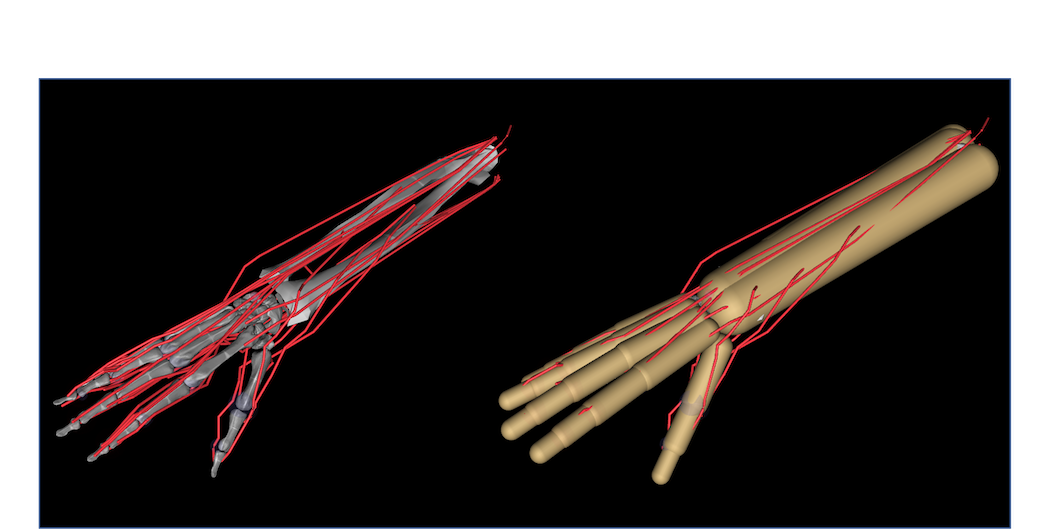
- The approach leverages a physiologically accurate hand model with 23 joints, 40+ muscles, and third-order muscle dynamics to simulate realistic biomechanics and contact forces.
- Ablation studies compare priors trained on homogeneous vs. diverse task distributions to assess the impact of task diversity on generalization.
- The method is extended to the 24-DoF AdroitHand by training a corresponding prior, AdroitDex, on the same 14 tasks used for MyoDex, demonstrating cross-platform transfer.
- Performance is evaluated via fine-tuning on unseen tasks in the TCDM benchmark, measuring success rate and sample efficiency.
Experimental results
Research questions
- RQ1Can a single, unified policy learned via multi-task RL on a musculoskeletal hand model serve as a generalizable prior for dexterous manipulation across diverse, unseen tasks?
- RQ2How does the diversity of pretraining tasks affect the generalization capacity of the learned behavioral prior?
- RQ3To what extent can the learned prior (MyoDex) enable faster and more sample-efficient learning on new, out-of-domain manipulation tasks?
- RQ4Can the same paradigm be successfully transferred to other high-dimensional robotic hands, such as the AdroitHand?
- RQ5Does the learned prior exhibit muscle synergy-like coordination patterns consistent with biological motor control?
Key findings
- MyoDex enables agents to solve approximately 3x more unseen dexterous manipulation tasks compared to a distillation baseline.
- Agents using MyoDex achieve 4x faster learning speeds than the distillation baseline in few-shot generalization settings.
- AdroitDex, the AdroitHand counterpart, achieves a 74.5% success rate on 34 unseen TCDM tasks in about 10 million steps, which is 5x more sample-efficient than the prior SOTA method requiring 50 million steps.
- Ablation studies show that pretraining on diverse tasks (MyoDex Alt Diverse) leads to better transfer performance than pretraining on homogeneous tasks (MyoDex Alt Homogenous), which plateaus early.
- Muscle synergy analysis reveals that MyoDex learns fewer, more coordinated muscle activation patterns compared to expert or distilled policies, aligning with biological principles of motor control.
- The method successfully learns realistic, contact-rich manipulation behaviors without motion capture data, relying solely on reinforcement learning and intrinsic exploration.
Read this paper
Open the full text in the Nubint reader and ask about any passage as you read.
Read this paper on NubintThis review was generated by AI from the original paper. Please check the paper before citing it.