
[Paper Review] Nanoscale engineering and dynamical stabilization of mesoscopic spin textures
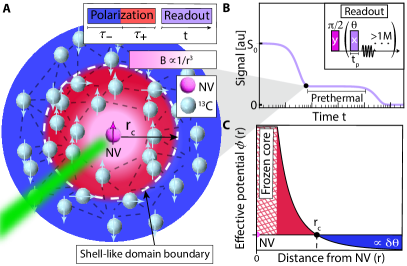
This paper demonstrates a novel method to engineer and stabilize mesoscopic shell-like spin textures in nuclear spins using thermalization dynamics, leveraging an NV center in diamond as a nanoscale polarization injector and dissipation source. By exploiting prethermalization under a Floquet-driven electronic gradient field, the system achieves long-lived, stable spin textures spanning several nanometers and hundreds of spins, with coherence times exceeding one million interaction timescales—enabling robust, non-local control and readout without individual spin addressing.
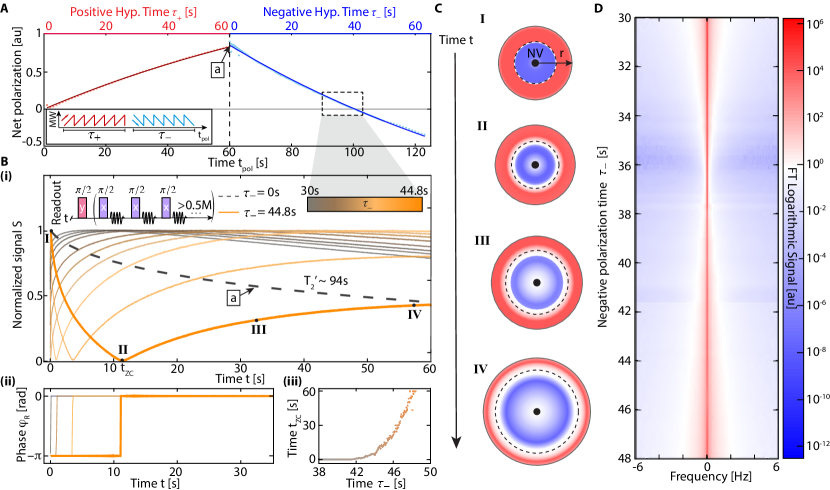
Thermalization phenomena, while ubiquitous in quantum systems, have traditionally been viewed as obstacles to be mitigated. In this study, we demonstrate the ability, instead, to harness thermalization to dynamically engineer and stabilize structured quantum states in a mesoscopically large ensemble of spins. Specifically, we showcase the capacity to generate, control, stabilize, and read out 'shell-like' spin texture with interacting $ {}^{ 13}\mathrm{C}$ nuclear spins in diamond, wherein spins are polarized oppositely on either side of a critical radius. The texture spans several nanometers and encompasses many hundred spins. We capitalize on the thermalization process to impose a quasi-equilibrium upon the generated texture; as a result, it is highly stable, immune to spin diffusion, and endures over multiple-minute long periods -- over a million times longer than the intrinsic interaction scale of the spins. Additionally, the texture is created and interrogated without locally controlling or probing the nuclear spins. These features are accomplished using an electron spin as a nanoscale injector of spin polarization, and employing it as a source of spatially varying dissipation, allowing for serial readout of the emergent spin texture. Long-time stabilization is achieved via prethermalization to a Floquet-induced Hamiltonian under the electronic gradient field. Our work presents a new approach to robust nanoscale spin state engineering and paves the way for new applications in quantum simulation, quantum information science, and nanoscale imaging.
Motivation & Objective
- To overcome the traditional view of thermalization as a detrimental process in quantum systems by harnessing it to stabilize structured spin states.
- To achieve long-lived, mesoscopically extended spin textures in a high-temperature nuclear spin ensemble without local control or readout.
- To demonstrate a scalable, non-invasive method for creating and monitoring complex spin textures using a single NV center as a nanoscale probe and injector.
- To establish a framework for robust quantum state engineering via engineered dissipation and prethermalization in long-range interacting spin systems.
Proposed method
- Utilizes an NV center in diamond as a nanoscale source of spin polarization and spatially varying dissipation to inject and shape spin textures.
- Employs a time-periodic (Floquet) driving of the NV electron spin to induce a prethermalized effective Hamiltonian that stabilizes the spin texture.
- Applies a spatially dependent effective on-site potential via the NV's magnetic dipole field to create a radial polarization gradient in surrounding 13C nuclear spins.
- Uses serial readout via the NV center to monitor the emergent spin texture in real time without local addressing of individual nuclear spins.
- Employs classical simulations with coarse-grained lattice models to validate the long-time dynamics, neglecting short-time fluctuations below a minimal inter-spin distance of 2a.
- Averages results over multiple lattice configurations and initial states to model the statistical behavior of the NV environment, consistent with experimental ensemble averaging.
Experimental results
Research questions
- RQ1Can thermalization dynamics be harnessed to stabilize complex, mesoscopic spin textures rather than being suppressed?
- RQ2Can a single NV center enable non-local, serial readout and control of a large ensemble of nuclear spins without individual addressing?
- RQ3To what extent can prethermalization under a Floquet drive stabilize spin textures against spin diffusion and decoherence?
- RQ4How does the spatial inhomogeneity of the effective potential from the NV influence the formation of shell-like polarization profiles?
- RQ5What is the role of long-range dipolar interactions in enabling macroscopic, stable spin textures in high-temperature systems?
Key findings
- The system stabilizes a shell-like spin texture with opposite polarization on either side of a critical radius, spanning several nanometers and encompassing hundreds of 13C nuclear spins.
- The spin texture persists for over three minutes—more than a million times longer than the intrinsic spin-spin interaction timescale—demonstrating exceptional stability.
- The texture is dynamically stabilized via prethermalization to a Floquet-induced effective Hamiltonian, rendering it robust against spin diffusion and control errors.
- The polarization profile at late times matches the spatially varying effective potential from the NV, confirming that the system reaches a quasi-equilibrium state governed by the ETH (Eigenstate Thermalization Hypothesis).
- The method enables continuous, serial readout of the spin texture using only the NV center, without requiring local manipulation or detection of individual nuclear spins.
- Classical simulations confirm the formation of a stable, inhomogeneous polarization profile matching experimental observations, validating the theoretical model under coarse-grained dynamics.
Read this paper
Open the full text in the Nubint reader and ask about any passage as you read.
Read this paper on NubintThis review was generated by AI from the original paper. Please check the paper before citing it.