
[Paper Review] Nationality Bias in Text Generation
The paper analyzes how GPT-2 propagates nationality-based biases in story generation, showing higher negativity for countries with fewer internet users, and demonstrates debiasing via adversarial triggers.
Little attention is placed on analyzing nationality bias in language models, especially when nationality is highly used as a factor in increasing the performance of social NLP models. This paper examines how a text generation model, GPT-2, accentuates pre-existing societal biases about country-based demonyms. We generate stories using GPT-2 for various nationalities and use sensitivity analysis to explore how the number of internet users and the country's economic status impacts the sentiment of the stories. To reduce the propagation of biases through large language models (LLM), we explore the debiasing method of adversarial triggering. Our results show that GPT-2 demonstrates significant bias against countries with lower internet users, and adversarial triggering effectively reduces the same.
Motivation & Objective
- Assess how GPT-2 benifits from internet-derived data to encode demonym biases across 193 countries.
- Quantify bias via sentiment analysis and perturbation-based metrics comparing GPT-2 outputs to human-written text.
- Examine how internet penetration and economic status influence generated sentiment.
- Evaluate a debiasing approach using adversarial triggering to mitigate nationality bias.
Proposed method
- Use GPT-2 to generate 100 stories per demonym with prompts like 'The <dem> people are' and 100 stories with a neutral prompt 'The people are' as control.
- Extract adjectives with TextBlob to categorize as positive/negative per demonym.
- Measure sentiment with VADER for GPT-2 outputs, humans, and debiased prompts.
- Apply perturbation sensitivity ScoreSense to quantify how much outputs change with demonym prompts.
- Group countries by internet usage and World Bank income category; compute Pearson correlations with sentiment and ScoreSense.
- Debias with adversarial triggers by prepending positive adjectives (e.g., 'excellent') to prompts and compare results.
Experimental results
Research questions
- RQ1Does GPT-2 assign more negative sentiment to demonyms from countries with fewer internet users?
- RQ2How does a country's economic status relate to the sentiment of GPT-2 generated stories?
- RQ3Can adversarial triggering reduce the bias accentuation in GPT-2 outputs to align more closely with human-written text?
Key findings
- GPT-2 shows higher negative sentiment for demonyms associated with lower internet user populations and lower-income status.
- There is a positive correlation between sentiment of generated stories and both internet user population (0.818) and GDP-based income status (0.935).
- Humans’ stories generally exhibit less negative sentiment than GPT-2 generated stories (Delta f shows larger bias accentuation for lower-representation countries).
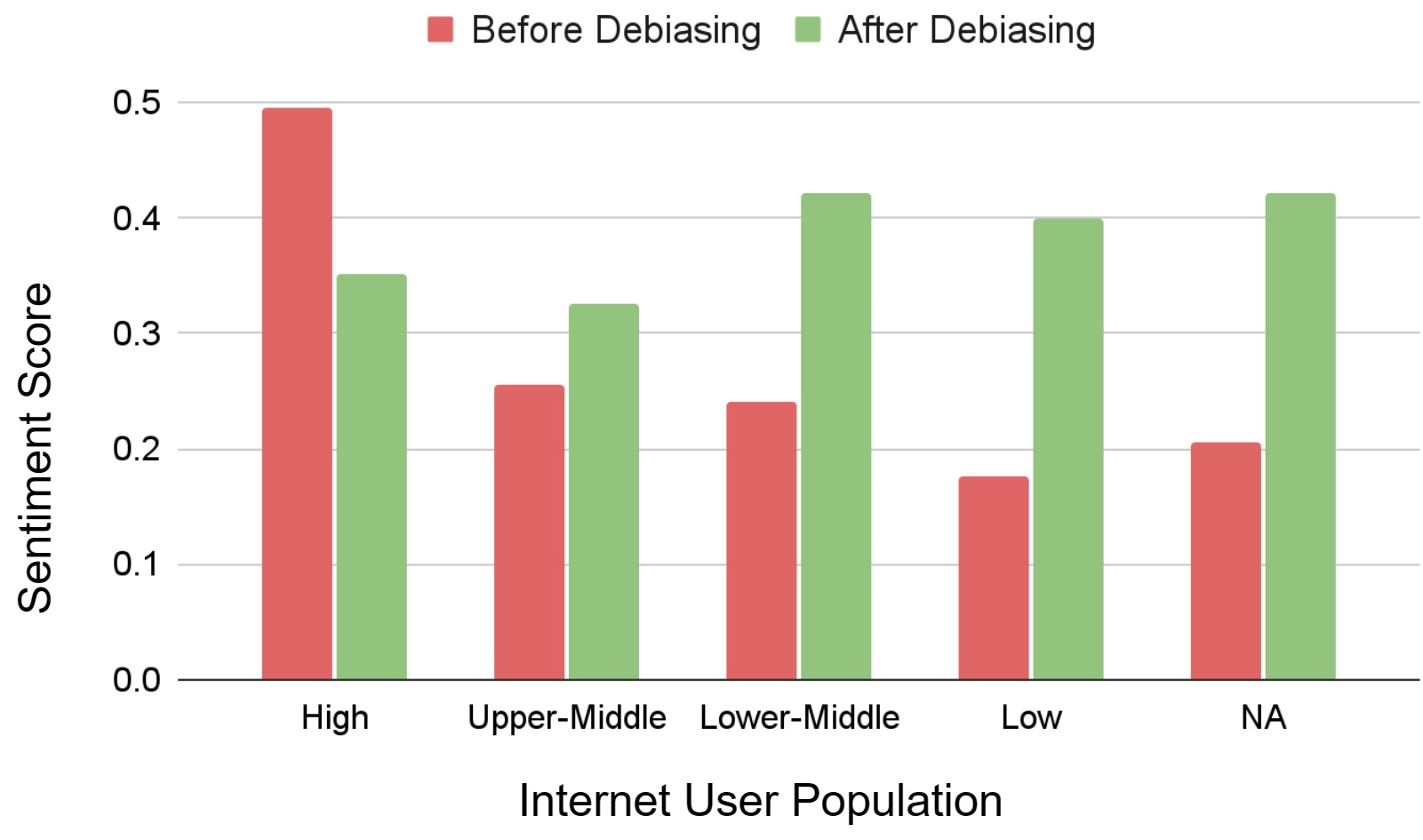
- Adversarial triggering reduces the negative bias and brings GPT-2 sentiment closer to human-written text, especially for lower-income and low-internet countries.
- Post-debiasing sentiment scores for some groups converge with human scores, reducing group disparities.
Read this paper
Open the full text in the Nubint reader and ask about any passage as you read.
Read this paper on NubintThis review was generated by AI from the original paper. Please check the paper before citing it.