
[Paper Review] NatSGD: A Dataset with Speech, Gestures, and Demonstrations for Robot Learning in Natural Human-Robot Interaction
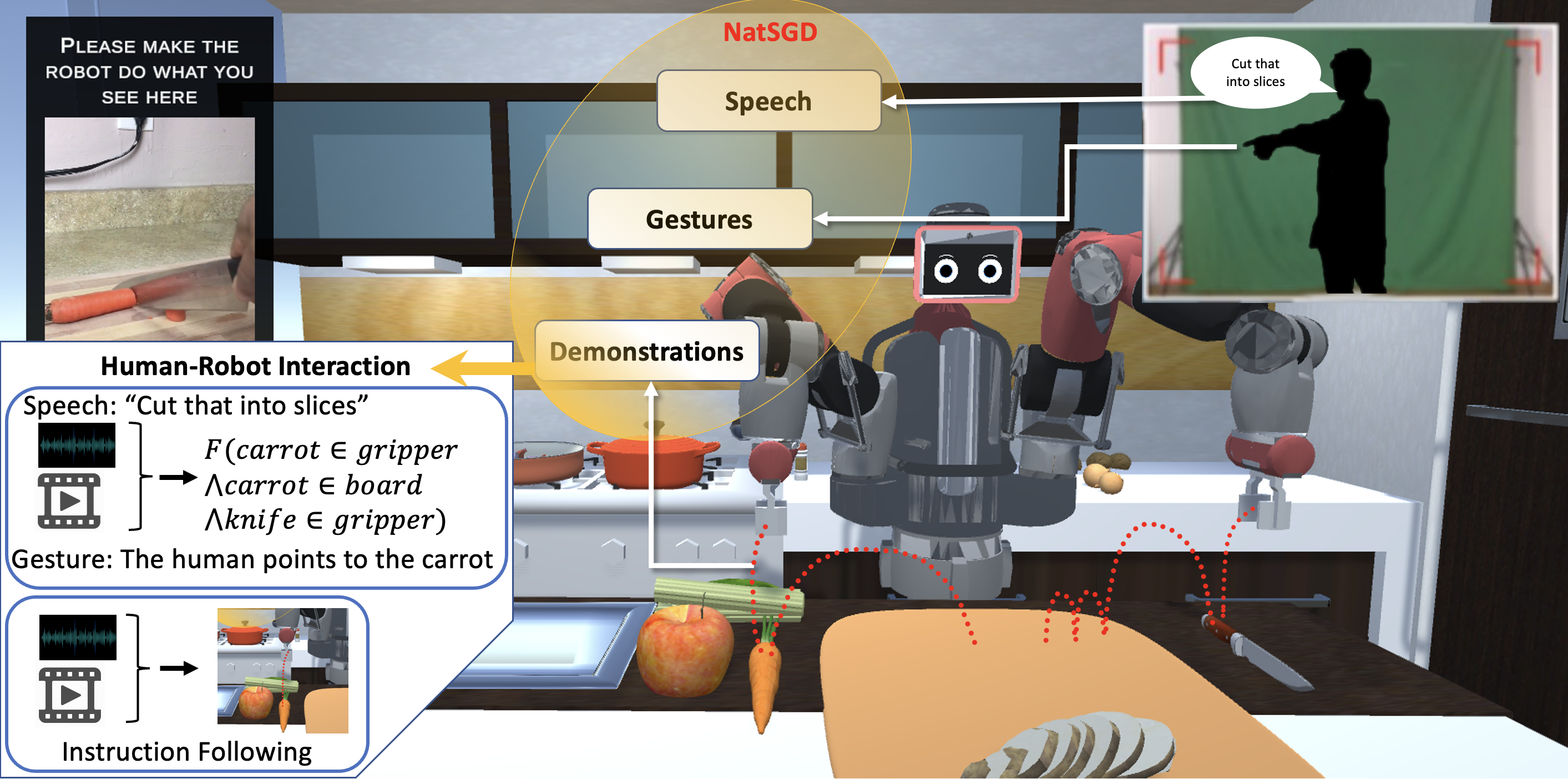
NatSGD introduces a novel multimodal HRI dataset combining natural speech, gestures, and robot demonstration trajectories for complex daily tasks like cooking and cleaning. It enables robots to learn from joint speech-gesture commands with synchronized expert demonstrations, significantly improving task understanding over unimodal inputs, and is released with a photorealistic ROS-compatible simulator for RL and sim2real research.
Recent advancements in multimodal Human-Robot Interaction (HRI) datasets have highlighted the fusion of speech and gesture, expanding robots' capabilities to absorb explicit and implicit HRI insights. However, existing speech-gesture HRI datasets often focus on elementary tasks, like object pointing and pushing, revealing limitations in scaling to intricate domains and prioritizing human command data over robot behavior records. To bridge these gaps, we introduce NatSGD, a multimodal HRI dataset encompassing human commands through speech and gestures that are natural, synchronized with robot behavior demonstrations. NatSGD serves as a foundational resource at the intersection of machine learning and HRI research, and we demonstrate its effectiveness in training robots to understand tasks through multimodal human commands, emphasizing the significance of jointly considering speech and gestures. We have released our dataset, simulator, and code to facilitate future research in human-robot interaction system learning; access these resources at https://www.snehesh.com/natsgd/
Motivation & Objective
- To address the lack of multimodal HRI datasets that combine natural speech, gestures, and robot demonstration trajectories for complex real-world tasks.
- To enable robots to learn intricate tasks such as cooking and cleaning by fusing explicit (speech) and implicit (gesture) human communication.
- To provide a richly annotated dataset with synchronized human and robot perspective data, including task subcomponents, references, gesture intent, and body part roles.
- To support the development of joint speech-gesture understanding systems through a unified, scalable, and realistic dataset and simulation environment.
- To bridge the gap between perception-focused HRI datasets and the need for task-complexity-aware, behavior-grounded learning in human-robot collaboration.
Proposed method
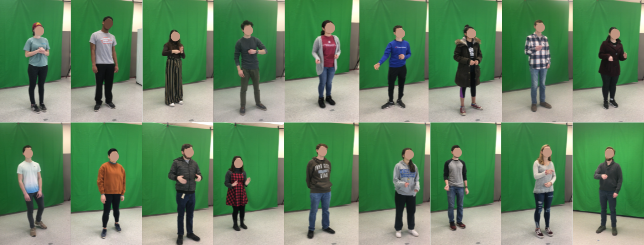
- Conducted a Wizard-of-Oz experiment where participants interacted with a perceived autonomous humanoid robot, issuing natural commands using speech and gestures.
- Collected 1143 human commands from 18 participants across 11 actions, 20 objects, and 16 states, each paired with expert robot demonstration trajectories.
- Employed temporal annotation via the Fast Event Video Annotation (FEVA) tool to label speech, gestures, sub-tasks, references (action/object), gesture intent (intentional vs. non-intentional), and body part usage.
- Annotated gestures based on communicative intent: task-oriented (intentional) vs. non-intentional (contextual), with body parts segmented into six groups: head, torso, left/right hand, left/right leg.
- Integrated a photorealistic simulator with ROS interface to support reinforcement learning and sim2real transfer, enabling scalable training and evaluation.
- Provided synchronized data from both human and robot egocentric views, including depth images, semantic segmentation of objects, and end-effector, head, and base trajectories.
Experimental results
Research questions
- RQ1Can robots achieve better task understanding by jointly processing speech and gestures compared to using either modality in isolation?
- RQ2How can gesture intent (intentional vs. non-intentional) and body part usage be systematically annotated to support machine learning in HRI?
- RQ3To what extent does incorporating expert demonstration trajectories improve the learning of complex, multi-step tasks like cooking and cleaning?
- RQ4How can a unified, multimodal dataset with synchronized human and robot perspectives enable more robust and generalizable HRI policy learning?
- RQ5What role do contextual, non-intentional gestures and para-linguistic features play in human-robot task understanding, and how can they be modeled?
Key findings
- NatSGD is the first dataset to combine natural speech, gestures, and synchronized robot demonstration trajectories for complex daily tasks such as food preparation and cleaning.
- The integration of speech and gestures significantly improves robot task understanding compared to unimodal approaches, demonstrating the value of multimodal fusion.
- Gesture annotations distinguish between intentional (task-related) and non-intentional (contextual) gestures, reducing ambiguity and improving model generalization.
- The dataset includes detailed temporal annotations of sub-tasks, object and action references, and body part roles, enabling fine-grained task representation learning.
- The photorealistic simulator with ROS interface enables efficient training and sim2real transfer, accelerating development of HRI systems.
- The dataset supports rich supervisory signals at both trajectory-level (demonstrations) and symbolic-level (ground-truth activities), enhancing policy learning and interpretation.
Read this paper
Open the full text in the Nubint reader and ask about any passage as you read.
Read this paper on NubintThis review was generated by AI from the original paper. Please check the paper before citing it.