
[Paper Review] Natural Example-Based Explainability: a Survey
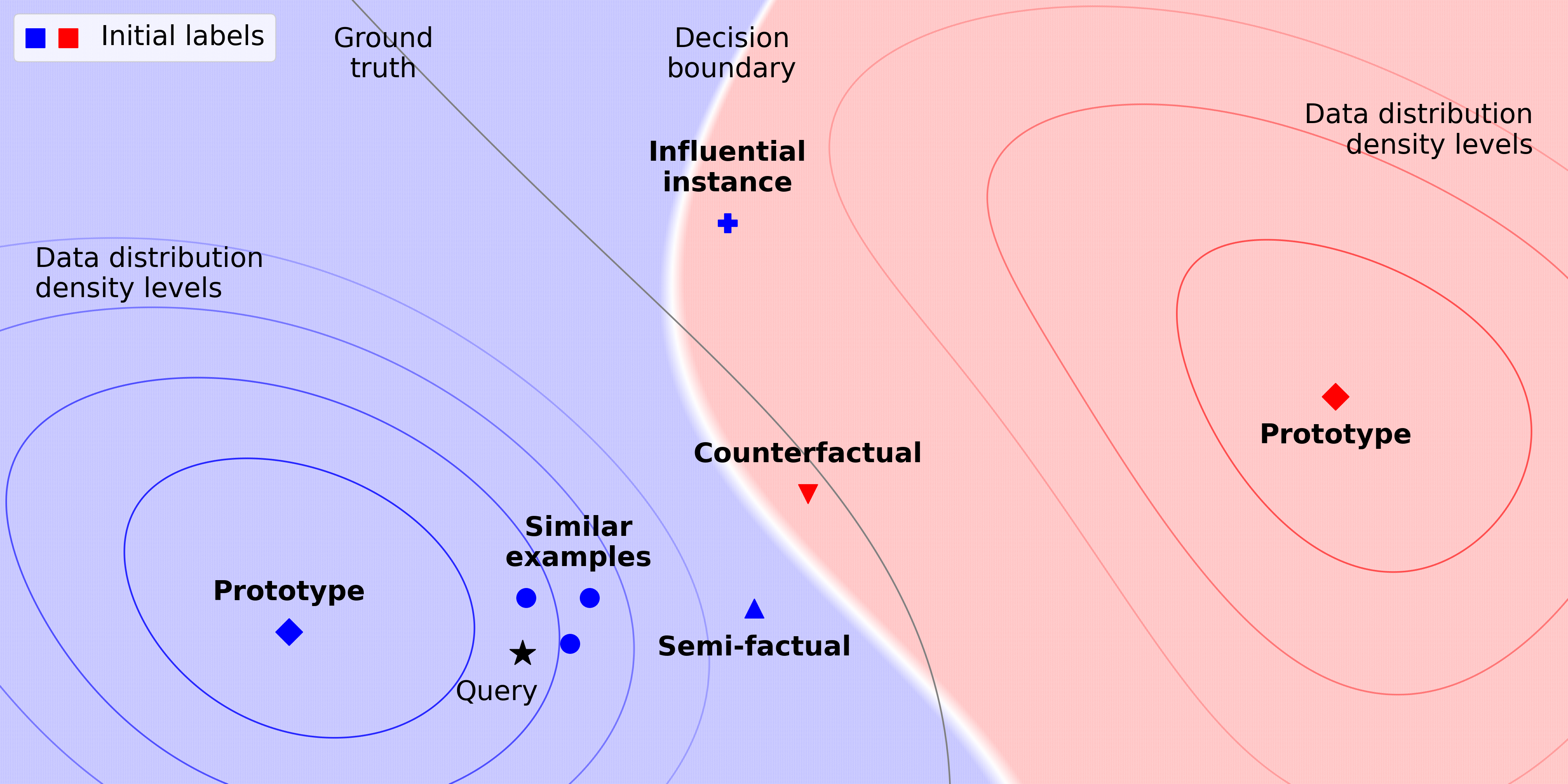
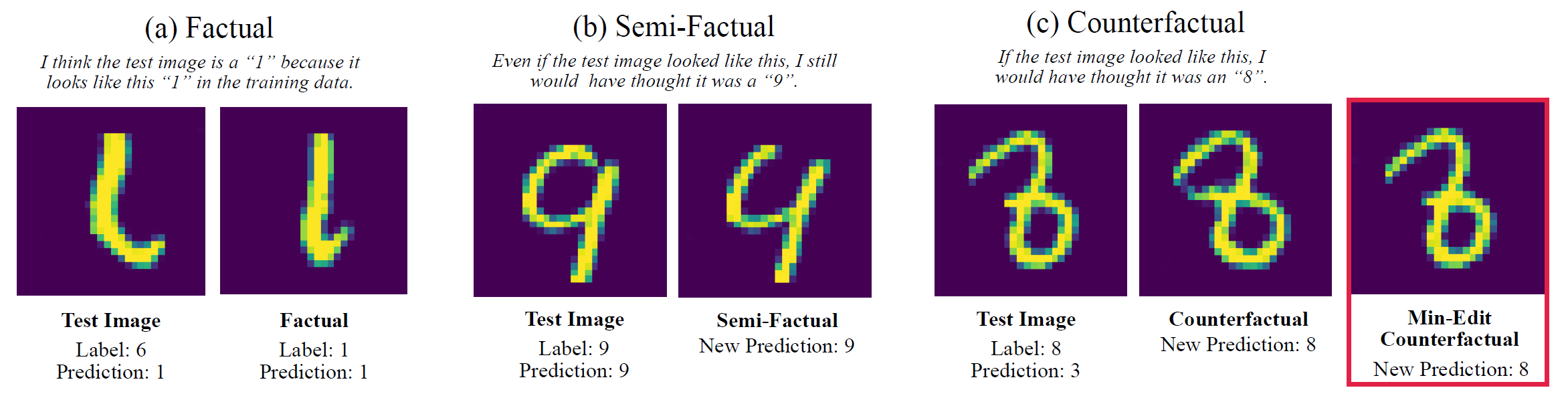
This survey presents a comprehensive analysis of natural example-based explainability in AI, focusing on non-generative methods that use real training data examples to explain model decisions. It evaluates five formats—similar examples, counterfactuals, semi-factuals, influential instances, prototypes, and concepts—highlighting their semantic definitions, cognitive impact, and practical advantages in enhancing model interpretability and user trust.
Explainable Artificial Intelligence (XAI) has become increasingly significant for improving the interpretability and trustworthiness of machine learning models. While saliency maps have stolen the show for the last few years in the XAI field, their ability to reflect models' internal processes has been questioned. Although less in the spotlight, example-based XAI methods have continued to improve. It encompasses methods that use examples as explanations for a machine learning model's predictions. This aligns with the psychological mechanisms of human reasoning and makes example-based explanations natural and intuitive for users to understand. Indeed, humans learn and reason by forming mental representations of concepts based on examples. This paper provides an overview of the state-of-the-art in natural example-based XAI, describing the pros and cons of each approach. A "natural" example simply means that it is directly drawn from the training data without involving any generative process. The exclusion of methods that require generating examples is justified by the need for plausibility which is in some regards required to gain a user's trust. Consequently, this paper will explore the following family of methods: similar examples, counterfactual and semi-factual, influential instances, prototypes, and concepts. In particular, it will compare their semantic definition, their cognitive impact, and added values. We hope it will encourage and facilitate future work on natural example-based XAI.
Motivation & Objective
- To provide a systematic overview of natural example-based explainability methods that use real training data without generative processes.
- To analyze the cognitive and psychological plausibility of example-based explanations in aligning with human reasoning mechanisms.
- To compare the semantic definitions, cognitive impact, and practical advantages of five key formats: similar examples, counterfactuals, semi-factuals, influential instances, prototypes, and concepts.
- To highlight the limitations of saliency maps and advocate for example-based methods as more intuitive and trustworthy alternatives.
- To encourage future research by clarifying the state-of-the-art, taxonomy, and open challenges in natural example-based XAI.
Proposed method
- Classifies example-based explainability into five semantic formats: similar examples (factuals), counterfactuals, semi-factuals, influential instances, prototypes, and concepts.
- Evaluates each method based on semantic definition (relation to query and decision boundary), cognitive impact (how users interpret them), and added value (e.g., trust, decision boundary insight).
- Focuses exclusively on non-generative methods—natural examples drawn directly from training data—to ensure plausibility and user trust.
- Reviews 100+ methods from the literature, organizing them into a comparative table (Table 1) with metadata on model type, explainability type, and requirements.
- Uses a taxonomy based on four dimensions: local/global, post-hoc/intrinsic, black-box/white-box, and explanation format.
- Analyzes the role of similarity metrics (e.g., Euclidean, cosine) and model access (gradients, checkpoints) in enabling each method.
Experimental results
Research questions
- RQ1How do different natural example-based formats (e.g., counterfactuals, prototypes) differ in their semantic meaning and cognitive impact on users?
- RQ2Why are natural (non-generative) examples more trustworthy and intuitive than generated examples or saliency maps?
- RQ3What are the key advantages and limitations of each example-based format in explaining model decisions across different model types and tasks?
- RQ4How do influential instances and prototypes contribute to understanding model behavior beyond local predictions?
- RQ5What are the open challenges and research gaps in the development and evaluation of natural example-based explainability methods?
Key findings
- Natural example-based explainability outperforms saliency maps in user trust and interpretability because examples align with human cognitive mechanisms of learning through exemplars.
- Similar examples (factuals) are most effective for local confidence and misclassification diagnosis but are limited to the immediate neighborhood of the query.
- Counterfactuals and semi-factuals provide complementary insights into the decision boundary, with counterfactuals showing the minimal change needed to flip a prediction.
- Influential instances identify training samples that most significantly alter model predictions, offering insight into data-driven model behavior without requiring model retraining.
- Prototypes and concepts provide global insights into class representations and feature-level semantics, respectively, with prototypes being particularly effective in dense data regions.
- The survey identifies a lack of standardized evaluation protocols and a need for more user studies validating the cognitive impact of different example formats.
Read this paper
Open the full text in the Nubint reader and ask about any passage as you read.
Read this paper on NubintThis review was generated by AI from the original paper. Please check the paper before citing it.