
[Paper Review] Natural Language Processing in Ethiopian Languages: Current State, Challenges, and Opportunities
This paper surveys the current state of NLP for four Ethiopian languages—Amharic, Afaan Oromo, Tigrinya, and Wolaytta—identifying major challenges like scarce publicly available data and limited NLP tools. It proposes a centralized, collaboratively maintained GitHub repository hosting datasets, models, and tools, and outlines opportunities such as benchmark development, transfer learning, and community-driven data collection to advance low-resource NLP research in Ethiopia.
This survey delves into the current state of natural language processing (NLP) for four Ethiopian languages: Amharic, Afaan Oromo, Tigrinya, and Wolaytta. Through this paper, we identify key challenges and opportunities for NLP research in Ethiopia. Furthermore, we provide a centralized repository on GitHub that contains publicly available resources for various NLP tasks in these languages. This repository can be updated periodically with contributions from other researchers. Our objective is to identify research gaps and disseminate the information to NLP researchers interested in Ethiopian languages and encourage future research in this domain.
Motivation & Objective
- To assess the current state of NLP research for four major Ethiopian languages: Amharic, Afaan Oromo, Tigrinya, and Wolaytta.
- To identify key challenges hindering NLP progress in low-resource Ethiopian languages, including data scarcity and lack of standardized tools.
- To compile and centralize publicly available NLP resources—datasets, models, and tools—for Ethiopian languages into a single, maintainable GitHub repository.
- To highlight underexplored research opportunities such as benchmark development, transfer learning, and community engagement.
- To support future research by enabling reproducibility, reducing redundant efforts, and guiding funding and collaboration priorities.
Proposed method
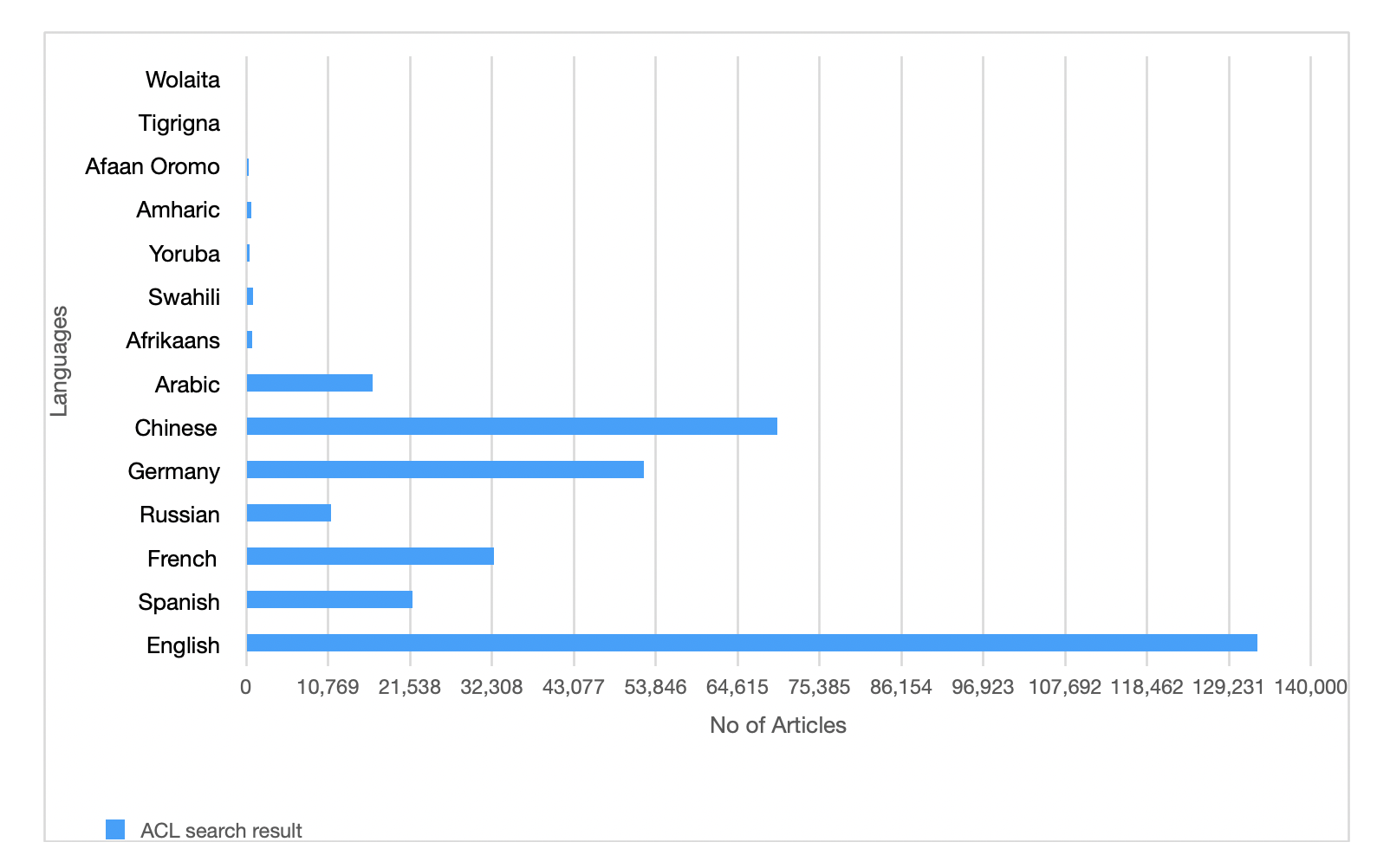
- Conducted a systematic review of NLP research in Ethiopian languages using the ACL anthology and other academic sources to identify published works on key NLP tasks.
- Collected and curated publicly available datasets, pre-trained models, and tools for NLP tasks such as POS tagging, NER, sentiment analysis, and machine translation.
- Hosted the compiled resources in a centralized, version-controlled GitHub repository to ensure accessibility, transparency, and extensibility through community contributions.
- Analyzed the availability and quality of existing resources, identifying gaps in data, annotation standards, and benchmarking across languages.
- Proposed future research directions based on identified challenges, including the creation of standardized benchmark datasets and the use of transfer learning from high-resource languages.
- Engaged with the research community through the repository to encourage collaboration, reproducibility, and sustained development of NLP infrastructure for Ethiopian languages.
Experimental results
Research questions
- RQ1What is the current state of NLP research for Amharic, Afaan Oromo, Tigrinya, and Wolaytta in terms of published NLP tasks and methodologies?
- RQ2What are the primary challenges impeding NLP development for low-resource Ethiopian languages, particularly regarding data availability and tooling?
- RQ3How can a centralized, community-maintained repository improve reproducibility and collaboration in NLP research for Ethiopian languages?
- RQ4What opportunities exist for advancing NLP in Ethiopian languages through transfer learning, benchmark development, and community engagement?
- RQ5To what extent do existing NLP resources for Ethiopian languages support cross-lingual comparison and model evaluation?
Key findings
- A significant majority of NLP research on Ethiopian languages is concentrated on English-to-Amharic machine translation, with limited work on other languages and tasks.
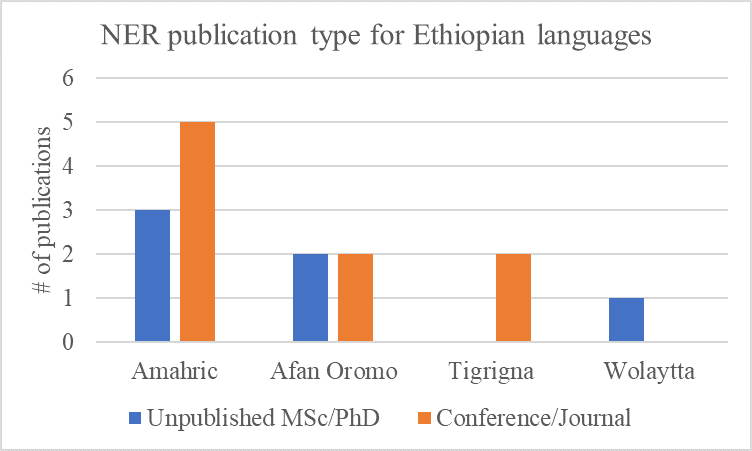
- Only a small fraction of NLP research on Ethiopian languages is published in top-tier international conferences, with most works appearing as master’s theses.
- Publicly available datasets and models for Ethiopian languages are fragmented and not systematically maintained, leading to difficulties in reproducibility and benchmarking.
- The GitHub repository hosted by EthioNLP now serves as a centralized, publicly accessible, and updatable resource for NLP tools and data across four major Ethiopian languages.
- The scarcity of labeled data and lack of standardized evaluation benchmarks remain the most critical barriers to progress in NLP for Ethiopian languages.
- Community involvement and sustained funding are essential to transform low-resource Ethiopian languages into viable targets for scalable NLP innovation.
Read this paper
Open the full text in the Nubint reader and ask about any passage as you read.
Read this paper on NubintThis review was generated by AI from the original paper. Please check the paper before citing it.