
[Paper Review] Navigating Scaling Laws: Compute Optimality in Adaptive Model Training
This paper proposes adaptive training strategies for Vision Transformers that dynamically adjust model shape—specifically patch size and width—during training to achieve compute-optimal performance. By scheduling these parameters based on neural scaling laws, the method reduces required FLOPs by over 50% compared to static models while maintaining or improving accuracy.
In recent years, the state-of-the-art in deep learning has been dominated by very large models that have been pre-trained on vast amounts of data. The paradigm is very simple: investing more computational resources (optimally) leads to better performance, and even predictably so; neural scaling laws have been derived that accurately forecast the performance of a network for a desired level of compute. This leads to the notion of a `compute-optimal' model, i.e. a model that allocates a given level of compute during training optimally to maximize performance. In this work, we extend the concept of optimality by allowing for an `adaptive' model, i.e. a model that can change its shape during training. By doing so, we can design adaptive models that optimally traverse between the underlying scaling laws and outpace their `static' counterparts, leading to a significant reduction in the required compute to reach a given target performance. We show that our approach generalizes across modalities and different shape parameters.
Motivation & Objective
- To address the inefficiency of static model training, where fixed architecture shapes lead to suboptimal compute utilization despite known scaling laws.
- To investigate whether dynamically adapting model shape during training can lead to faster convergence and reduced computational cost for a given performance target.
- To develop a principled, scalable strategy for scheduling shape parameters (patch size and width) in Vision Transformers based on empirical scaling laws.
- To demonstrate that adaptive models can outperform static models in terms of compute efficiency while maintaining or exceeding performance targets.
Proposed method
- The method uses neural scaling laws to predict the optimal model configuration (patch size or width) at each compute level during training.
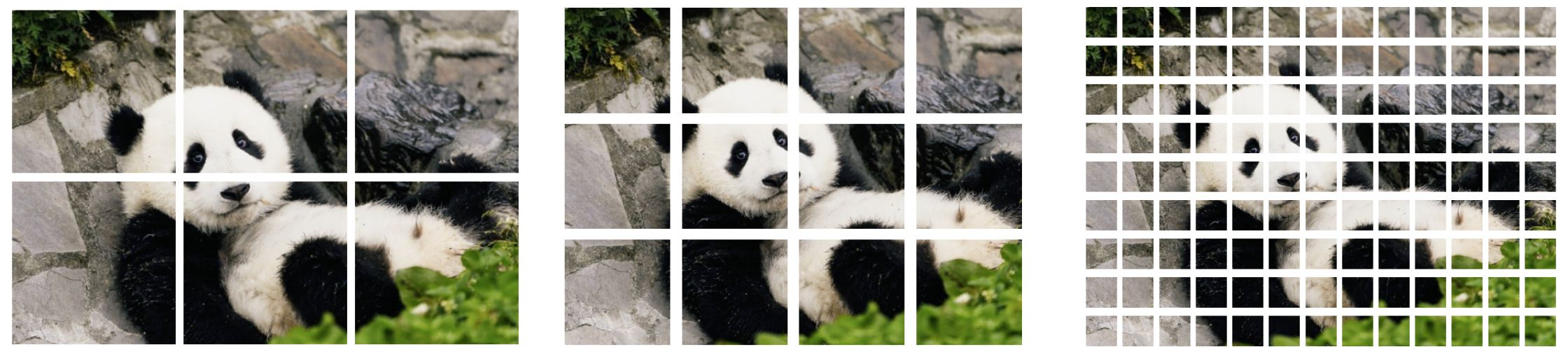
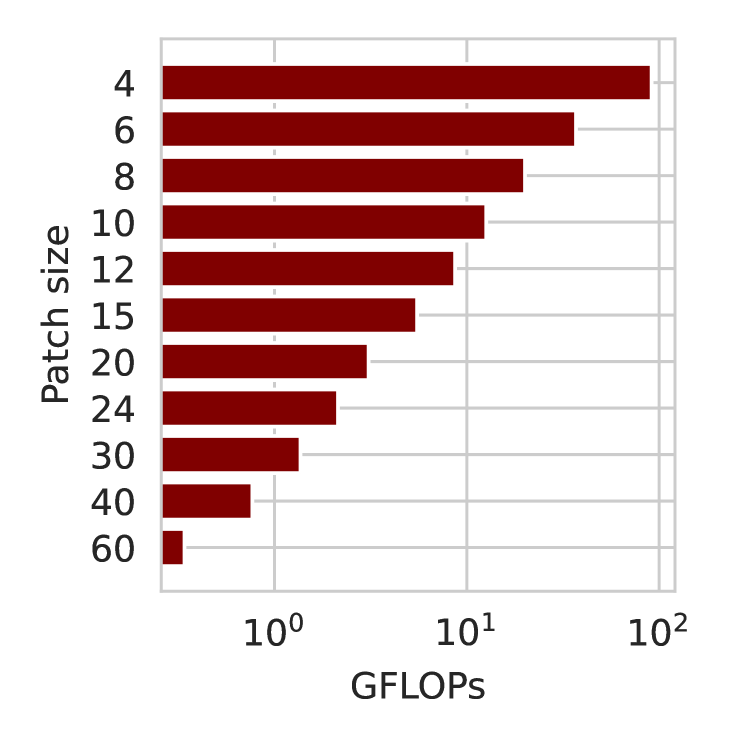
- For patch size adaptation, the model is trained with a schedule that transitions between different patch sizes based on the predicted performance gain per FLOP.
- For width adaptation, the model is expanded from a smaller initial width (e.g., 192) to larger widths (e.g., 384, 768) using a simple expansion mechanism that preserves the original weights and randomly initializes new parameters.
- The expansion process is applied to all layers, including attention weights, MLP weights, and normalization parameters, ensuring compatibility with the Transformer architecture.
- The scheduler selects the next shape parameter (patch size or width) based on which scaling law offers the steepest performance gain for the next increment of compute.
- Performance is monitored throughout training, and the method is validated by comparing adaptive models against static models of fixed size.
Experimental results
Research questions
- RQ1Can dynamically adapting model shape (patch size or width) during training lead to faster convergence and reduced FLOP consumption compared to static models?
- RQ2How does the performance of an adaptive model compare to static models when trained under the same compute budget, particularly in terms of accuracy and efficiency?
- RQ3To what extent can the principles of neural scaling laws be used to guide the scheduling of shape parameters to achieve compute-optimality?
- RQ4Does the performance drop during shape adaptation (e.g., after width expansion) recover quickly, and is the model still optimal in the long term?
- RQ5Can the proposed adaptive strategy be generalized to other shape parameters beyond patch size and width, such as depth or sparsity?
Key findings
- Adaptive scheduling of patch size in Vision Transformers reduces the required training FLOPs by more than 50% to reach a target ImageNet-1k error rate, significantly outperforming static models.
- The adaptive model based on the computed scheduler recovers quickly from performance drops after shape transitions and remains aligned with the predicted scaling law.
- Scheduling model width also leads to improved compute efficiency, though the gains are slightly less pronounced than with patch size adaptation.
- The method achieves compute-optimality by continuously selecting the shape configuration (patch size or width) that maximizes performance gain per FLOP at each training stage.
- The simple expansion mechanism—preserving original weights and randomly initializing new ones—proves sufficient for recovery and performance improvement, outperforming more complex function-preserving schemes.
- The results confirm that dynamic adaptation allows models to optimally traverse multiple scaling laws, leveraging the best performance characteristics of each shape configuration at different compute levels.
Better researchstarts right now
From reading papers to final review, dramatically reduce your research time.
No credit card · Free plan available
This review was created by AI and reviewed by human editors.