
[Paper Review] Near-Field Hierarchical Beam Management for RIS-Enabled Millimeter Wave Multi-Antenna Systems
This paper proposes a low-overhead hierarchical beam management framework for Reconfigurable Intelligent Surface (RIS)-enabled millimeter-wave multi-antenna systems operating in the near-field regime. By introducing a variable-width hierarchical phase-shift codebook and a fast alignment algorithm, the method achieves near-optimal performance with only 24 pilot transmissions—demonstrating a 99% reduction in overhead compared to full CSI acquisition while maintaining SNR within 1 dB of the optimal benchmark.
In this paper, we present a low overhead beam management approach for near-field millimeter-wave multi-antenna communication systems enabled by Reconfigurable Intelligent Surfaces (RISs). We devise a novel variable-width hierarchical phaseshift codebook suitable for both the near- and far-field of the RIS, and present a fast alignment algorithm for the RIS phase shifts and the transceiver beamformers. Indicative performance evaluation results are shown, verifying the effectiveness of the proposed approach in comparison with various benchmark schemes.
Motivation & Objective
- Address the high channel state information (CSI) acquisition overhead in large-scale RIS-empowered millimeter-wave systems, especially in the near-field regime where conventional far-field assumptions fail.
- Design a low-overhead beam management solution that reduces pilot signaling and computational complexity without sacrificing spectral efficiency.
- Enable efficient beam alignment in near-field scenarios by exploiting the spatial and angular sparsity of mmWave channels and the directional focusing capability of RIS.
- Develop a hierarchical codebook structure that adapts to both near- and far-field propagation conditions, ensuring scalability for large RISs with up to 8,000 elements.
- Demonstrate that the proposed method achieves performance close to full CSI benchmarks while drastically reducing training overhead
Proposed method
- Propose a variable-width hierarchical phase-shift codebook tailored for both near- and far-field RIS operation, enabling scalable beam search across multiple resolution levels.
- Design a fast alignment algorithm that performs hierarchical beam search over the RIS phase-shift configurations, starting from coarse to fine levels, to rapidly converge on a strong beam.
- Leverage the line-of-sight (LoS) path as the primary design focus, assuming it dominates in mmWave bands, and use it to guide phase-shift optimization and codebook construction.
- Utilize a four-level hierarchical codebook with 16, 4, 2, and 2 pilots at levels 1 to 4, respectively, reducing total pilot overhead to 24 transmissions.
- Formulate the beam management problem as a joint optimization of RIS phase shifts and transceiver beamformers, exploiting the sparse angular structure of mmWave channels.
- Integrate the wide-illumination approach from prior work to enable low-overhead channel estimation in mobile near-field scenarios
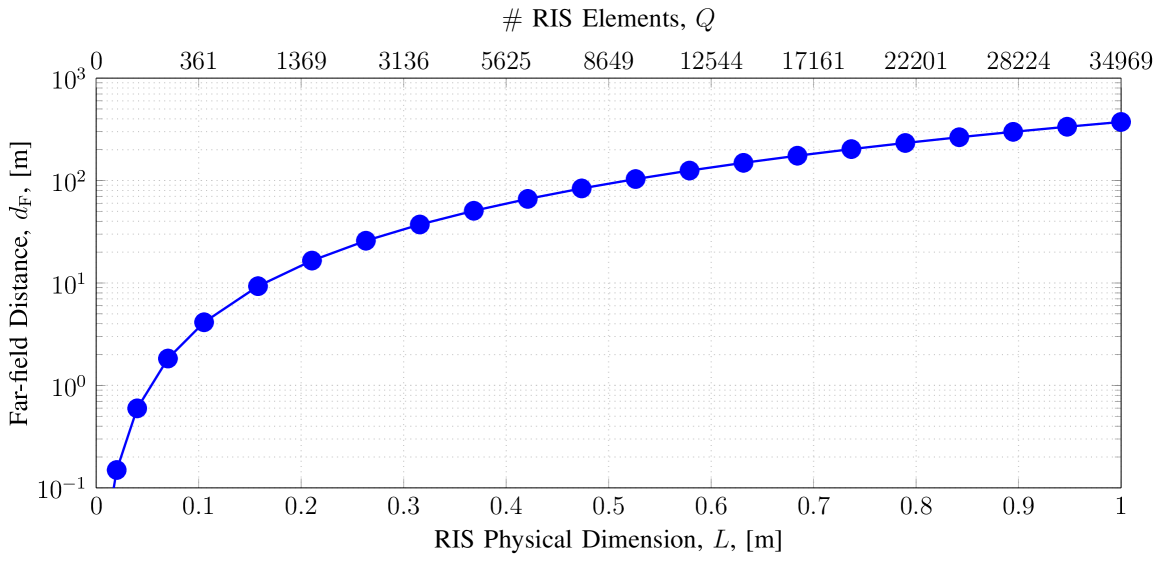
Experimental results
Research questions
- RQ1How can beam management overhead be minimized in RIS-empowered mmWave systems operating in the near-field, where conventional far-field beamforming models fail?
- RQ2What hierarchical codebook structure enables efficient beam search across multiple resolution levels while maintaining performance in large-scale RIS deployments?
- RQ3To what extent can a beam management algorithm based on LoS path focusing outperform full CSI or full codebook search in terms of SNR and training overhead?
- RQ4Can a variable-width hierarchical codebook designed for near-field conditions achieve near-optimal performance with minimal pilot signaling?
Key findings
- The proposed beam management algorithm achieves an average received SNR of 16 dB in a practical mmWave scenario (β = 10 dB), which is within 1 dB of the full CSI benchmark (25 dB).
- With only 24 pilot transmissions, the method reduces training overhead by 99% compared to the full CSI benchmark, which requires approximately 16,000 channel coefficient estimates.
- The performance of the proposed method remains stable across varying LOS-to-NLOS power ratios, outperforming full codebook search (Benchmark 1) and showing robustness to non-LOS path dominance.
- Benchmark 3 (full CSI) achieves the highest SNR (25 dB) but requires full knowledge of 2×Q = 17,298 channel coefficients, highlighting the practical advantage of the proposed low-overhead method.
- The algorithm successfully locates a near-optimal RIS phase-shift configuration for large RISs (Q ≈ 8,000 elements) using just 24 pilots, demonstrating scalability and real-world feasibility.
- The hierarchical search strategy enables fast convergence and effective beam alignment even in complex near-field environments with multiple scattering paths
![Figure 2: Received SNR vs. the displacement along the ${\mathsf{x}}$ - and ${\mathsf{y}}$ -axes when the RIS is configured to focus on the center of the blockage area. The system parameters are the same as those used in Section IV. In particular, BS and RIS are located at $\mathbf{p}_{i}=[40,0,10]$](https://ar5iv.labs.arxiv.org/html/2203.15557/assets/x2.png)
Better researchstarts right now
From reading papers to final review, dramatically reduce your research time.
No credit card · Free plan available
This review was created by AI and reviewed by human editors.