
[Paper Review] NeeDrop: Self-supervised Shape Representation from Sparse Point Clouds using Needle Dropping
NeeDrop proposes a self-supervised method for learning 3D shape representations from sparse point clouds using a needle-dropping loss inspired by Buffon’s needle problem. By sampling random needles on sparse point clouds and leveraging statistical surface crossing probabilities, it achieves reconstruction quality on par with supervised methods on synthetic data and promising results on real-world KITTI lidar data without any shape supervision or dense point clouds.
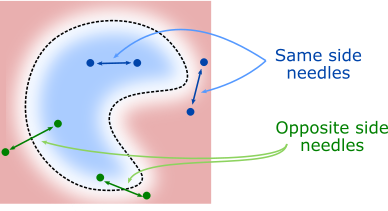
There has been recently a growing interest for implicit shape representations. Contrary to explicit representations, they have no resolution limitations and they easily deal with a wide variety of surface topologies. To learn these implicit representations, current approaches rely on a certain level of shape supervision (e.g., inside/outside information or distance-to-shape knowledge), or at least require a dense point cloud (to approximate well enough the distance-to-shape). In contrast, we introduce NeeDrop, a self-supervised method for learning shape representations from possibly extremely sparse point clouds. Like in Buffon's needle problem, we "drop" (sample) needles on the point cloud and consider that, statistically, close to the surface, the needle end points lie on opposite sides of the surface. No shape knowledge is required and the point cloud can be highly sparse, e.g., as lidar point clouds acquired by vehicles. Previous self-supervised shape representation approaches fail to produce good-quality results on this kind of data. We obtain quantitative results on par with existing supervised approaches on shape reconstruction datasets and show promising qualitative results on hard autonomous driving datasets such as KITTI.
Motivation & Objective
- To develop a self-supervised method for 3D shape reconstruction that does not require dense point clouds or shape supervision.
- To enable robust learning from highly sparse, noisy, and partial point clouds, such as those from autonomous vehicle lidars.
- To eliminate reliance on mesh-based supervision or distance-to-surface signals during training.
- To produce high-quality implicit occupancy fields that can be directly converted into meshes using Marching Cubes.
- To validate the method on both synthetic datasets and real-world autonomous driving data where no ground-truth shape supervision is available.
Proposed method
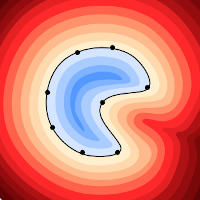
- The method introduces a novel self-supervised loss based on needle-dropping: random line segments (needles) are sampled from input point cloud points, and the model predicts whether needle endpoints lie on the same or opposite sides of the shape surface.
- The loss function is derived from statistical surface crossing probabilities, with different terms for same-side (label 1) and opposite-side (label 0) predictions, using sigmoid and exponential transformations for numerical stability.
- The network architecture uses a PointNet-based backbone to encode sparse point clouds into a latent vector, followed by a multi-layer perceptron to predict occupancy values at query points in 3D space.
- The loss is computed by sampling multiple random needles per point cloud, with endpoints generated by perturbing input points, and the model is trained to predict correct side labels based on the occupancy field.
- The method is invariant to point redundancy due to max-pooling in the PointNet encoder, allowing it to handle low-density and duplicated points without degradation.
- Symmetry augmentation is applied during training by mirroring point clouds along the car's symmetry plane to improve generalization on partial views.
Experimental results
Research questions
- RQ1Can a self-supervised method learn high-quality 3D shape representations from extremely sparse point clouds without any shape supervision?
- RQ2Does the needle-dropping loss effectively capture surface geometry even when the input point cloud is sparse or incomplete?
- RQ3Can the method generalize to real-world autonomous driving datasets like KITTI, where point clouds are sparse and partial?
- RQ4How does the performance of the self-supervised NeeDrop method compare to supervised baselines on standard shape reconstruction benchmarks?
- RQ5Does training on complete shapes yield better generalization than training on partial views, despite the latter being more realistic for real-world scenarios?
Key findings
- NeeDrop achieves quantitative reconstruction performance on par with supervised methods on the ShapeNet and D-Shape datasets, despite using no shape supervision.
- The method produces plausible and coherent 3D reconstructions on the KITTI dataset, which consists of sparse, partial, and noisy lidar point clouds from autonomous vehicles.
- The model trained on complete shapes generalizes better than the one trained on partial views, indicating that full geometric context improves latent space learning.
- The method successfully handles highly sparse inputs, such as those from real lidar sensors, where existing methods fail due to reliance on dense point clouds for distance supervision.
- The use of symmetry augmentation during training improves reconstruction quality on partial point clouds, particularly for symmetric objects like cars.
- The NeeDrop loss is robust to sparse and noisy inputs, as demonstrated by consistent performance across both synthetic and real-world data distributions.
Read this paper
Open the full text in the Nubint reader and ask about any passage as you read.
Read this paper on NubintThis review was generated by AI from the original paper. Please check the paper before citing it.