
[Paper Review] NeRF-SLAM: Real-Time Dense Monocular SLAM with Neural Radiance Fields
NeRF-SLAM proposes a real-time, monocular SLAM pipeline that leverages dense depth maps and uncertainty estimates from a dense monocular SLAM system to train a hierarchical volumetric neural radiance field (NeRF) on-the-fly. By weighting depth predictions by their marginal covariance, the method achieves state-of-the-art photometric and geometric accuracy—up to 179% better PSNR and 86% better L1 depth than competing approaches—while running at 10–12 FPS on standard GPU hardware.
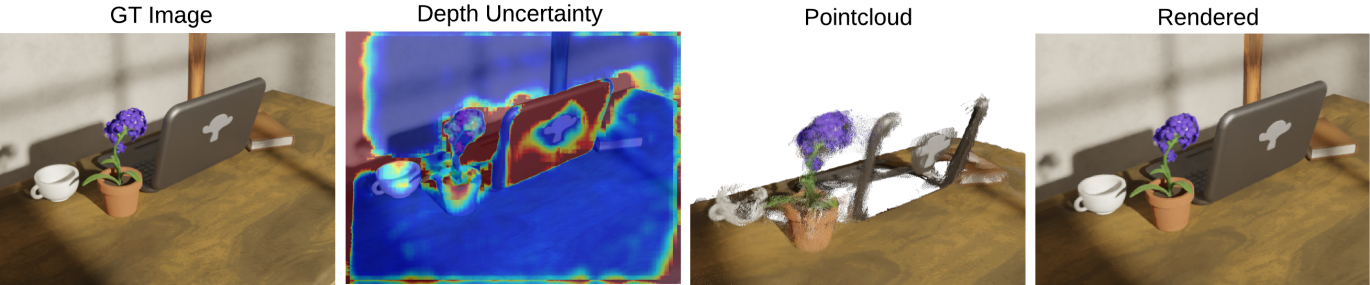
We propose a novel geometric and photometric 3D mapping pipeline for accurate and real-time scene reconstruction from monocular images. To achieve this, we leverage recent advances in dense monocular SLAM and real-time hierarchical volumetric neural radiance fields. Our insight is that dense monocular SLAM provides the right information to fit a neural radiance field of the scene in real-time, by providing accurate pose estimates and depth-maps with associated uncertainty. With our proposed uncertainty-based depth loss, we achieve not only good photometric accuracy, but also great geometric accuracy. In fact, our proposed pipeline achieves better geometric and photometric accuracy than competing approaches (up to 179% better PSNR and 86% better L1 depth), while working in real-time and using only monocular images.
Motivation & Objective
- Address the challenge of real-time, accurate 3D scene reconstruction from monocular RGB video, which lacks explicit depth measurements.
- Overcome the limitations of traditional NeRFs, which require ground-truth poses and suffer from ghost geometry and slow convergence.
- Integrate dense monocular SLAM with hierarchical volumetric NeRFs to enable real-time, metrically accurate 3D mapping using only monocular input.
- Improve geometric and photometric accuracy by leveraging uncertainty-aware depth supervision during NeRF optimization.
- Demonstrate that uncertainty-weighted depth priors significantly enhance NeRF convergence and robustness, even with noisy or imprecise depth estimates.
Proposed method
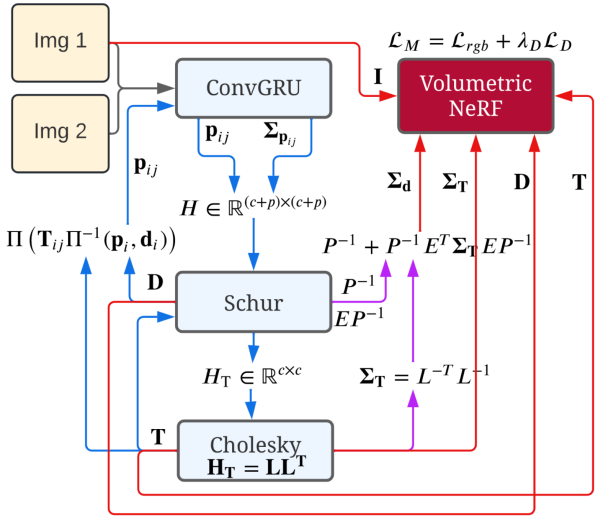
- Utilize a dense monocular SLAM system to estimate camera poses and dense depth maps with associated marginal covariance (uncertainty) estimates in real time.
- Apply a novel uncertainty-based depth loss during NeRF optimization, where depth predictions are weighted by their uncertainty to reduce bias and improve convergence.
- Train a hierarchical hash-based volumetric neural radiance field using the SLAM outputs as supervision, enabling real-time inference on a stream of RGB images.
- Parallelize the tracking and mapping threads, with the tracking thread operating at ~15 FPS and the mapping thread at ~10 FPS, achieving real-time performance at 10 FPS overall.
- Use custom CUDA kernels to accelerate correlation volume computation and volumetric rendering, reducing memory and computational bottlenecks.
- Implement a keyframe selection strategy based on optical flow magnitude (>2.5 pixels) to balance accuracy and computational load.
Experimental results
Research questions
- RQ1Can dense monocular SLAM provide sufficient geometric and photometric priors to enable real-time, accurate NeRF reconstruction without ground-truth poses or depth?
- RQ2How does uncertainty-weighted depth supervision improve the convergence and accuracy of neural radiance fields compared to unweighted or no depth supervision?
- RQ3To what extent can a NeRF trained from monocular SLAM outputs achieve superior photometric and geometric accuracy compared to existing monocular reconstruction methods?
- RQ4What is the impact of noisy or uncertain depth estimates on NeRF optimization, and can uncertainty weighting mitigate these effects?
- RQ5Is it feasible to achieve real-time NeRF reconstruction using only monocular RGB input, without RGB-D or stereo sensors?
Key findings
- NeRF-SLAM achieves up to 179% better PSNR than competing monocular approaches on the Replica dataset, indicating superior photometric accuracy.
- The method reduces L1 depth error by 86% compared to state-of-the-art monocular methods, demonstrating significant improvement in geometric accuracy.
- Using uncertainty-weighted depth priors leads to faster and more robust NeRF convergence, reducing PSNR degradation and depth bias compared to unweighted depth.
- The pipeline runs at 10–12 FPS on standard GPU hardware (640×480 resolution), achieving real-time performance through parallelized tracking and mapping threads.
- Even with noisy poses and depth estimates, NeRF-SLAM maintains high accuracy when depth is weighted by its marginal covariance, outperforming both unweighted depth and no-depth baselines.
- The approach achieves strong performance without requiring ground-truth poses or depth, relying solely on the SLAM system’s uncertainty-aware outputs for supervision.
Read this paper
Open the full text in the Nubint reader and ask about any passage as you read.
Read this paper on NubintThis review was generated by AI from the original paper. Please check the paper before citing it.