
[Paper Review] Nerfbusters: Removing Ghostly Artifacts from Casually Captured NeRFs
This paper proposes Nerfbusters, a 3D diffusion-based method that uses a learned local 3D geometric prior and a novel density-based score distillation sampling (DSDS) loss to remove ghostly artifacts and improve scene geometry in casually captured NeRFs. Evaluated on a new in-the-wild dataset with dual camera trajectories, Nerfbusters significantly outperforms hand-crafted regularizers, reducing floaters and enhancing surface coherence in challenging novel-view synthesis scenarios.
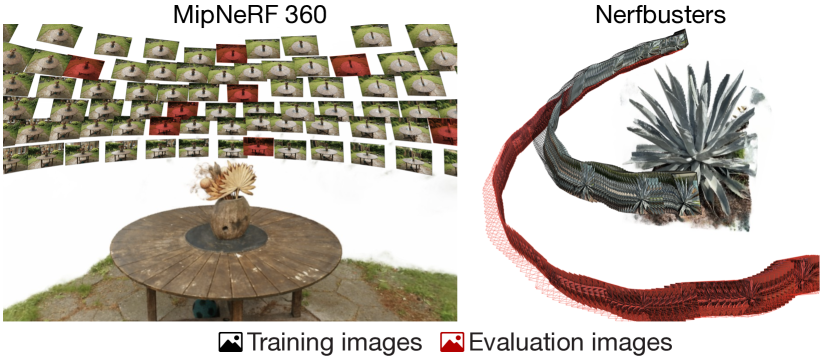
Casually captured Neural Radiance Fields (NeRFs) suffer from artifacts such as floaters or flawed geometry when rendered outside the camera trajectory. Existing evaluation protocols often do not capture these effects, since they usually only assess image quality at every 8th frame of the training capture. To push forward progress in novel-view synthesis, we propose a new dataset and evaluation procedure, where two camera trajectories are recorded of the scene: one used for training, and the other for evaluation. In this more challenging in-the-wild setting, we find that existing hand-crafted regularizers do not remove floaters nor improve scene geometry. Thus, we propose a 3D diffusion-based method that leverages local 3D priors and a novel density-based score distillation sampling loss to discourage artifacts during NeRF optimization. We show that this data-driven prior removes floaters and improves scene geometry for casual captures.
Motivation & Objective
- To address the persistent issue of ghostly artifacts and poor geometry in casually captured NeRFs, especially when rendering novel views far from the training trajectory.
- To identify the limitations of existing NeRF evaluation protocols, which primarily test small viewpoint changes along the same camera path and fail to reflect real-world rendering quality.
- To propose a new evaluation protocol using two distinct camera trajectories—one for training and one for evaluation—enabling more realistic assessment of NeRF generalization.
- To develop a data-driven, local 3D geometric prior that improves surface coherence and reduces artifacts without requiring category-specific or global scene priors.
- To demonstrate that a learned 3D prior via diffusion can outperform traditional hand-crafted regularizers in improving NeRF quality under realistic, out-of-distribution rendering conditions.
Proposed method
- The method introduces a novel evaluation protocol using two camera trajectories per scene: one for training and one for evaluation, enabling realistic assessment of novel-view synthesis performance.
- A 3D diffusion model is trained on synthetic 3D data to learn a local 3D geometric prior, capturing plausible surface patches in a category-agnostic and scalable manner.
- The learned prior is used to guide NeRF optimization via a new unconditional Density Score Distillation Sampling (DSDS) loss, which encourages realistic density predictions during training.
- The DSDS loss distills scores from the diffusion model into the NeRF’s volume rendering process, discouraging implausible or artifact-prone density values.
- The method is integrated into the Nerfstudio framework and trained end-to-end, with the diffusion prior acting as a regularizer during NeRF optimization.
- The approach uses a lightweight 28 MB U-Net architecture to model local 3D geometry, ensuring efficiency and generalization across diverse, unstructured scenes.
Experimental results
Research questions
- RQ1Can a data-driven, local 3D geometric prior improve NeRF geometry and reduce artifacts in casually captured scenes under realistic out-of-distribution novel-view rendering?
- RQ2Does the proposed DSDS loss, which distills scores from a 3D diffusion model, lead to better generalization than hand-crafted regularizers in challenging, in-the-wild settings?
- RQ3How does the new dual-trajectory evaluation protocol reveal limitations of existing NeRF benchmarks that only evaluate on in-distribution views?
- RQ4To what extent can a lightweight, category-agnostic 3D prior improve NeRF quality without requiring explicit supervision or scene-specific tuning?
- RQ5Does the combination of a learned 3D prior and score distillation lead to measurable improvements in both quantitative metrics and qualitative artifact reduction?
Key findings
- On the 'pipe' scene, Nerfbusters achieved a PSNR of 19.23, a 2.0 dB improvement over the baseline Nerfacto (19.62), and reduced LPIPS by 0.03, indicating better perceptual quality.
- In the 'plant' scene, Nerfbusters achieved a PSNR of 20.20 and an SSIM of 0.7535, outperforming all baselines, including those with visibility, sparsity, and TV regularization.
- For the 'roses' scene, Nerfbusters reduced mean angular error from 52.08° (baseline) to 48.67°, and coverage improved from 0.88 to 0.69, indicating better geometric consistency.
- On the 'table' scene, Nerfbusters achieved a 0.35% improvement in the percentage of views with less than 30° error, while reducing depth error by 0.02 and dispersion by 0.03.
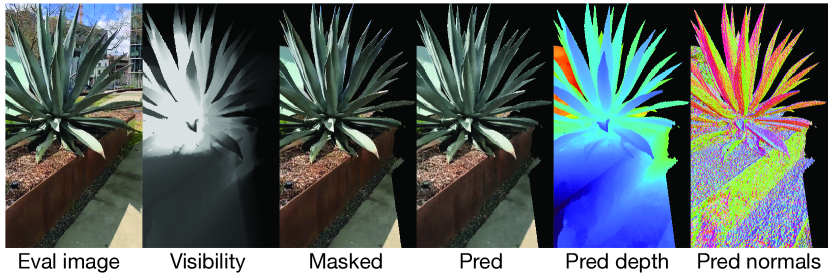
- The method significantly reduced floaters and cloudy artifacts in all scenes, with qualitative results showing crisper geometry and fewer hallucinated structures.
- The proposed DSDS loss and local 3D prior consistently outperformed hand-crafted regularizers such as visibility loss, sparsity, total variation, and RegNeRF across all scenes and metrics.
Read this paper
Open the full text in the Nubint reader and ask about any passage as you read.
Read this paper on NubintThis review was generated by AI from the original paper. Please check the paper before citing it.