
[Paper Review] NeRO: Neural Geometry and BRDF Reconstruction of Reflective Objects from Multiview Images
NeRO proposes a two-stage neural rendering method for reconstructing the 3D geometry and BRDF of highly reflective objects from multiview RGB images without requiring known environment lighting or object masks. By integrating the rendering equation via split-sum approximation and directional encoding for initial geometry estimation, followed by Monte Carlo-based refinement of BRDF and lighting, NeRO achieves state-of-the-art reconstruction quality on reflective surfaces, including accurate albedo, metalness, and roughness decomposition.
We present a neural rendering-based method called NeRO for reconstructing the geometry and the BRDF of reflective objects from multiview images captured in an unknown environment. Multiview reconstruction of reflective objects is extremely challenging because specular reflections are view-dependent and thus violate the multiview consistency, which is the cornerstone for most multiview reconstruction methods. Recent neural rendering techniques can model the interaction between environment lights and the object surfaces to fit the view-dependent reflections, thus making it possible to reconstruct reflective objects from multiview images. However, accurately modeling environment lights in the neural rendering is intractable, especially when the geometry is unknown. Most existing neural rendering methods, which can model environment lights, only consider direct lights and rely on object masks to reconstruct objects with weak specular reflections. Therefore, these methods fail to reconstruct reflective objects, especially when the object mask is not available and the object is illuminated by indirect lights. We propose a two-step approach to tackle this problem. First, by applying the split-sum approximation and the integrated directional encoding to approximate the shading effects of both direct and indirect lights, we are able to accurately reconstruct the geometry of reflective objects without any object masks. Then, with the object geometry fixed, we use more accurate sampling to recover the environment lights and the BRDF of the object. Extensive experiments demonstrate that our method is capable of accurately reconstructing the geometry and the BRDF of reflective objects from only posed RGB images without knowing the environment lights and the object masks. Codes and datasets are available at https://github.com/liuyuan-pal/NeRO.
Motivation & Objective
- Address the challenge of multiview reconstruction for reflective objects, which violates view consistency due to view-dependent specular reflections.
- Overcome limitations of existing neural reconstruction methods that fail on strong specular reflections due to inadequate modeling of environment lighting and BRDF.
- Enable reconstruction without object masks or prior knowledge of environment lighting, which are typically required in state-of-the-art methods.
- Achieve accurate joint estimation of surface geometry, BRDF parameters (albedo, metalness, roughness), and environment lighting from only posed RGB images.
- Develop a method robust to indirect lighting and complex reflections, even when the object is not segmented or isolated in the input images.
Proposed method
- Use a split-sum approximation to decouple the rendering equation into view-independent and view-dependent components, enabling tractable geometry estimation under unknown lighting.
- Apply integrated directional encoding to represent both direct and indirect lighting effects in the shading function, improving accuracy without requiring explicit light estimation during geometry optimization.
- Fix the estimated geometry in a second stage and perform Monte Carlo sampling to reconstruct high-fidelity environment lighting and BRDF parameters.
- Introduce a neutral light loss and smoothness loss to improve albedo accuracy and prevent noisy BRDF predictions during refinement.
- Represent the surface BRDF using a differentiable neural network that predicts albedo, metalness, and roughness, enabling end-to-end optimization with the geometry and lighting.
- Leverage a neural SDF field to implicitly represent the 3D shape, with positional encoding to capture high-frequency surface details despite inherent smoothing in neural fields.
Experimental results
Research questions
- RQ1Can a neural rendering framework accurately reconstruct the 3D geometry of reflective objects from multiview images when environment lighting and object masks are unknown?
- RQ2How can the rendering equation be effectively approximated in a neural reconstruction pipeline to model both direct and indirect specular reflections without explicit lighting supervision?
- RQ3To what extent can a two-stage optimization strategy—first geometry, then BRDF and lighting—improve reconstruction quality compared to end-to-end approaches on reflective surfaces?
- RQ4Can the method decompose input images into physically meaningful components (albedo, lighting, material parameters) with high fidelity, even under complex lighting conditions?
- RQ5What are the primary failure modes of the method, and how do geometric inaccuracies propagate to BRDF estimation in highly reflective materials?
Key findings
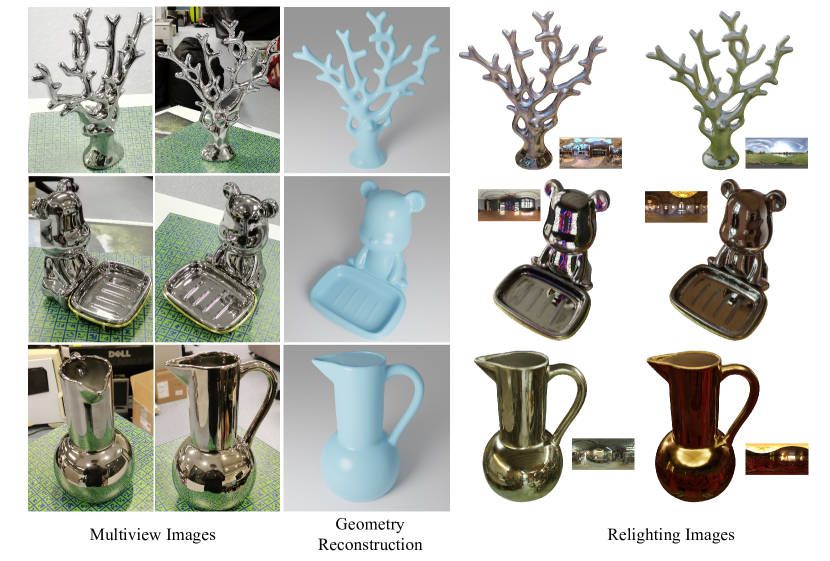
- NeRO achieves state-of-the-art 3D reconstruction quality on reflective objects, outperforming methods like COLMAP, NeuS, Ref-NeRF, and NDRMC, especially in capturing sharp specular highlights and complex shapes.
- The method successfully reconstructs the overall shape of reflective objects even with subtle details missing, as seen in the 'Angel' and 'Cat' models, though fine textures like beards and cloth are not fully captured due to SDF smoothing.
- The BRDF decomposition results show accurate separation of albedo from lighting effects, with correct prediction of metalness and roughness—e.g., distinguishing metallic vases from non-metallic calibration boards.
- The ablation study confirms that both neutral light loss and smoothness loss significantly improve relighting quality by enhancing albedo accuracy and reducing BRDF noise.
- The method is robust to indirect lighting and can reconstruct objects under unknown illumination, as demonstrated by successful relighting and decomposition on the Glossy-Real dataset.
- Failure cases reveal that inaccurate surface normals from the neural SDF field lead to incorrect reflective directions, which in turn degrade BRDF estimation, especially on objects with complex or fine geometry.
Read this paper
Open the full text in the Nubint reader and ask about any passage as you read.
Read this paper on NubintThis review was generated by AI from the original paper. Please check the paper before citing it.