
[论文解读] Network-Assisted Full-Duplex Cell-Free Massive MIMO: Spectral and Energy Efficiencies
该论文提出了一种网络辅助的全双工(NAFD)无蜂窝大规模MIMO系统,通过半双工接入点实现上下行链路的同时传输,联合优化接入点模式分配、功率控制和大尺度衰落解码权重,以最大化频谱效率和能量效率。数值结果表明,与传统的半双工和全双工方案相比,频谱效率最高提升30%,能量效率最高提升200%。
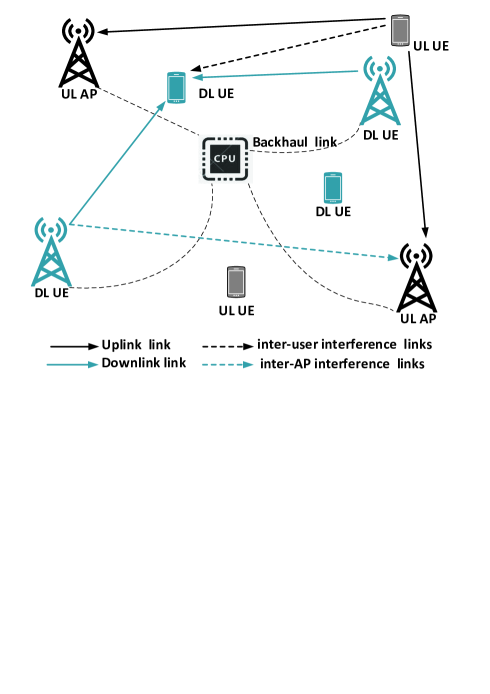
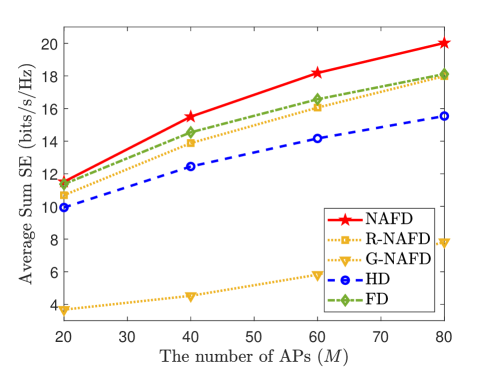
We consider network-assisted full-duplex (NAFD) cell-free massive multiple-input multiple-output (CF-mMIMO) systems, where full-duplex (FD) transmission is virtually realized via half-duplex (HD) hardware devices. The HD access points (APs) operating in uplink (UL) mode and those operating in downlink (DL) mode simultaneously serve DL and UL user equipments (UEs) in the same frequency bands. We comprehensively analyze the performance of NAFD CF-mMIMO from both a spectral efficiency (SE) and energy efficiency (EE) perspectives. Specifically, we propose a joint optimization approach that designs the AP mode assignment, power control, and large-scale fading (LSFD) weights to improve the sum SE and EE of NAFD CF-mMIMO systems. We formulate two mixed-integer nonconvex optimization problems of maximizing the sum SE and EE, under realistic power consumption models, and the constraints on minimum individual SE requirements, maximum transmit power at each DL AP and UL UE. The challenging formulated problems are transformed into tractable forms and two novel algorithms are proposed to solve them using successive convex approximation techniques. More importantly, our approach can be applied to jointly optimize power control and LSFD weights for maximizing the sum SE and EE of HD and FD CF-mMIMO systems, which, to date, has not been studied. Numerical results show that: (a) our joint optimization approach significantly outperforms the heuristic approaches in terms of both sum SE and EE; (b) in CF-mMIMO systems, the NAFD scheme can provide approximately 30\% SE gains, while achieving a remarkable EE gain of up to 200\% compared with the HD and FD schemes.
研究动机与目标
- 为解决全双工无蜂窝大规模MIMO(CF-mMIMO)系统中因自干扰和交叉链路干扰导致的高功耗与干扰挑战。
- 通过引入灵活的、网络辅助的全双工(NAFD)架构,克服传统半双工与全双工CF-mMIMO的局限性,实现接入点传输模式的动态分配。
- 联合优化接入点模式分配、功率控制和大尺度衰落解码权重,在真实硬件与服务质量约束下,最大化总频谱效率与能量效率。
- 针对NAFD CF-mMIMO中的混合整数非凸问题,构建可处理的优化框架,采用逐次凸逼近(successive convex approximation)技术。
提出的方法
- 提出一种网络辅助全双工(NAFD)CF-mMIMO架构,其中接入点可工作于上行、下行或混合模式,无需全双工硬件即可实现同时传输与接收。
- 引入联合优化框架,同步设计接入点模式分配、发射功率控制与大尺度衰落解码(LSFD)权重,以提升频谱与能量效率。
- 建立真实功耗模型,包含电路功耗与传输功耗,并构建两个混合整数非凸优化问题,以最大化总频谱效率与能量效率。
- 利用逐次凸逼近(SCA)技术将非凸问题转化为可处理的形式,从而实现高效的算法求解。
- 通过“用后即弃”容量界定技术,推导下行链路频谱效率的闭式表达式,考虑了期望信号功率、波束成形不确定性与交叉链路干扰。
- 通过数值结果验证方法的有效性,与启发式方案对比表明,所提方法在频谱效率与能量效率方面均表现更优。
实验结果
研究问题
- RQ1与传统的半双工和全双工系统相比,网络辅助全双工(NAFD)CF-mMIMO架构是否能显著提升频谱效率与能量效率?
- RQ2在NAFD CF-mMIMO中,接入点模式分配、功率控制与大尺度衰落解码权重的联合优化,对总频谱效率与能量效率有何影响?
- RQ3在使用半双工接入点的NAFD CF-mMIMO中,干扰抑制(自干扰与交叉链路干扰)与能量效率之间存在何种权衡?
- RQ4所提出的联合优化框架在频谱效率与能量效率方面,相较于启发式方法能提升多少?
- RQ5在真实硬件与服务质量约束下,NAFD方案相对于传统全双工与半双工CF-mMIMO的性能扩展性如何?
主要发现
- 所提出的联合优化方法在总频谱效率与能量效率方面均显著优于启发式方案,验证了协同设计的有效性。
- NAFD方案相比传统半双工与全双工CF-mMIMO系统,频谱效率提升约30%。
- NAFD方案相比半双工与全双工对应方案,能量效率提升高达200%。
- 功率控制与大尺度衰落解码权重的联合优化,可实现对混合双工与灵活双工CF-mMIMO网络中干扰的更好管理,并提升频谱效率。
- 采用逐次凸逼近技术,能够高效求解原本难以处理的NAFD CF-mMIMO中的混合整数非凸优化问题。
- 推导出的频谱效率表达式考虑了波束成形不确定性、其他用户设备带来的交叉链路干扰与有效噪声,支持准确的性能评估。
更好的研究,从现在开始
从阅读论文到最终审阅,大幅缩短您的研究时间。
无需绑定信用卡
本解读由 AI 生成,并经人工编辑审核。