
[Paper Review] Neural-Logic Human-Object Interaction Detection
LogicHOI proposes a novel Transformer-based HOI detector that replaces fixed human-object pair inputs with triplet-reasoning attention, enabling dynamic inference over unobserved {human, action, object} triplets. By grounding affordances and proxemics in first-order logic and projecting them into continuous space, the model improves zero-shot generalization and achieves state-of-the-art performance on V-COCO and HICO-DET.
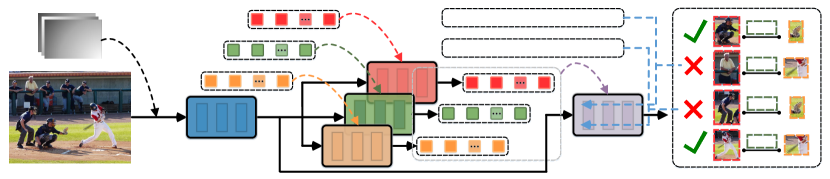
The interaction decoder utilized in prevalent Transformer-based HOI detectors typically accepts pre-composed human-object pairs as inputs. Though achieving remarkable performance, such paradigm lacks feasibility and cannot explore novel combinations over entities during decoding. We present L OGIC HOI, a new HOI detector that leverages neural-logic reasoning and Transformer to infer feasible interactions between entities. Specifically, we modify the self-attention mechanism in vanilla Transformer, enabling it to reason over the triplet and constitute novel interactions. Meanwhile, such reasoning process is guided by two crucial properties for understanding HOI: affordances (the potential actions an object can facilitate) and proxemics (the spatial relations between humans and objects). We formulate these two properties in first-order logic and ground them into continuous space to constrain the learning process of our approach, leading to improved performance and zero-shot generalization capabilities. We evaluate L OGIC HOI on V-COCO and HICO-DET under both normal and zero-shot setups, achieving significant improvements over existing methods.
Motivation & Objective
- Address the limitation of existing HOI detectors that rely on pre-composed human-object pairs, restricting their ability to generalize to novel combinations.
- Overcome the lack of reasoning capacity in current methods, which treat interactions as static predictions on fixed pairs rather than dynamic inferences.
- Integrate symbolic knowledge—specifically affordances and proxemics—into deep learning to guide more logical and generalizable interaction prediction.
- Enable zero-shot generalization by constraining predictions to physically and semantically plausible interactions using first-order logic.
- Develop a more efficient and effective HOI detection framework that maintains high performance while reducing computational overhead compared to prior methods.
Proposed method
- Modify the self-attention mechanism in the Transformer decoder to operate on triplets of queries: human, action, and object, enabling joint reasoning over all three elements.
- Introduce triplet-reasoning attention that updates representations by aggregating information across all three components simultaneously, rather than attending to pre-defined pairs.
- Formulate affordances (which actions an object can support) and proxemics (spatial plausibility of interactions) as first-order logic constraints.
- Embed these logical constraints into continuous space using differentiable functions to guide the learning process of the Transformer model.
- Optimize the model with two auxiliary losses: $\mathcal{L}_{v,p}$ for visual-physical plausibility (proxemics) and $\mathcal{L}_{o,p}$ for object-action compatibility (affordances).
- Apply query filtering and minimize the number of decoder layers and queries to maintain efficiency, achieving faster inference than prior methods despite increased reasoning capacity.

Experimental results
Research questions
- RQ1Can a Transformer-based HOI detector generalize to unseen {human, action, object} triplets without requiring them in the training data?
- RQ2How can symbolic knowledge such as affordances and proxemics be effectively integrated into a neural network to improve reasoning and zero-shot generalization?
- RQ3Does modifying the attention mechanism to reason over triplets rather than pairs lead to better performance and more interpretable predictions?
- RQ4Can logic-guided constraints reduce the model's reliance on spurious correlations and improve robustness to rare or unseen interactions?
- RQ5What is the trade-off between model complexity, inference speed, and performance when incorporating symbolic reasoning into a neural architecture?
Key findings
- LogicHOI achieves a new state-of-the-art performance of 25.97 mAP on the full set of HICO-DET, a 1.96-point improvement over the previous SOTA.
- On the rare category split of HICO-DET, LogicHOI achieves 15.67 mAP, a 2.41-point gain over the prior state-of-the-art, demonstrating strong zero-shot generalization.
- The ablation study confirms that both $\mathcal{L}_{v,p}$ (proxemics) and $\mathcal{L}_{o,p}$ (affordances) contribute significantly to performance, especially under zero-shot settings.
- The model maintains high efficiency: with only 3 decoder layers and 32 queries, it achieves 16.84 FPS on a ResNet-50 backbone, outperforming most one-stage detectors in speed and FLOPs.
- Increasing the number of queries beyond 32 degrades performance, indicating an optimal balance between representational capacity and optimization stability.
- The integration of logic-guided learning leads to faster convergence and more plausible predictions, as evidenced by the model's ability to reject physically implausible interactions during inference.
Better researchstarts right now
From reading papers to final review, dramatically reduce your research time.
No credit card · Free plan available
This review was created by AI and reviewed by human editors.