
[Paper Review] Neural sequence labeling for Vietnamese POS Tagging and NER
This paper proposes a bidirectional LSTM-CRF neural sequence labeling model for Vietnamese part-of-speech (POS) tagging and named entity recognition (NER), leveraging character-level embeddings and pre-trained word vectors. It achieves state-of-the-art results with 93.52% accuracy on POS tagging and 94.88% F1 on NER, demonstrating the effectiveness of character-level representations and syntactic features without handcrafted features or domain-specific resources.
This paper presents a neural architecture for Vietnamese sequence labeling tasks including part-of-speech (POS) tagging and named entity recognition (NER). We applied the model described in \cite{lample-EtAl:2016:N16-1} that is a combination of bidirectional Long-Short Term Memory and Conditional Random Fields, which rely on two sources of information about words: character-based word representations learned from the supervised corpus and pre-trained word embeddings learned from other unannotated corpora. Experiments on benchmark datasets show that this work achieves state-of-the-art performances on both tasks - 93.52\% accuracy for POS tagging and 94.88\% F1 for NER. Our sourcecode is available at here.
Motivation & Objective
- To develop a deep learning-based sequence labeling framework for Vietnamese that reduces reliance on handcrafted features and external linguistic resources.
- To evaluate the effectiveness of character-level representations learned via bidirectional LSTM for improving sequence tagging performance in low-resource and morphologically complex languages like Vietnamese.
- To investigate the impact of syntactic features (POS tags, chunks) on NER performance in a neural sequence labeling setup.
- To achieve state-of-the-art performance on benchmark Vietnamese POS and NER datasets using a unified, end-to-end trainable architecture.
- To release the source code to support reproducibility and further research in Vietnamese NLP.
Proposed method
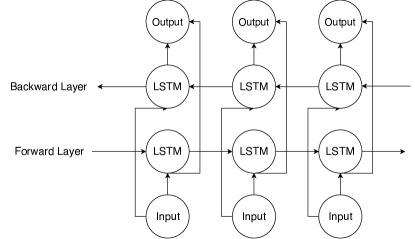
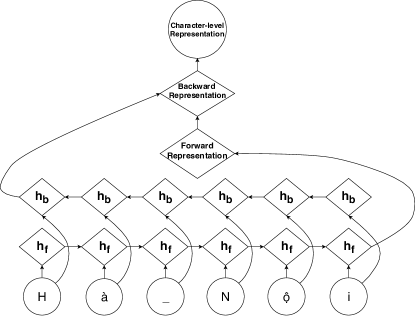
- The model uses bidirectional Long Short-Term Memory (LSTM) networks to learn character-level word representations from raw character sequences.
- Character embeddings are concatenated with pre-trained word embeddings from unannotated corpora to form a combined word representation.
- Dropout with a rate of 0.35 is applied to both input and output of the second bidirectional LSTM layer to prevent overfitting.
- A bidirectional LSTM processes the combined word representations to capture contextual dependencies across the sentence.
- Conditional Random Fields (CRFs) are applied on top of the bidirectional LSTM to perform joint sequence decoding and ensure label consistency.
- The model is trained using the Adam optimizer with a learning rate decay schedule and early stopping based on development set performance.
Experimental results
Research questions
- RQ1Can a neural sequence labeling model based on bidirectional LSTM and CRF achieve state-of-the-art performance on Vietnamese POS tagging and NER without relying on handcrafted features?
- RQ2How effective are character-level embeddings learned via bidirectional LSTM compared to CNN-based character embeddings for Vietnamese word representation?
- RQ3To what extent do syntactic features such as POS tags and chunk information improve NER performance in a neural sequence labeling framework?
- RQ4Does the integration of pre-trained word embeddings and character-level representations lead to significant performance gains over classical machine learning methods in Vietnamese NLP tasks?
- RQ5Can a unified deep learning architecture outperform existing models like NNVLP, which use similar CRF-based frameworks but different character encoding methods?
Key findings
- The proposed model achieves 93.52% accuracy on the Vietnamese POS tagging task, outperforming previous state-of-the-art methods such as VNTagger (93.40%) and RDRPOSTagger (92.59%).
- For NER on the VLSP 2016 dataset, the model achieves a 94.88% F1 score, significantly outperforming Feature-rich CRFs (93.93%) and NNVLP (92.91%).
- The inclusion of chunk information in the input representation leads to the largest performance gain in NER, increasing F1 from 89.21% to 94.88% when combined with POS tags.
- The model without character-level embeddings (BiLSTM-CRFs w.o. char) achieves only 92.22% accuracy on POS tagging, indicating that character-level representations are crucial for performance.
- The model outperforms NNVLP despite using the same CRF-based architecture and pre-trained word embeddings, suggesting that bidirectional LSTM-based character encoding is more effective than CNN-based encoding for Vietnamese.
- The model’s performance is robust and generalizable, achieving state-of-the-art results with minimal feature engineering and no need for external linguistic resources.
Read this paper
Open the full text in the Nubint reader and ask about any passage as you read.
Read this paper on NubintThis review was generated by AI from the original paper. Please check the paper before citing it.