
[Paper Review] Neurosymbolic AI -- Why, What, and How
The paper presents Neurosymbolic AI as a hybrid approach that integrates neural networks with symbolic knowledge to enhance cognition, explainability, and safety in AI systems.
Humans interact with the environment using a combination of perception - transforming sensory inputs from their environment into symbols, and cognition - mapping symbols to knowledge about the environment for supporting abstraction, reasoning by analogy, and long-term planning. Human perception-inspired machine perception, in the context of AI, refers to large-scale pattern recognition from raw data using neural networks trained using self-supervised learning objectives such as next-word prediction or object recognition. On the other hand, machine cognition encompasses more complex computations, such as using knowledge of the environment to guide reasoning, analogy, and long-term planning. Humans can also control and explain their cognitive functions. This seems to require the retention of symbolic mappings from perception outputs to knowledge about their environment. For example, humans can follow and explain the guidelines and safety constraints driving their decision-making in safety-critical applications such as healthcare, criminal justice, and autonomous driving. This article introduces the rapidly emerging paradigm of Neurosymbolic AI combines neural networks and knowledge-guided symbolic approaches to create more capable and flexible AI systems. These systems have immense potential to advance both algorithm-level (e.g., abstraction, analogy, reasoning) and application-level (e.g., explainable and safety-constrained decision-making) capabilities of AI systems.
Motivation & Objective
- Motivate the need for combining perception-based neural networks with knowledge-based symbolic reasoning.
- Explain how neurosymbolic AI supports abstraction, analogy, reasoning, and long-term planning.
- Highlight application-level benefits like explainability, interpretability, safety, and trust in AI systems.
- Survey architecture categories and practical implications for algorithmic and application-level performance.
Proposed method
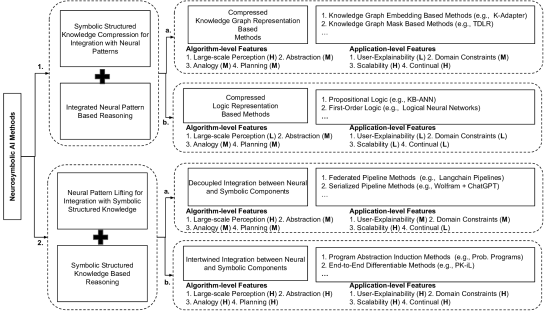
- Classifies neurosymbolic methods into two main categories: lowering (compressing symbolic knowledge to integrate with neural patterns) and lifting (extracting information from neural patterns to map to symbolic knowledge).
- Further sub-categorizes Category 1 into (a) compressed knowledge graphs and (b) compressed formal logic representations, and Category 2 into (a) federated pipelines with end-to-end learning and (b) fully differentiable end-to-end pipelines.
- Analyzes algorithm-level outcomes across low, medium, and high scales for cognition and perception, and application-level outcomes for explainability, constraints, scalability, and continual adaptation.
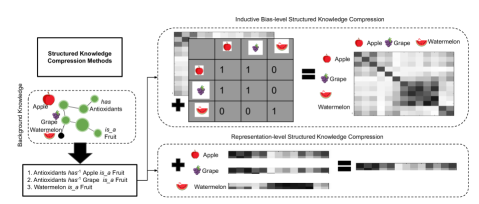
- Provides architectural diagrams and examples illustrating how knowledge graphs and logic can be integrated with neural networks, including attention biases and masking techniques.
- Discusses the challenges of explainability, scalability, and user adoption for different integration approaches.
Experimental results
Research questions
- RQ1What are the primary motivations for integrating neural and symbolic AI systems?
- RQ2What are the main categories and sub-categories of neurosymbolic methods, and how do they perform at algorithmic and application levels?
- RQ3How do compression and lifting techniques affect cognition, perception, explainability, and safety in neurosymbolic systems?
- RQ4What is the potential impact of federated versus fully end-to-end differentiable pipelines on scalability and continual learning?
- RQ5What are the future directions and safety considerations for neurosymbolic AI?
Key findings
- Neurosymbolic AI blends neural perception with symbolic cognition to enable abstraction, analogy, and planning.
- Knowledge graph compression via embeddings or masking enables integration with neural pipelines with modest cognition gains due to lossy semantics.
- Compression of formal logic representations is computationally inefficient and offers limited applicability for large-scale perception.
- Federated pipelines with language models and plugins enable strong perception but have limited cognitive capabilities dependent on model understanding.
- Fully differentiable end-to-end pipelines (category 2b) show high potential across all application-level aspects, with promising results in mental health diagnostic assistance.
- Future knowledge graphs and high-capacity neural networks could offer high algorithmic and application-level utility, with safety and explainability enhanced by symbolic guardrails.
Read this paper
Open the full text in the Nubint reader and ask about any passage as you read.
Read this paper on NubintThis review was generated by AI from the original paper. Please check the paper before citing it.