
[Paper Review] NeuSpeech: Decode Neural signal as Speech
NeuSpeech presents the first end-to-end, teacher-forcing-free framework for direct MEG-to-text translation using a cross-attention-based Whisper model, achieving 60.30 BLEU-1 on the GWilliams dataset and 53.16 BLEU-1 on Schoffelen without pretraining or discrete signal tokenization, demonstrating high-performance, open-vocabulary speech decoding from non-invasive neural signals.
Decoding language from brain dynamics is an important open direction in the realm of brain-computer interface (BCI), especially considering the rapid growth of large language models. Compared to invasive-based signals which require electrode implantation surgery, non-invasive neural signals (e.g. EEG, MEG) have attracted increasing attention considering their safety and generality. However, the exploration is not adequate in three aspects: 1) previous methods mainly focus on EEG but none of the previous works address this problem on MEG with better signal quality; 2) prior works have predominantly used $``teacher-forcing"$ during generative decoding, which is impractical; 3) prior works are mostly $``BART-based"$ not fully auto-regressive, which performs better in other sequence tasks. In this paper, we explore the brain-to-text translation of MEG signals in a speech-decoding formation. Here we are the first to investigate a cross-attention-based ``whisper" model for generating text directly from MEG signals without teacher forcing. Our model achieves impressive BLEU-1 scores of 60.30 and 52.89 without pretraining $\&$ teacher-forcing on two major datasets ($ extit{GWilliams}$ and $ extit{Schoffelen}$). This paper conducts a comprehensive review to understand how speech decoding formation performs on the neural decoding tasks, including pretraining initialization, training $\&$ evaluation set splitting, augmentation, and scaling law. Code is available at https://github.com/NeuSpeech/NeuSpeech1$.
Motivation & Objective
- To enable end-to-end, open-vocabulary MEG-to-text translation without relying on teacher forcing, which is impractical in real-world inference.
- To explore the feasibility of using a full autoregressive transformer (Whisper-based) model for direct neural signal-to-speech decoding, overcoming limitations of prior BART-based, non-autoregressive approaches.
- To evaluate performance across multiple datasets, subjects, languages, and MEG layouts to ensure generalization and robustness.
- To investigate the impact of data augmentation, pretraining, and model architecture on decoding performance using raw MEG signals.
Proposed method
- Adopts a cross-attention-based encoder-decoder architecture inspired by the Whisper ASR model to map raw MEG waveforms directly to text tokens.
- Uses a modified Whisper encoder with two initial convolutional layers and a point-wise convolution to enhance feature extraction and reduce temporal resolution.
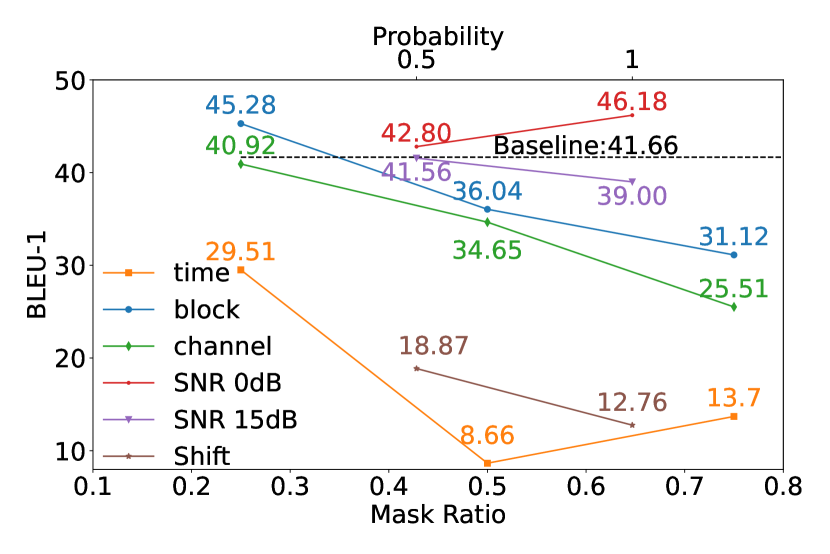
- Employs block masking and low-SNR noise augmentation during training to improve robustness to signal degradation and enhance generalization.
- Trains the model end-to-end on raw MEG signals without event markers or discrete code representations, enabling direct sequence-to-sequence generation.
- Applies no pretraining on MEG data, relying solely on the model’s capacity to learn from the raw neural signals and language priors.
- Uses standard translation metrics (BLEU-1, ROUGE-1) for evaluation, with held-out test sets to assess zero-shot generalization and robustness.
Experimental results
Research questions
- RQ1Can a full autoregressive transformer model achieve high-performance MEG-to-text translation without teacher forcing?
- RQ2How does cross-attention in a Whisper-based architecture compare to prior BART-based models in decoding raw MEG signals?
- RQ3What data augmentation strategies (e.g., block masking, noise injection) most effectively improve model robustness and performance on noisy MEG data?
- RQ4To what extent can the model generalize across different subjects, MEG layouts, and languages without fine-tuning?
- RQ5How does the absence of pretraining affect performance, and what role does the model’s architecture play in learning meaningful semantic representations from raw MEG?
Key findings
- NeuSpeech achieves 60.30 BLEU-1 and 55.26 ROUGE-1 F-measure on the GWilliams dataset without teacher forcing or pretraining, demonstrating strong zero-shot generation capability.
- On the Schoffelen dataset, the model achieves 53.16 BLEU-1, confirming consistent performance across multiple MEG datasets and subjects.
- Block masking with a small mask ratio and low-SNR noise augmentation significantly improves model generalization, while strong noise (0dB SNR) enhances performance, likely by improving noise robustness.
- Removing the point-wise convolution layer in the encoder leads to a substantial performance drop (from 41.65 to 34.81 BLEU-1), highlighting its importance in feature learning.
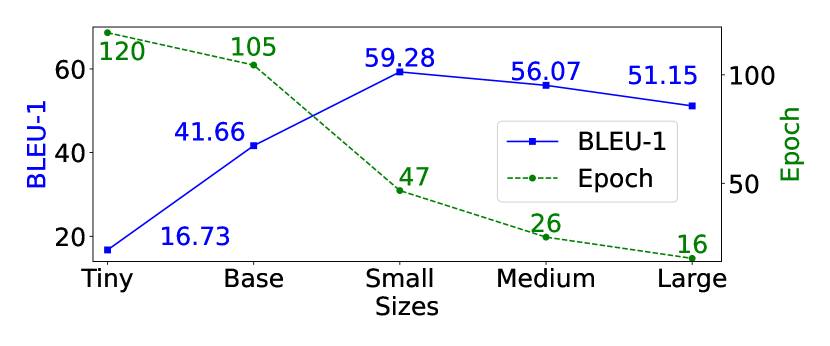
- Performance improves with increased training data and more fine-tuned layers, suggesting scalability and potential for further gains with larger data and deeper adaptation.
- Shifting data augmentation provides no benefit and degrades performance, indicating that temporal shifts may disrupt the model’s ability to learn from MEG signal patterns.
Read this paper
Open the full text in the Nubint reader and ask about any passage as you read.
Read this paper on NubintThis review was generated by AI from the original paper. Please check the paper before citing it.