
[Paper Review] NFTCert: NFT-Based Certificates With Online Payment Gateway
NFTCert proposes a blockchain-based, NFT-native certificate system that enables secure, privacy-preserving, and verifiable digital credential management without relying on cryptocurrency. By integrating a traditional online payment gateway into NFT minting, it enhances usability and regulatory compliance while ensuring authenticity, confidentiality, and transparency through on-chain metadata hashing and decentralized ownership verification.
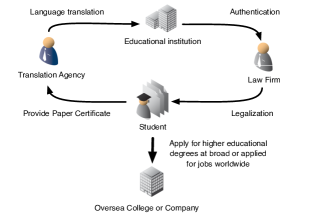
Nowadays, academic certificates are still widely issued in paper format. Traditional certificate verification is a lengthy, manually intensive, and sometimes expensive process. In this paper, we propose a novel NFT-based certificate framework called NFTCert, which enables the establishment of links between a legitimate certificate and its owner through a Blockchain. In this paper, we describe the implementation of the NFTCert framework, including schema definition, minting, verification, and revocation of NFT-based certificates. We also introduce a payment gateway into the minting process, which enables NFTCert to be used by a wider audience. Therefore, participants of NFTCerts do not need to rely on cryptocurrency for transactions. All in all, the proposed framework is designed to achieve usability, authenticity, confidentiality, transparency, and availability properties when it is compared to existing Blockchain-based systems.
Motivation & Objective
- To address the inefficiencies and vulnerabilities of traditional paper-based academic certificate systems, including lengthy verification and fraud risks.
- To enable secure, tamper-proof, and decentralized verification of educational credentials using NFTs on a private blockchain.
- To eliminate reliance on cryptocurrency by integrating a standard online payment gateway, improving accessibility and regulatory compliance.
- To preserve student privacy by storing only hashed personal information on the blockchain, not raw data.
- To allow students to consolidate all their academic certificates in a single digital wallet for easy sharing and verification.
Proposed method
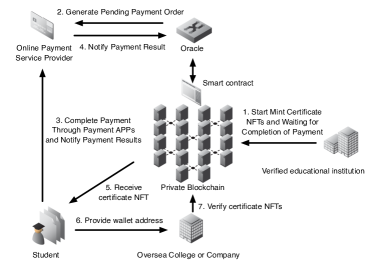
- NFTCert uses a private blockchain architecture, restricting access to verified educational institutions and authorized entities.
- It defines a custom NFT metadata schema that includes a SHA-256 hash of student and certificate details (e.g., name, DOB, degree, conferral date), excluding raw personal data.
- Certificates are minted as NFTs and stored in students’ digital wallets, with ownership and authenticity verifiable via on-chain hash comparison.
- The system integrates a traditional online payment gateway to facilitate fee payments during NFT issuance, avoiding cryptocurrency use.
- Verification is performed by overseas institutions or employers who compare a hash of resume-provided data with the hash stored in the NFT metadata.
- Revocation is supported through a smart contract mechanism that marks certificates as invalid on the blockchain.
Experimental results
Research questions
- RQ1How can NFT-based certificates be issued and verified without requiring users to hold or transact in cryptocurrency?
- RQ2In what ways can NFTs enhance the privacy, authenticity, and transparency of academic credential management?
- RQ3How can a payment gateway be integrated into an NFT-based certificate system to improve usability and regulatory compliance?
- RQ4What are the advantages of NFTCert over existing blockchain-based certificate systems in terms of privacy, revocation, and centralized credential storage?
- RQ5Can a private blockchain NFT framework effectively support scalable and secure issuance and verification of academic certificates?
Key findings
- NFTCert successfully supports all seven key properties: usability, authenticity, confidentiality, transparency, availability, revocation, and privacy.
- The integration of a traditional online payment gateway enables NFT-based certificate transactions without cryptocurrency, expanding accessibility in regulated regions.
- By storing only a SHA-256 hash of personal and certificate data on the blockchain, NFTCert ensures that sensitive information remains private and not exposed on-chain.
- The system allows students to collect all their educational certificates in a single digital wallet, streamlining sharing and verification for employers and universities.
- NFTCert outperforms existing systems like Blockcerts, EduCTX, and UZHBC in supporting privacy, revocation, and non-cryptocurrency payments.
- The framework enables verifiable, tamper-proof credential verification by comparing client-provided data hashes with on-chain stored hashes, ensuring authenticity.
Read this paper
Open the full text in the Nubint reader and ask about any passage as you read.
Read this paper on NubintThis review was generated by AI from the original paper. Please check the paper before citing it.