
[Paper Review] nnU-Net Revisited: A Call for Rigorous Validation in 3D Medical Image Segmentation
The paper re-evaluates recent 3D medical image segmentation methods and shows CNN-based U-Net configurations within nnU-Net, properly scaled to hardware, outperform Transformer- and Mamba-based approaches; it also releases updated baselines and advocates rigorous validation.
The release of nnU-Net marked a paradigm shift in 3D medical image segmentation, demonstrating that a properly configured U-Net architecture could still achieve state-of-the-art results. Despite this, the pursuit of novel architectures, and the respective claims of superior performance over the U-Net baseline, continued. In this study, we demonstrate that many of these recent claims fail to hold up when scrutinized for common validation shortcomings, such as the use of inadequate baselines, insufficient datasets, and neglected computational resources. By meticulously avoiding these pitfalls, we conduct a thorough and comprehensive benchmarking of current segmentation methods including CNN-based, Transformer-based, and Mamba-based approaches. In contrast to current beliefs, we find that the recipe for state-of-the-art performance is 1) employing CNN-based U-Net models, including ResNet and ConvNeXt variants, 2) using the nnU-Net framework, and 3) scaling models to modern hardware resources. These results indicate an ongoing innovation bias towards novel architectures in the field and underscore the need for more stringent validation standards in the quest for scientific progress.
Motivation & Objective
- Identify validation pitfalls in 3D medical image segmentation research.
- Perform large-scale, rigorously controlled benchmarking across CNN-, Transformer-, and Mamba-based methods.
- Assess dataset suitability for benchmarking methodological progress.
- Provide updated standardized baselines within nnU-Net and guidance for fair comparisons.
Proposed method
- Catalog validation pitfalls and provide concrete recommendations (R1-R4).
- Conduct a large-scale benchmark on six public 3D segmentation datasets under a uniform hardware and cross-validation setup.
- Compare CNN-, Transformer-, and Mamba-based architectures, as well as Auto3DSeg framework, within the nnU-Net framework; ensure equal VRAM budgets.
- Analyze model scaling effects and dataset- and task-specific performance to identify genuine progress factors.
- Release updated standardized baselines and a dataset-suitability evaluation framework.
Experimental results
Research questions
- RQ1Do recent claims of architectural superiority hold under rigorous validation with fair baselines and standardized configurations?
- RQ2What are the key factors driving state-of-the-art performance in 3D medical image segmentation when controlling for data, compute, and baseline quality?
- RQ3Which datasets are most suitable for benchmarking methodological advances in 3D segmentation?
- RQ4How do model scaling and architecture type (CNN vs Transformer vs Mamba) impact performance under equal resources?
Key findings
- CNN-based U-Net methods implemented in nnU-Net consistently deliver strong performance across six datasets.
- MedNeXt often yields the best Dice scores but requires substantially more training time, and some gains relate to target spacing rather than architecture alone.
- Transformer-based networks (SwinUNETR, nnFormer, CoTr) do not match CNN-based nnU-Net performance in this benchmark.
- U-Mamba variants underperform once a proper baseline (No-Mamba Base) is used, suggesting prior gains were due to confounding factors.
- Auto3DSeg configurations do not consistently reach nnU-Net performance under equal resource constraints; nnU-Net ResEnc variants and longer/higher-budget configurations outperform out-of-the-box Auto3DSeg.
- Scaling results show larger models yield meaningful gains on harder datasets (AMOS, KiTS) but less on easier tasks (BTCV, BraTS).
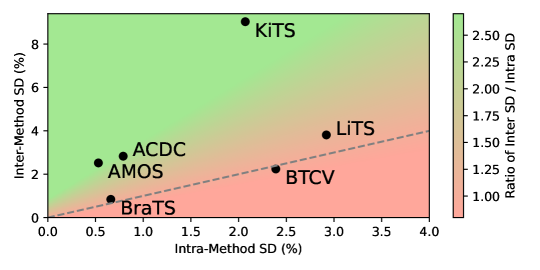
- A systematic dataset suitability analysis identifies KiTS, AMOS, and ACDC as most suitable for benchmarking, BraTS and BTCV being less suitable.
Read this paper
Open the full text in the Nubint reader and ask about any passage as you read.
Read this paper on NubintThis review was generated by AI from the original paper. Please check the paper before citing it.