
[Paper Review] NodeCoder: a graph-based machine learning platform to predict active sites of modeled protein structures
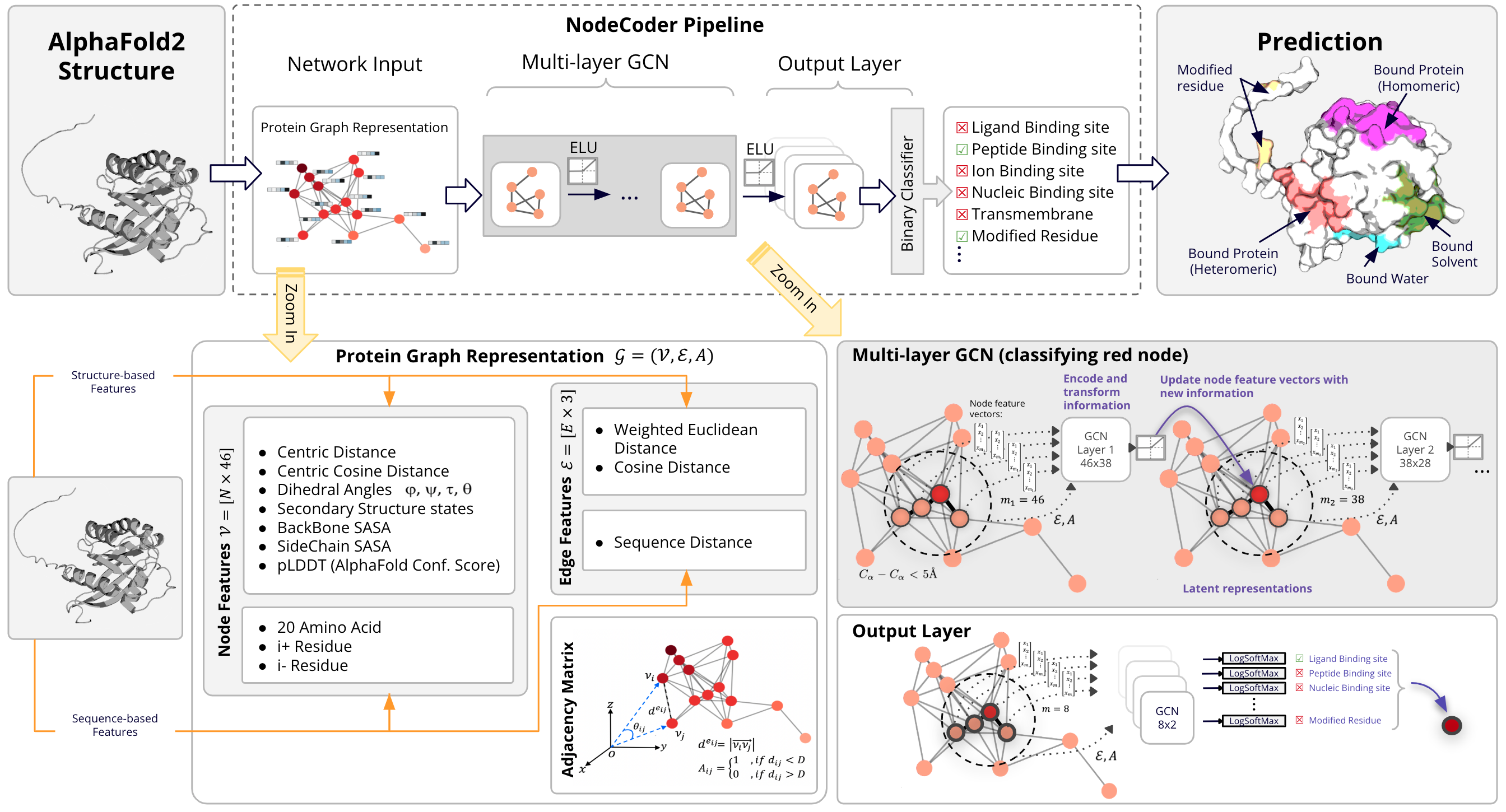
NodeCoder is a graph-based machine learning platform that predicts functional protein sites by mapping residue-level data onto AlphaFold2-predicted 3D structures, encoding them into contact networks, and applying Graph Convolutional Networks (GCNs) for residue classification. It outperformed P2Rank in ligand binding site prediction and supports six diverse functional tasks using a single, reusable framework.
While accurate protein structure predictions are now available for nearly every observed protein sequence, predicted structures lack much of the functional context offered by experimental structure determination. We address this gap with NodeCoder, a task-independent platform that maps residue-based datasets onto 3D protein structures, embeds the resulting structural feature into a contact network, and models residue classification tasks with a Graph Convolutional Network (GCN). We demonstrate the versatility of this strategy by modeling six separate tasks, with some labels derived from other experimental structure studies (ligand, peptide, ion, and nucleic acid binding sites) and other labels derived from annotation databases (post-translational modification and transmembrane regions). Moreover, A NodeCoder model trained to identify ligand binding site residues was able to outperform P2Rank, a widely-used software developed specifically for ligand binding site detection. NodeCoder is available as an open-source python package at https://pypi.org/project/NodeCoder/.
Motivation & Objective
- To address the lack of functional context in high-accuracy, predicted protein structures from models like AlphaFold2.
- To develop a unified, task-independent framework for predicting diverse functional sites (e.g., ligand, ion, PTM, transmembrane) on modeled protein structures.
- To enable accurate residue classification without requiring high-resolution experimental structures by leveraging structural topology and biophysical features.
- To create a scalable, open-source platform that supports diverse computational biology applications beyond ligand binding site prediction.
Proposed method
- Maps residue-level labels (e.g., from PDB or annotation databases) onto predicted 3D protein structures from AlphaFold2.
- Constructs a residue contact network where each residue is a node and edges represent spatial proximity (within 5Å) between residues.
- Computes biophysical features (e.g., solvent accessibility, hydrophobicity, electrostatic potential) for each residue and embeds them into node feature vectors.
- Applies a multi-layer Graph Convolutional Network (GCN) to learn hierarchical representations from the contact graph, with ELU and LogSoftMax activation functions.
- Trains the GCN using cross-entropy loss via Adam optimizer with a fixed learning rate of 0.01, and selects the best model based on PR AUC over 10,000 epochs.
- Uses 5-fold cross-validation on a human proteome dataset of 3,823 proteins, excluding those without functional annotations to avoid class imbalance bias.
Experimental results
Research questions
- RQ1Can a single, generalizable graph-based deep learning framework effectively predict diverse functional sites on predicted protein structures without relying on experimental high-resolution data?
- RQ2How does NodeCoder’s performance compare to task-specific tools like P2Rank in predicting ligand binding sites on AlphaFold2-predicted structures?
- RQ3To what extent can a unified GCN architecture generalize across distinct functional tasks such as post-translational modifications, transmembrane regions, and metal binding sites?
- RQ4How robust is the model to class imbalance in functional site prediction tasks, and what evaluation metrics best reflect performance in such scenarios?
Key findings
- NodeCoder achieved superior performance in ligand binding site prediction compared to P2Rank, a widely used, specialized tool, demonstrating the effectiveness of its generalizable GCN approach.
- The model achieved high precision and recall across six distinct functional tasks, including ligand, peptide, ion, nucleic acid, post-translational modification, and transmembrane region prediction.
- The use of a contact network abstraction enabled the model to capture structural topology effectively, even when side-chain conformations were less accurate in AlphaFold2 predictions.
- Cross-validation results showed consistent performance across five folds, with PR AUC used as the primary metric to evaluate model robustness and generalization.
- The framework successfully leveraged biophysical features and graph convolution to model complex, long-range residue interactions critical for functional site prediction.
- The open-source availability of NodeCoder via PyPI and GitHub enables broad adoption and extension for new prediction tasks in computational biology and drug discovery.

Read this paper
Open the full text in the Nubint reader and ask about any passage as you read.
Read this paper on NubintThis review was generated by AI from the original paper. Please check the paper before citing it.