
[Paper Review] Noise2Music: Text-conditioned Music Generation with Diffusion Models
Noise2Music trains cascaded diffusion models to generate 30-second, text-conditioned music at 24 kHz, using either a spectrogram or low-fidelity waveform as an intermediate representation, with large-language-model grounding for semantic alignment.
We introduce Noise2Music, where a series of diffusion models is trained to generate high-quality 30-second music clips from text prompts. Two types of diffusion models, a generator model, which generates an intermediate representation conditioned on text, and a cascader model, which generates high-fidelity audio conditioned on the intermediate representation and possibly the text, are trained and utilized in succession to generate high-fidelity music. We explore two options for the intermediate representation, one using a spectrogram and the other using audio with lower fidelity. We find that the generated audio is not only able to faithfully reflect key elements of the text prompt such as genre, tempo, instruments, mood, and era, but goes beyond to ground fine-grained semantics of the prompt. Pretrained large language models play a key role in this story -- they are used to generate paired text for the audio of the training set and to extract embeddings of the text prompts ingested by the diffusion models. Generated examples: https://google-research.github.io/noise2music
Motivation & Objective
- Motivate and enable high-quality text-conditioned music generation at scale.
- Develop a diffusion-based pipeline that produces 30-second music conditioned on free-form text prompts.
- Leverage large language models and music-text embeddings to ground fine-grained semantic attributes in audio.
Proposed method
- Train a cascade of diffusion models consisting of a generator that outputs an intermediate representation and a cascader that refines to high-fidelity audio.
- Explore two intermediate representations: (i) log-mel spectrograms and (ii) 3.2 kHz waveforms.
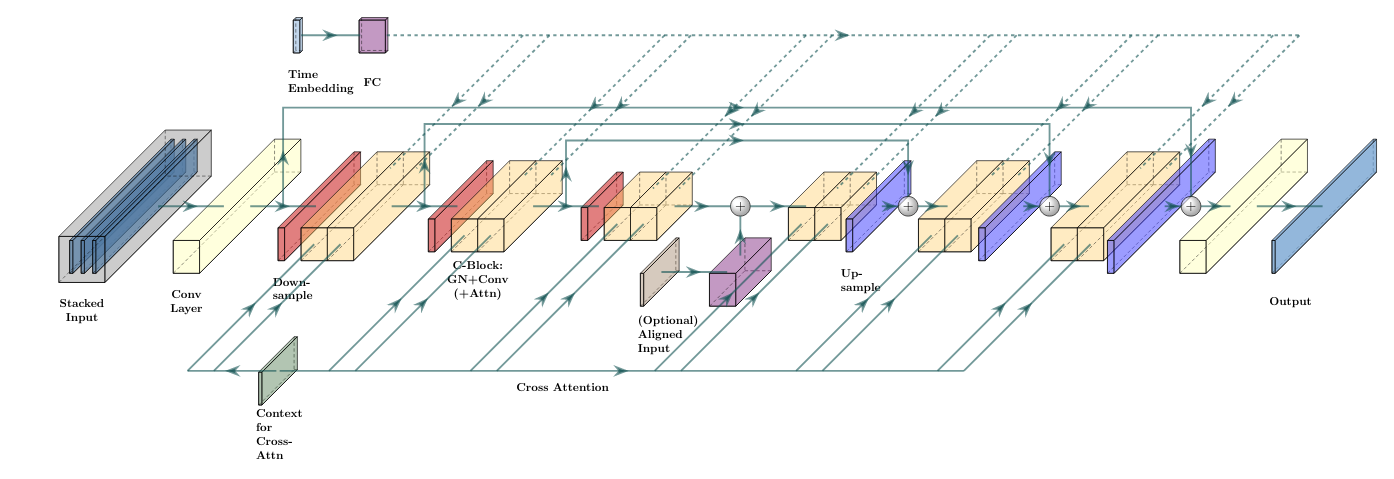
- Condition diffusion models on text via cross-attention to a pre-trained language model encoder (T5).
- Use a final super-resolution cascader to produce 24 kHz audio from 16 kHz intermediate audio.
- Employ pseudo-labeling with MuLan-LM to create large-scale text-audio pairs and construct MuLaMCap for training data diversity.
- Train four 1D U-Net diffusion models (waveform generator, waveform cascader, spectrogram generator, spectrogram vocoder) and a super-resolution cascader under varied training and augmentation schemes.
- Inference uses CFG, front/back/front-heavy denoising schedules, and tuned stochasticity to balance quality and diversity.
Experimental results
Research questions
- RQ1Can diffusion-based architectures generate long (30-second) music clips conditioned on arbitrary text prompts with high fidelity?
- RQ2Does grounding with large language models and music-text embeddings yield grounded, fine-grained semantic control (genre, tempo, mood, era) in generated music?
- RQ3How do intermediate representations (spectrogram vs. waveform) impact quality and semantic alignment in text-conditioned music generation?
Key findings
- The Noise2Music models produce 30-second audio that reflects high-level and fine-grained prompt attributes such as genre, tempo, instruments, mood, and era.
- Two-stage cascaded diffusion (generator for intermediate representation and cascader for final audio) with a super-resolution step achieves high fidelity 24 kHz output.
- Large-scale pseudo-labeling with MuLan and LaMDA enables groundings of nuanced semantics beyond standard metadata.
- FAD scores and MuLan similarity show competitive or superior quality and semantic alignment compared to baselines like Riffusion and Mubert across multiple datasets.
- Human listening tests indicate Noise2Music waveform is competitive with MusicLM in semantic alignment on MusicCaps prompts.
- Grounding prompts via multi-vocabulary pseudo-labels and cross-attention with text encodings (T5) improves perceptual and semantic fidelity.

Read this paper
Open the full text in the Nubint reader and ask about any passage as you read.
Read this paper on NubintThis review was generated by AI from the original paper. Please check the paper before citing it.