
[Paper Review] Non-Hermitian Floquet Topological Matter -- A Review
This review synthesizes recent advances in non-Hermitian Floquet topological matter, presenting theoretical frameworks and tools to characterize topological phases in periodically driven systems with non-Hermitian effects. It identifies novel phenomena such as topological invariants, bulk-edge/corner correspondences, skin effects, and localization transitions in one- and two-dimensional systems, including insulators, superconductors, and quasicrystals.
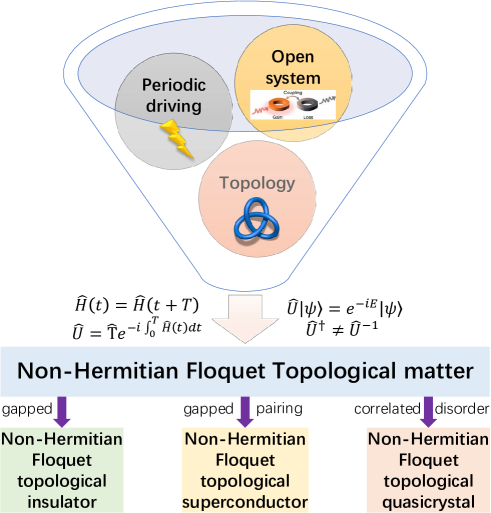
The past few years have witnessed a surge of interest in non-Hermitian Floquet topological matters due to their exotic properties resulting from the interplay between driving fields and non-Hermiticity. The present review sums up our studies on non-Hermitian Floquet topological matters in one and two spatial dimensions. We first give a bird's-eye view of the literature for clarifying the physical significance of non-Hermitian Floquet systems. We then introduce, in a pedagogical manner, a number of useful tools tailored for the study of non-Hermitian Floquet systems and their topological properties. With the aid of these tools, we present typical examples of non-Hermitian Floquet topological insulators, superconductors, and quasicrystals, with a focus on their topological invariants, bulk-edge correspondences, non-Hermitian skin effects, dynamical properties, and localization transitions. We conclude this review by summarizing our main findings and presenting our vision of future directions.
Motivation & Objective
- To systematize theoretical tools for studying topological phases in non-Hermitian Floquet systems.
- To characterize exotic topological phenomena arising from the interplay between periodic driving and non-Hermiticity.
- To explore bulk-edge and bulk-corner correspondences, localization transitions, and non-Hermitian skin effects in non-Hermitian Floquet systems.
- To identify and classify topological invariants and dynamical indicators such as the dynamic winding number and mean chiral displacement.
- To provide a foundation for future exploration of many-body, disordered, and higher-dimensional non-Hermitian Floquet phases.
Proposed method
- Application of Floquet theory to derive the time-ordered evolution operator and quasienergy eigenstates in periodically driven systems.
- Use of high-frequency expansion to construct effective non-Hermitian Floquet Hamiltonians for analyzing band topology.
- Employment of symmetry-based classification and topological invariants (e.g., dynamic winding number, mean chiral displacement) to characterize topological phases.
- Numerical and analytical study of bulk-edge/corner correspondences and localization transitions in non-Hermitian Floquet systems.
- Analysis of exceptional points and non-Hermitian skin effects in systems with non-reciprocal couplings and gain/loss terms.
- Use of discrete-time quantum walks as experimental platforms to simulate and detect non-Hermitian Floquet topological phases.
Experimental results
Research questions
- RQ1How do non-Hermitian effects modify the topological invariants and edge states in periodically driven systems?
- RQ2What is the role of the dynamic winding number and mean chiral displacement in diagnosing topological phases in non-Hermitian Floquet systems?
- RQ3How do exceptional points and non-Hermitian skin effects influence the localization and transport properties in these systems?
- RQ4What are the conditions under which bulk-edge or bulk-corner correspondences emerge in non-Hermitian Floquet topological insulators and superconductors?
- RQ5Can non-Hermitian Floquet engineering realize topological phases not accessible in static or Hermitian systems?
Key findings
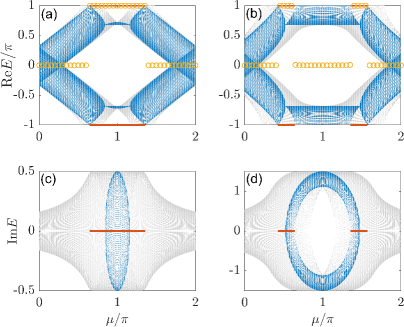
- Non-Hermitian Floquet systems support unique topological phases, including first-order, second-order, and qth-root topological insulators, with distinct topological invariants.
- The dynamic winding number and mean chiral displacement serve as reliable dynamical indicators for detecting topological transitions in non-Hermitian Floquet systems.
- Non-Hermitian skin effects lead to strong localization of bulk states at system boundaries, which can be linked to topological edge states in certain regimes.
- Bulk-edge and bulk-corner correspondences are established in non-Hermitian Floquet topological insulators and superconductors, even in the presence of non-Hermitian terms.
- Localization transitions and mobility edges are observed in non-Hermitian Floquet quasicrystals, indicating complex interplay between topology and disorder.
- High-frequency and near-resonant driving fields can stabilize and enrich non-Hermitian Floquet topological phases, enabling new phases absent in the static limit.
Read this paper
Open the full text in the Nubint reader and ask about any passage as you read.
Read this paper on NubintThis review was generated by AI from the original paper. Please check the paper before citing it.