
[Paper Review] Non-polaritonic effects in cavity-modified photochemistry
This study re-examines the seminal claim of vacuum-modified photochemistry via strong coupling in a visible-light microcavity, finding no evidence for polaritonic effects in spiropyran isomerization. Instead, UV absorption within the cavity structure alone explains the observed rate changes, challenging the attribution of chemical modifications to strong light-matter coupling and urging caution in interpreting cavity-based photochemistry results.
Strong coupling of molecules to vacuum fields has been widely reported to lead to modified chemical properties such as reaction rates. However, some recent attempts to reproduce infrared strong coupling results have not been successful, suggesting that factors other than strong coupling may sometimes be involved. Here we re-examine the first of these vacuum-modified chemistry experiments in which changes to a molecular photoisomerisation process in the UV-vis spectral range were attributed to strong coupling of the molecules to visible light. We observed significant variations in photoisomerisation rates consistent with the original work; however, we found no evidence that these changes need to be attributed to strong coupling. Instead, we suggest that the photoisomerisation rates involved are most strongly influenced by the absorption of ultraviolet radiation in the cavity. Our results indicate that care must be taken to rule out non-polaritonic effects before invoking strong coupling to explain any changes of chemical properties arising in cavity-based experiments.
Motivation & Objective
- To re-examine the original experiment claiming strong coupling-induced modification of photoisomerization in spiropyran (SPI) under visible light.
- To determine whether observed changes in reaction rates are due to strong coupling or non-polaritonic effects such as UV absorption in the cavity.
- To assess the validity of control experiments used in prior polaritonic chemistry studies, particularly regarding cavity detuning and field confinement.
- To evaluate whether quantum yield of the photoisomerization process is altered by strong coupling or instead governed by light absorption.
- To provide a framework for designing more rigorous control experiments in cavity-modified chemistry to distinguish polaritonic from non-polaritonic effects.
Proposed method
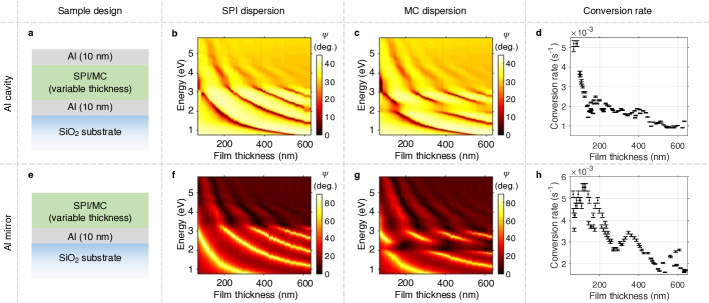
- Measured photoisomerization rates of SPI/MC in a series of planar microcavities with varying thicknesses and mirror configurations, including Al/Al and Ag/Ag cavities.
- Calculated average UV absorption (at 2.2 eV and 3.5 eV) across different cavity structures and incident angles (0° and 65°), using unpolarized light approximations.
- Simulated transmittance and dispersion profiles for Al/MC/Al cavities across a range of MC film thicknesses (10–180 nm), identifying anticrossing behavior indicative of strong coupling.
- Normalized reaction rates to SPI absorption at 3.5 eV to extract effective quantum yields, comparing them to theoretical absorption curves at 2.2 eV (where strong coupling is expected).
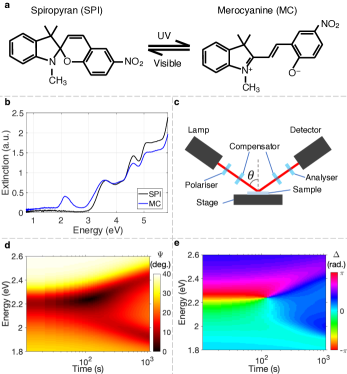
- Used ellipsometry and normal incidence transmission measurements to correlate structural parameters with optical response and reaction kinetics.
- Evaluated the impact of field confinement and impedance matching by comparing data from glass substrates and metal cavities with varying optical quality and roughness.
Experimental results
Research questions
- RQ1Is the observed change in SPI photoisomerization rate in microcavities truly due to strong coupling, or could it be explained by UV light absorption within the cavity structure?
- RQ2To what extent do control experiments—such as off-resonance or cavity-free structures—fail to rule out non-polaritonic effects in cavity-modified photochemistry?
- RQ3Does strong coupling to the cavity mode alter the quantum yield of the SPI-to-MC isomerization process, or is the reaction yield solely governed by photon absorption?
- RQ4Can the correlation between reaction rate and cavity thickness be explained by strong coupling conditions, or is it better matched by absorption profiles?
- RQ5How do experimental parameters such as incidence angle, cavity quality factor, and material roughness influence the interpretation of reaction rate changes in cavity-based systems?
Key findings
- Photoisomerization rates in the cavity experiments showed significant variation but did not correlate with conditions expected for strong coupling, such as anticrossing or mode splitting.
- The best match between experimental reaction rates and theoretical predictions was achieved when using UV absorption at 3.5 eV (not 2.2 eV), indicating that absorption—not polaritonic coupling—drives the observed kinetics.
- No correlation was found between the quantum yield of the SPI-MC isomerization process and the presence of strong coupling, as evidenced by normalization of reaction rates to SPI absorption at 3.5 eV.
- Cavity thicknesses required for strong coupling (e.g., L=140 nm for Al cavities) did not align with observed rate maxima, and control cavities with thicknesses below 90 nm were insufficient to rule out coupling effects.
- The Ag cavity data revealed polarisation-dependent mode splitting at oblique angles (65°), confirming cavity mode structure, but this did not influence reaction rates, further undermining polaritonic explanations.
- Glass substrate data showed higher noise and weaker field confinement due to impedance matching, which enhanced sensitivity to surface roughness and other non-optical factors, suggesting that absorption dominates over coupling in low-Q systems.
Read this paper
Open the full text in the Nubint reader and ask about any passage as you read.
Read this paper on NubintThis review was generated by AI from the original paper. Please check the paper before citing it.