
[Paper Review] Nonlinear Balanced Truncation: Part 2 -- Model Reduction on Manifolds
This paper develops a scalable balance-and-reduce approach for nonlinear balanced truncation by performing model reduction on polynomially nonlinear balanced manifolds, including a strategy to handle ill-conditioning of the nonlinear transformation.
Nonlinear balanced truncation is a model order reduction technique that reduces the dimension of nonlinear systems in a manner that accounts for either open- or closed-loop observability and controllability aspects of the system. Two computational challenges have so far prevented its deployment on large-scale systems: (a) the energy functions required for characterization of controllability and observability are solutions of high-dimensional Hamilton-Jacobi-(Bellman) equations, which have been computationally intractable and (b) the transformations to construct the reduced-order models (ROMs) are potentially ill-conditioned and the resulting ROMs are difficult to simulate on the nonlinear balanced manifolds. Part~1 of this two-part article addressed challenge (a) via a scalable tensor-based method to solve for polynomial approximations of the open- and closed-loop energy functions. This article, (Part~2), addresses challenge (b) by presenting a novel and scalable method to reduce the dimensionality of the full-order model via model reduction on polynomially-nonlinear balanced manifolds. The associated nonlinear state transformation simultaneously 'diagonalizes' relevant energy functions in the new coordinates. Since this nonlinear balancing transformation can be ill-conditioned and expensive to evaluate, inspired by the linear case we develop a computationally efficient balance-and-reduce strategy, resulting in a scalable and better conditioned truncated transformation to produce balanced nonlinear ROMs. The algorithm is demonstrated on a semi-discretized partial differential equation, namely Burgers equation, which illustrates that higher-degree transformations can improve the accuracy of ROM outputs.
Motivation & Objective
- Address the computational challenges of nonlinear balanced truncation for large-scale systems by (i) deriving a scalable nonlinear state transformation that diagonalizes energy functions in new coordinates, and (ii) proposing a balance-and-reduce procedure on nonlinear manifolds to mitigate ill-conditioning.
- Provide a polynomial-energy-function framework that enables scalable computation of open- and closed-loop energy functions and the associated nonlinear transforms.
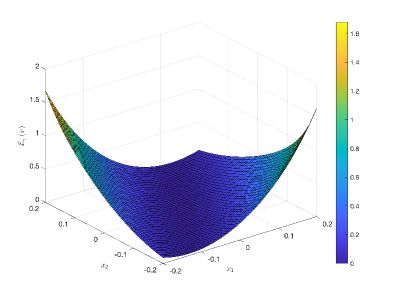
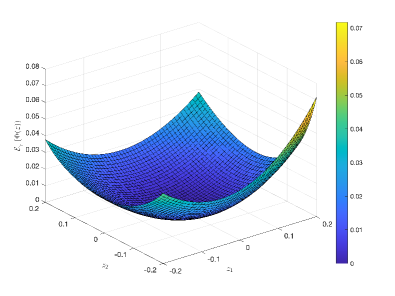
- Demonstrate the approach on a semi-discretized Burgers-type PDE to illustrate how higher-degree transformations impact ROM accuracy and singular-value behavior.
Proposed method
- Compute nonlinear energy function approximations via scalable Taylor-series tensor methods to represent open- and closed-loop energies.
- Derive a nonlinear state transformation that achieves input-normal/output-diagonal form and extract singular value functions.
- Express energy functions and singular value functions as polynomial (tensor) expansions with symmetric coefficients to enable efficient computation.
- Develop a balance-and-reduce strategy to construct balanced ROMs directly on nonlinear manifolds, mitigating ill-conditioning of the full nonlinear transformation.
- Define and utilize degree-k polynomial representations to balance energy functions and enable state truncation based on state-wise singular value functions.
- Validate the framework on a Burgers-type PDE example to study the effect of transformation degree on ROM accuracy.
Experimental results
Research questions
- RQ1How can nonlinear energy functions be computed scalably for large nonlinear systems to enable balancing?
- RQ2Can a nonlinear coordinate transformation be constructed that diagonally balances open- and closed-loop energy functions in a local neighborhood?
- RQ3How can one perform model reduction directly on nonlinear balanced manifolds to address ill-conditioning in the nonlinear transformation?
- RQ4What is the impact of higher-degree nonlinear transformations on the accuracy of reduced-order models for PDE-like systems?
- RQ5Do polynomial (tensor) representations of energy functions provide scalable and accurate components for nonlinear balancing?
Key findings
- A scalable Taylor-series-based strategy is provided to compute nonlinear state transformations and singular value functions in an open-access repository.
- A nonlinear state transformation is constructed that diagonally balances the open- and closed-loop energy functions in new coordinates, yielding nonlinear balanced models.
- A balance-and-reduce approach on nonlinear manifolds is developed to circumvent ill-conditioning and enable efficient nonlinear ROM evaluation.
- The nonlinear balanced ROMs are demonstrated on a semi-discretized Burgers-type PDE, showing that higher-degree transformations can improve ROM output accuracy.
- The methodology does not assume a specific system form; the transformation balances two polynomial energy functions and yields a reusable nonlinear mapping for general nonlinear systems.
Read this paper
Open the full text in the Nubint reader and ask about any passage as you read.
Read this paper on NubintThis review was generated by AI from the original paper. Please check the paper before citing it.