
[Paper Review] Nonlinear optics using intense optical coherent state superpositions
This paper demonstrates the generation of intense femtosecond optical Schrödinger 'cat' states in the infrared with mean photon numbers up to ~10², enabling nonlinear optics. By conditioning the quantum state of an intense IR laser after high-harmonic generation, the authors create macroscopic superpositions that induce second harmonic generation, with quantum interference imprinted in interferometric autocorrelation traces—proving the nonclassical nature of the state.
Superpositions of coherent light states, are vital for quantum technologies. However, restrictions in existing state preparation and characterization schemes, in combination with decoherence effects, prevent their intensity enhancement and implementation in nonlinear optics. Here, by developing a decoherence--free approach, we generate intense femtosecond--duration infrared coherent state superpositions (CSS) with a mean photon number orders of magnitude higher than the existing CSS sources. We utilize them in nonlinear optics to drive the second harmonic generation process in an optical crystal. We experimentally and theoretically show that the non--classical nature of the intense infrared CSS is imprinted in the second-order autocorrelation traces. Additionally, theoretical analysis shows that the quantum features of the infrared CSS are also present in the generated second harmonic. The findings introduce the optical CSS into the realm of nonlinear quantum optics, opening up new paths in quantum information science and quantum light engineering by creating non-classical light states in various spectral regions via non-linear up-conversion processes.
Motivation & Objective
- To overcome the limitation of low photon numbers in existing optical 'cat' state sources, which restricts their use in nonlinear optics.
- To generate intense, macroscopic superposition states of light with high average photon numbers suitable for driving nonlinear processes.
- To demonstrate that quantum interference in optical 'cat' states can be probed through second harmonic generation and interferometric autocorrelation measurements.
- To validate the nonclassical nature of the generated states by distinguishing them from classical mixtures using beating signatures in the 2-AC traces.
Proposed method
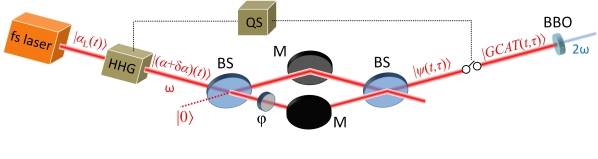
- The method uses high-power femtosecond infrared laser pulses with ~10¹¹ photons per pulse to generate intense coherent states.
- Quantum state engineering is applied via conditioning operations on the laser field after its nonlinear interaction with atoms in a high-harmonic generation (HHG) medium.
- The HHG process induces an amplitude shift δα in the coherent state, leading to a superposition state of the form |CAT>± = N±(|α> ± |-α>) with |α| ~ 10·¹¹.
- The generated 'cat' state is used to drive second harmonic generation (SHG) in a nonlinear crystal, up-converting infrared photons to blue frequencies.
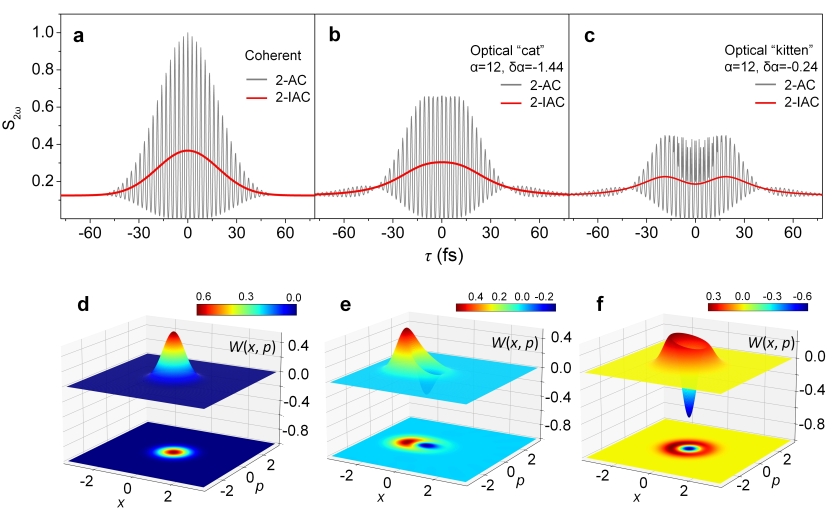
- Interferometric second-order autocorrelation (2-AC) traces are measured to detect quantum interference, with the signal S₊₉(τ) = η∫ dt ⌈I²(t,τ)⌉.
- Classical mixture models are used as a control to confirm that beating patterns in the 2-AC traces arise solely from quantum interference, not classical statistics.
Experimental results
Research questions
- RQ1Can optical 'cat' states with mean photon numbers sufficient to drive nonlinear processes be experimentally realized?
- RQ2Does quantum interference in macroscopic superpositions of coherent states manifest in nonlinear optical responses such as second harmonic generation?
- RQ3Can interferometric autocorrelation measurements distinguish nonclassical 'cat' states from classical mixtures of coherent states?
- RQ4What is the role of quantum state conditioning in generating high-intensity, nonclassical light states from intense laser fields?
Key findings
- The authors successfully generated intense optical 'cat' states in the infrared with mean photon numbers of approximately 10², significantly exceeding current sources.
- Second harmonic generation was observed using the 'cat' state as the input, confirming that the state possesses sufficient intensity to drive nonlinear processes.
- Quantum interference between the two coherent states in the superposition produced distinct beating signatures in the second-order interferometric autocorrelation (2-AC) traces.
- The beating features in the 2-AC traces were absent in classical mixture models, proving their origin in quantum coherence and confirming the nonclassical nature of the state.
- The measured signal S₊₉(τ) scaled as ⌈I²⌉ ≈ ⌈n²⌉ + ⌈n⌉, with ⌈n⌉ ~ 10², validating the high-intensity regime.
- The results demonstrate that optical 'cat' states can now be used as a resource in nonlinear quantum optics, opening new avenues in quantum information science.
Better researchstarts right now
From reading papers to final review, dramatically reduce your research time.
No credit card · Free plan available
This review was created by AI and reviewed by human editors.