
[Paper Review] Nonnegative Matrix Factorization in Dimensionality Reduction: A Survey
This survey classifies dimensionality reduction approaches and reviews NMF variants for both feature extraction and feature selection, outlining trends and future directions.
Dimensionality Reduction plays a pivotal role in improving feature learning accuracy and reducing training time by eliminating redundant features, noise, and irrelevant data. Nonnegative Matrix Factorization (NMF) has emerged as a popular and powerful method for dimensionality reduction. Despite its extensive use, there remains a need for a comprehensive analysis of NMF in the context of dimensionality reduction. To address this gap, this paper presents a comprehensive survey of NMF, focusing on its applications in both feature extraction and feature selection. We introduce a classification of dimensionality reduction, enhancing understanding of the underlying concepts. Subsequently, we delve into a thorough summary of diverse NMF approaches used for feature extraction and selection. Furthermore, we discuss the latest research trends and potential future directions of NMF in dimensionality reduction, aiming to highlight areas that need further exploration and development.
Motivation & Objective
- Classify dimensionality reduction into feature extraction and feature selection with emphasis on NMF roles.
- Summarize NMF variants and their applications in feature extraction.
- Summarize NMF variants and their applications in feature selection.
- Discuss current trends and propose future research directions for NMF in dimensionality reduction.
Proposed method
- Describe the loss framework for NMF with beta-divergence and Frobenius norm as a common objective.
- Review variants of NMF including SNMF, ONMF, NMTF, PNMF, and Discriminative NMF.
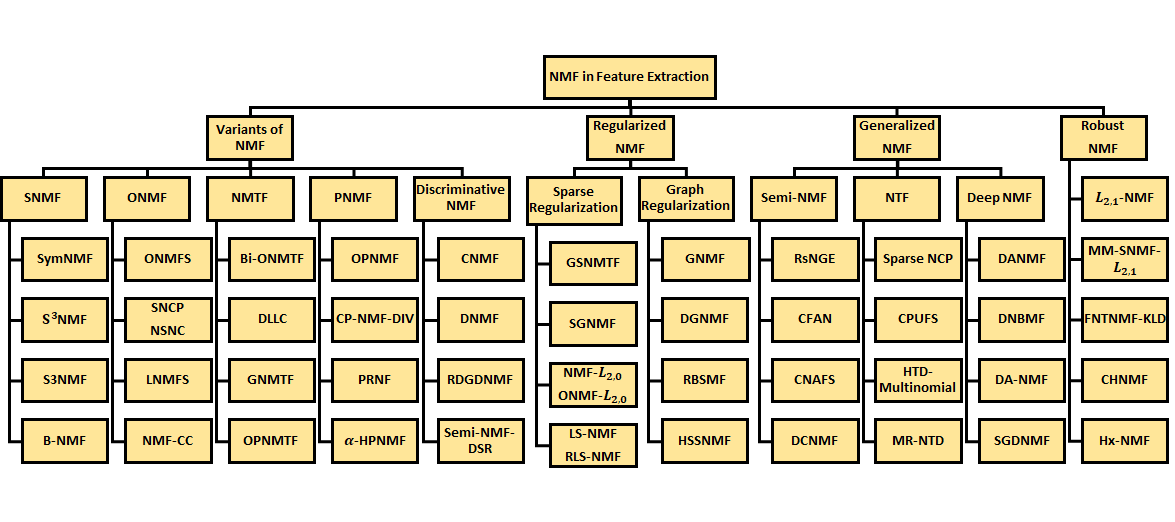
- Organize feature extraction NMF into variants, regularized, generalized, and robust categories.
- Organize feature selection NMF from standard, convex, graph-based, dual graph-based, sparsity, and orthogonality perspectives.
- Discuss optimization approaches for NMF such as MUR, ANLS, HALS, and ADMM.
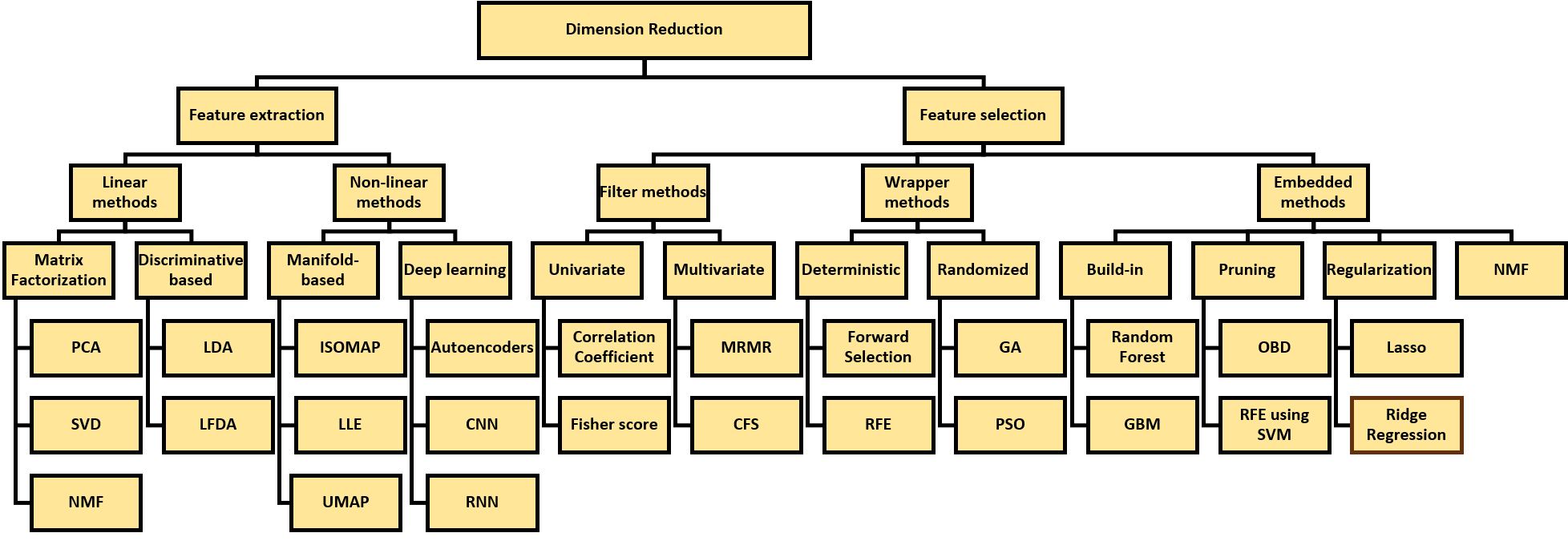
Experimental results
Research questions
- RQ1What is NMF and how does it function in dimension reduction?
- RQ2What are the various variations of NMF and their applications in dimension reduction?
- RQ3What are the advantages and limitations of NMF compared to other dimension reduction techniques?
- RQ4What are the future directions for NMF in dimension reduction?
Key findings
- NMF provides a parts-based, interpretable representation well-suited for nonnegative data.
- NMF variants can be categorized for feature extraction into four groups: variants, regularized, generalized, and robust.
- NMF for feature selection can be analyzed from multiple perspectives, including standard, convex, graph-based, and orthogonality constraints.
- The survey discusses multiple optimization methods tailored to NMF, highlighting their applicability and convergence considerations.
- SNMF, ONMF, and Bi-orthogonal variants offer clustering and interpretability advantages in graph-structured data.
- The paper identifies trends and future directions for advancing NMF in dimensionality reduction.
Read this paper
Open the full text in the Nubint reader and ask about any passage as you read.
Read this paper on NubintThis review was generated by AI from the original paper. Please check the paper before citing it.