
[Paper Review] Nonparametric Causal Decomposition of Group Disparities
This paper introduces a nonparametric causal decomposition framework that dissects group disparities in outcomes by attributing them to four mechanisms: baseline outcome differences, treatment prevalence, average treatment effects, and differential selection into treatment. The method uses counterfactual interventions and efficient influence function estimators to provide $√{n}$-consistent, asymptotically normal, and doubly robust estimates, revealing selection into treatment as a novel, policy-relevant mechanism for disparities in education and income.
We introduce a new nonparametric causal decomposition approach that identifies the mechanisms by which a treatment variable contributes to a group-based outcome disparity. Our approach distinguishes three mechanisms: group differences in 1) treatment prevalence, 2) average treatment effects, and 3) selection into treatment based on individual-level treatment effects. Our approach reformulates classic Kitagawa-Blinder-Oaxaca decompositions in causal and nonparametric terms, complements causal mediation analysis by explaining group disparities instead of group effects, and isolates conceptually distinct mechanisms conflated in recent random equalization decompositions. In contrast to all prior approaches, our framework uniquely identifies differential selection into treatment as a novel disparity-generating mechanism. Our approach can be used for both the retrospective causal explanation of disparities and the prospective planning of interventions to change disparities. We present both an unconditional and a conditional decomposition, where the latter quantifies the contributions of the treatment within levels of certain covariates. We develop nonparametric estimators that are $\sqrt{n}$-consistent, asymptotically normal, semiparametrically efficient, and multiply robust. We apply our approach to analyze the mechanisms by which college graduation causally contributes to intergenerational income persistence (the disparity in adult income between the children of high- vs low-income parents). Empirically, we demonstrate a previously undiscovered role played by the new selection component in intergenerational income persistence.
Motivation & Objective
- To develop a causal framework that decomposes group disparities in outcomes by an intermediate treatment variable, addressing limitations of existing methods.
- To formally identify and estimate the role of differential selection into treatment as a distinct mechanism contributing to disparities.
- To provide counterfactual interventions that inform policy by isolating modifiable contributors to disparities.
- To extend causal mediation analysis by explaining disparities rather than group effects, and to resolve conceptual issues in random equalization decompositions.
Proposed method
- Proposes a counterfactual decomposition framework that defines group disparities descriptively and treatment interventions counterfactually.
- Introduces three core components: baseline outcome difference, treatment prevalence effect, and average treatment effect, with a novel fourth component: differential selection into treatment.
- Uses conditional ignorability to express the selection term as the covariance between propensity score and conditional treatment effect given the propensity score.
- Develops nonparametric estimators based on efficient influence functions, ensuring $√{n}$-consistency, asymptotic normality, and semiparametric efficiency.
- Applies cross-fitting and weight stabilization to improve finite-sample performance in machine learning-based estimation.
- Distinguishes between unconditional and conditional decompositions, enabling interventions that are either marginal or conditional on covariates.
Experimental results
Research questions
- RQ1To what extent does differential prevalence of college graduation contribute to income disparities between high- and low-origin income groups?
- RQ2How much of the income disparity is attributable to differences in average treatment effects of college graduation across income origin groups?
- RQ3What is the contribution of differential selection into college graduation—based on individual treatment effects—to income disparities?
- RQ4How do these contributions change when conditioning on pre-treatment covariates such as parental education or early achievement?
- RQ5Can the proposed decomposition framework provide more interpretable and policy-relevant insights than existing methods like KBO or random equalization decomposition?
Key findings
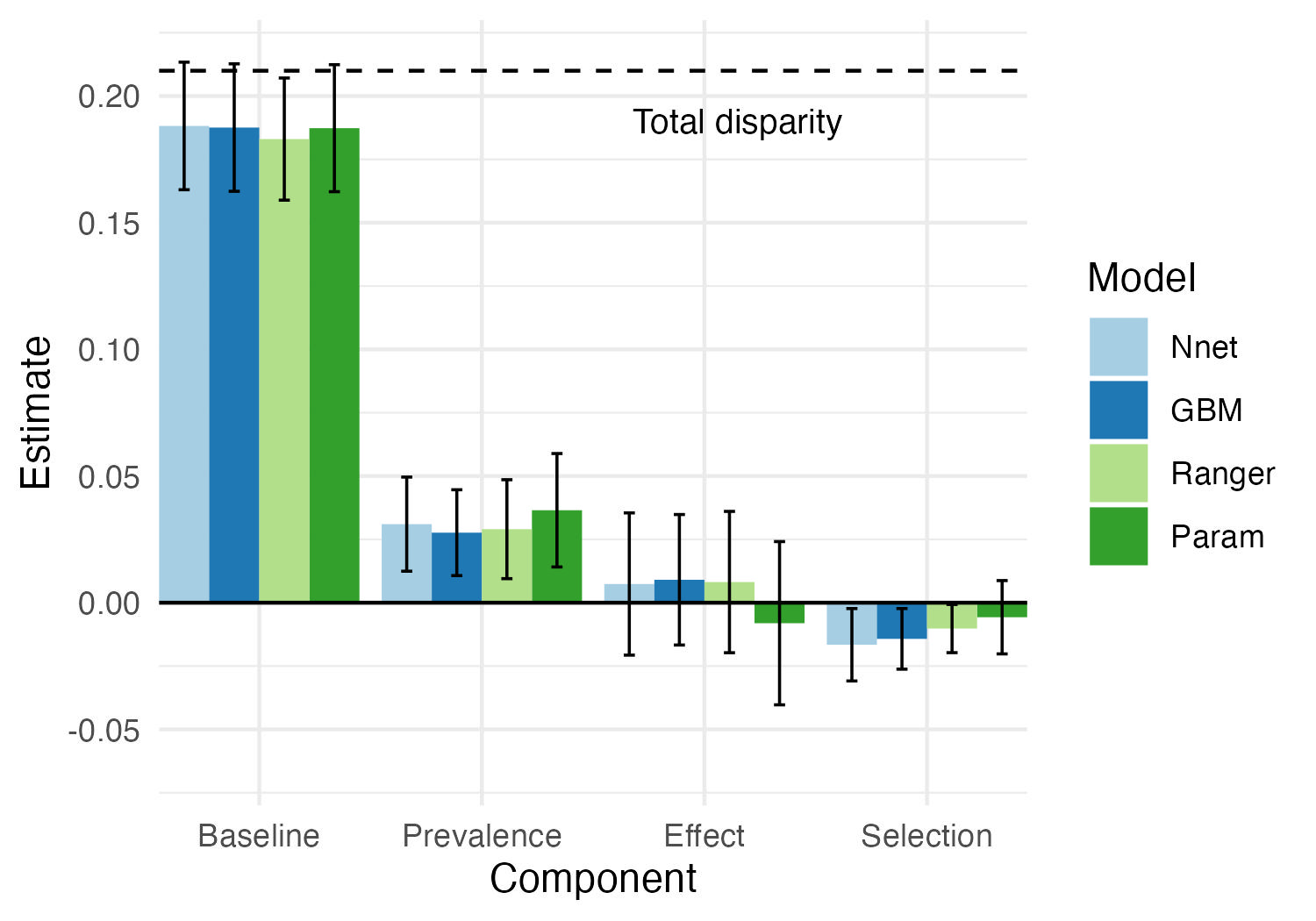
- In the unconditional decomposition, differential prevalence of college graduation contributes 0.028 to 0.036 of the total 0.210 income disparity, depending on the model.
- The average treatment effect (ATE) contribution is small and imprecise, ranging from -0.008 to 0.009, with wide confidence intervals, suggesting limited evidence of differential ATEs.
- The selection term, representing differential selection into treatment, contributes -0.014 to -0.017, indicating that selection patterns reduce disparities, and is statistically significant in multiple models.
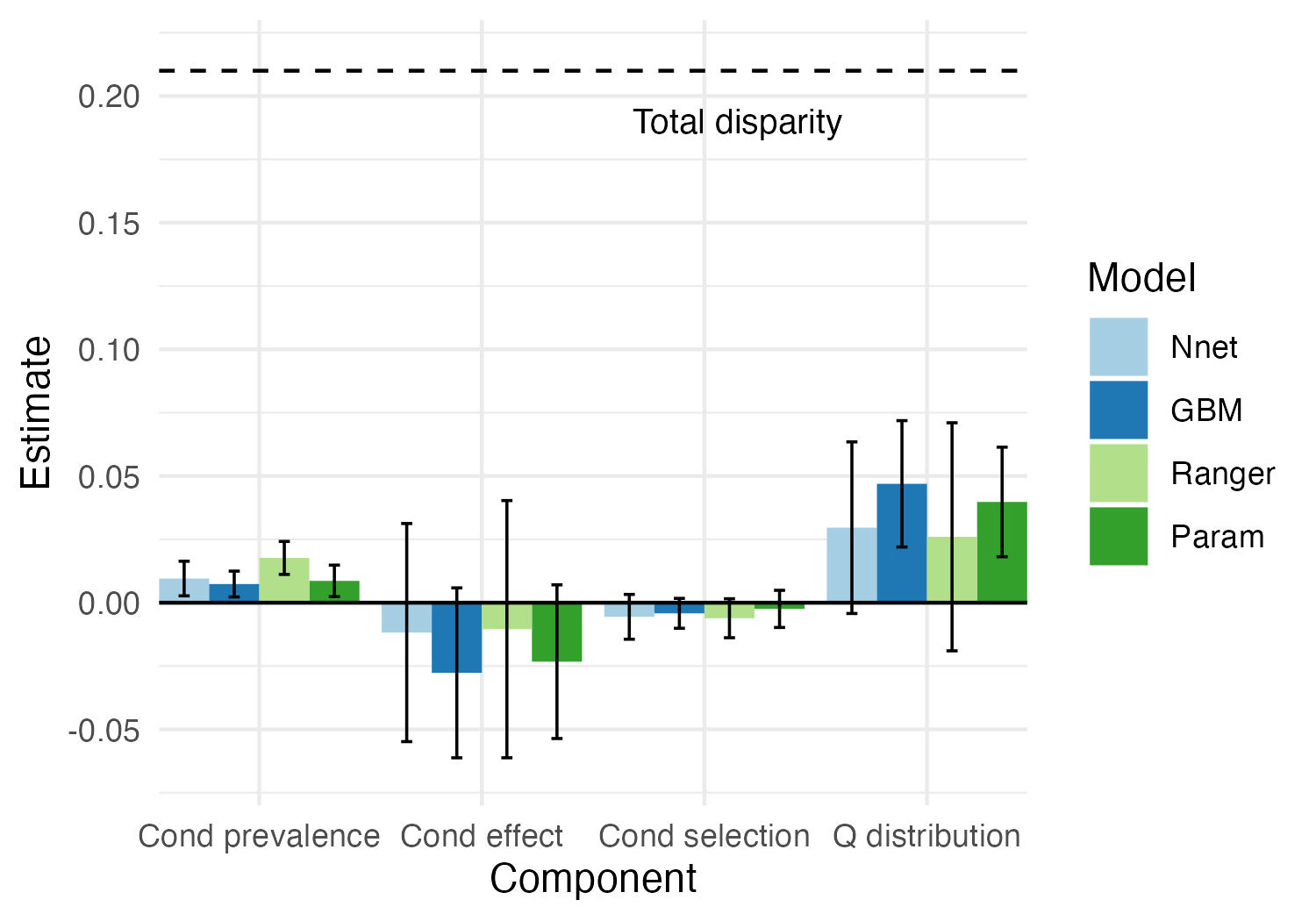
- In the conditional decomposition, the conditional prevalence effect is small (0.007–0.018), while the conditional effect term is negative (-0.028 to -0.010), suggesting that treatment effects may be lower for higher-origin groups after conditioning.
- The Jackson reduction term, representing the reduction in disparity under equalized treatment, is positive and significant (0.006–0.035), indicating that equalizing treatment could reduce disparities.
- The framework successfully identifies selection into treatment as a distinct and quantifiable mechanism, with estimates robust across multiple machine learning models and estimation techniques.
Read this paper
Open the full text in the Nubint reader and ask about any passage as you read.
Read this paper on NubintThis review was generated by AI from the original paper. Please check the paper before citing it.