
[Paper Review] Nonstationary Gaussian Process Surrogates
This paper presents a comprehensive survey of non-stationary Gaussian process (GP) surrogates for computer experiments, evaluating methods including non-stationary kernels, local GPs, treed-GP, and deep GP with Vecchia approximation. In an 8-dimensional satellite drag simulation, fully Bayesian deep GP with elliptical slice sampling and Vecchia approximation (DGP ESS) achieved the best predictive accuracy and uncertainty quantification, outperforming variational inference and local GP approaches.
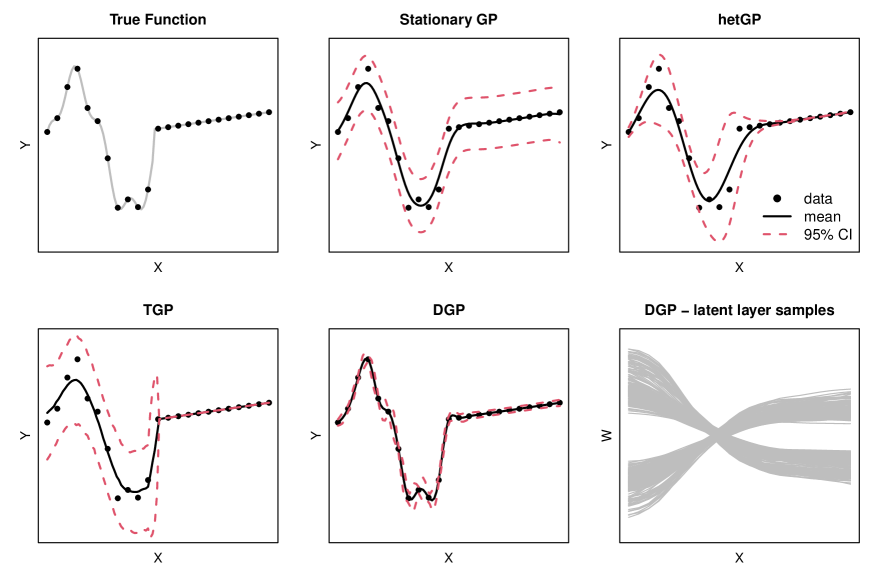
We provide a survey of nonstationary surrogate models which utilize Gaussian processes (GPs) or variations thereof, including nonstationary kernel adaptations, partition and local GPs, and spatial warpings through deep Gaussian processes. We also overview publicly available software implementations and conclude with a bake-off involving an 8-dimensional satellite drag computer experiment. Code for this example is provided in a public git repository.
Motivation & Objective
- To address the limitations of stationary GPs in modeling non-stationary response surfaces common in computer simulations.
- To evaluate and compare non-stationary GP surrogate methods across predictive accuracy and uncertainty quantification (UQ).
- To demonstrate the effectiveness of fully Bayesian inference in non-stationary GP models for real-world, high-dimensional simulations.
- To provide a reproducible benchmark using a large-scale 8-dimensional satellite drag simulation with 1 million runs.
- To highlight the importance of UQ in downstream tasks such as optimization, safety analysis, and calibration.
Proposed method
- Non-stationary kernel adaptations that allow spatially varying covariance structures beyond pairwise distance.
- Local approximate GP (laGP) using a divide-and-conquer strategy with local covariance matrices to model non-stationarity.
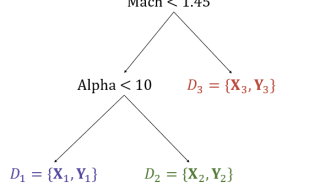
- Treed-GP (TGP) that partitions input space into regions with distinct GP models, enabling axis-aligned regime shifts.
- Deep Gaussian Process (DGP) with elliptical slice sampling (ESS) and Vecchia approximation for scalable, fully Bayesian inference.
- Use of scaled-Vecchia approximation (SVEC) in stationary GP for improved scalability and baseline comparison.
- Implementation of doubly stochastic variational inference (DSVI) in GPflux for comparison, though with limited UQ performance.
Experimental results
Research questions
- RQ1How do non-stationary GP surrogates compare in predictive accuracy and uncertainty quantification on a high-dimensional, real-world computer simulation?
- RQ2What is the impact of fully Bayesian inference on UQ and prediction in non-stationary GP models?
- RQ3Why does variational inference in DGP (DSVI) underperform in low-data, high-signal computer simulation settings?
- RQ4Can local GP or treed-GP methods effectively capture regime shifts in complex physical simulations?
- RQ5How does input pre-scaling affect surrogate model performance across different non-stationary GP methods?
Key findings
- The DGP ESS model achieved the lowest root mean squared error (RMSE) and continuous rank probability score (CRPS), indicating superior predictive accuracy and uncertainty quantification.
- DSVI-based DGP performed poorly in both RMSE and CRPS, likely due to variational inference's tendency to underestimate uncertainty and poor fit in low-data, high-signal regimes.
- Local GP (laGP) performed well but was outperformed by the stationary GP with SVEC, suggesting that its design for massive data may not suit moderate-sized, non-stationary simulations.
- Treed-GP showed strong performance, particularly capturing regime shifts driven by the eighth input (panel-angle), indicating that axis-aligned partitioning aligns well with physical dynamics in the Hubble telescope simulation.
- Fully Bayesian inference in TGP and DGP ESS led to more reliable UQ, underscoring the importance of coherent uncertainty propagation in downstream decision-making.
- Input pre-scaling using lengthscales from the SVEC model improved performance across all methods, confirming its value as a standard preprocessing step.
Read this paper
Open the full text in the Nubint reader and ask about any passage as you read.
Read this paper on NubintThis review was generated by AI from the original paper. Please check the paper before citing it.