
[Paper Review] Norm-based Generalization Bounds for Compositionally Sparse Neural Networks
This paper introduces norm-based generalization bounds for compositionally sparse deep neural networks, such as convolutional and Transformer architectures, by analyzing the Frobenius and spectral norms of individual filters rather than weight matrices. The proposed bounds are significantly tighter than standard norm-based bounds and empirically show strong correlation with actual generalization gaps, suggesting that compositional sparsity—not parameter sharing—is key to the success of modern deep networks.
In this paper, we investigate the Rademacher complexity of deep sparse neural networks, where each neuron receives a small number of inputs. We prove generalization bounds for multilayered sparse ReLU neural networks, including convolutional neural networks. These bounds differ from previous ones, as they consider the norms of the convolutional filters instead of the norms of the associated Toeplitz matrices, independently of weight sharing between neurons. As we show theoretically, these bounds may be orders of magnitude better than standard norm-based generalization bounds and empirically, they are almost non-vacuous in estimating generalization in various simple classification problems. Taken together, these results suggest that compositional sparsity of the underlying target function is critical to the success of deep neural networks.
Motivation & Objective
- To understand why compositionally sparse architectures like CNNs and Transformers generalize better than fully-connected networks.
- To address the limitation of existing norm-based generalization bounds that rely on weight matrix norms and fail to capture architectural inductive biases.
- To investigate whether parameter sharing or compositional sparsity is the primary driver of improved generalization in deep learning.
- To develop a theoretically sound and empirically tight generalization bound that reflects the structural sparsity of modern neural networks.
- To demonstrate that filter-level norms provide a more accurate measure of complexity than matrix-level norms in sparse architectures.
Proposed method
- Derives Rademacher complexity bounds for deep ReLU networks using the Frobenius norm of individual convolutional filters instead of the associated Toeplitz matrices.
- Proposes a generalization bound scaling as $ \rho(w) = \|w^L\|_2 \cdot \prod_{l=1}^{L-1} \|w^l\|_F $, which captures the compositional sparsity of the network.
- Applies weight normalization to control $ \prod_{l=1}^{L} \Vert w^l \Vert_F $, while applying weight decay only to the final layer to regularize $ \rho(w) $.
- Employs stochastic gradient descent with cosine learning rate scheduling and MSE loss for training on synthetic CIFAR-5m data with varying sample sizes.
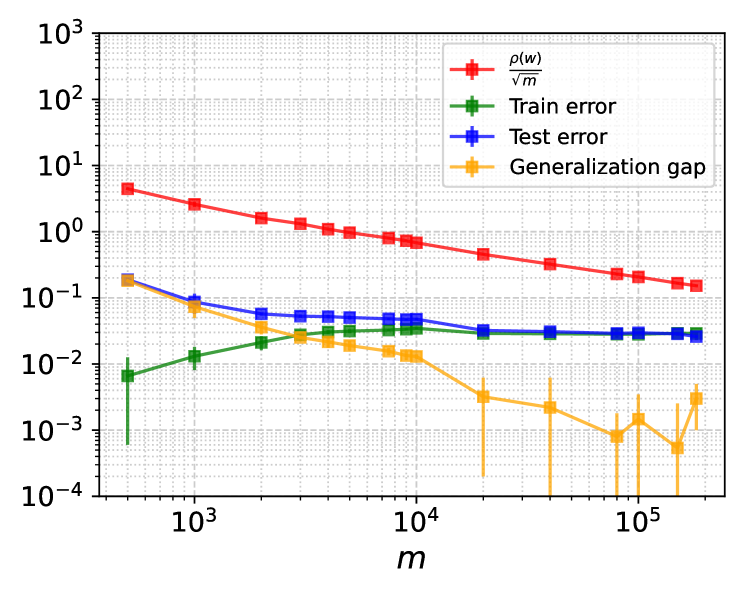
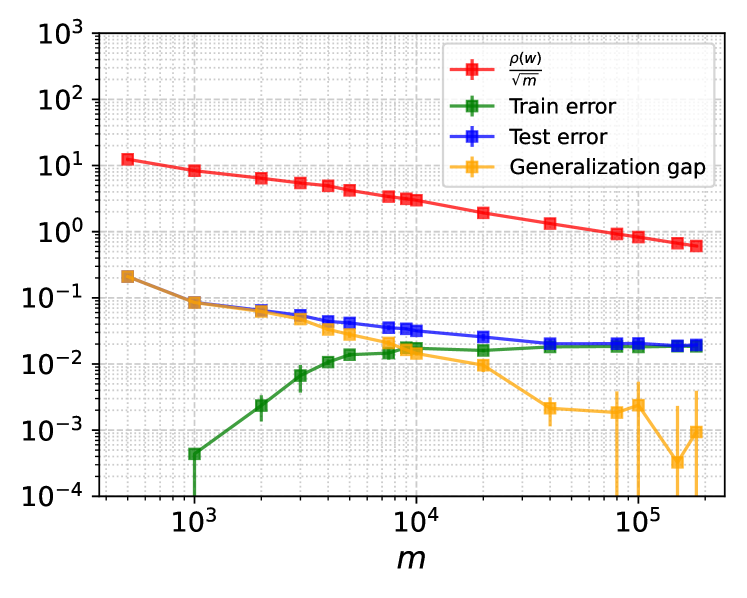
- Estimates generalization gap using 1000 test samples per class and compares $ \rho(w)/\sqrt{m} $ to actual train-test error differences.
- Analyzes two network architectures: one with a single final fully connected layer and another with a two-layer head, to assess sensitivity to model capacity.
Experimental results
Research questions
- RQ1Why do compositionally sparse architectures like CNNs and Transformers generalize better than fully-connected networks despite similar overparameterization?
- RQ2Is parameter sharing in convolutional layers necessary for improved generalization, or is compositional sparsity sufficient?
- RQ3Can norm-based generalization bounds be significantly improved by focusing on filter-level norms rather than matrix-level norms?
- RQ4How tight is the proposed bound $ \rho(w)/\sqrt{m} $ in estimating the actual generalization gap across varying training set sizes?
- RQ5Does $ \rho(w) $ remain bounded as training set size $ m $ increases, suggesting a $ \mathcal{O}(1/\sqrt{m}) $ decay in the bound?
Key findings
- The proposed generalization bound $ \rho(w)/\sqrt{m} $ is empirically non-vacuous and tightly estimates the actual generalization gap across various training set sizes.
- For $ m > 10,000 $, $ \rho(w)/\sqrt{m} < 1 $, indicating that the bound remains meaningful even in overparameterized regimes.
- The quantity $ \rho(w) $ remains bounded as $ m $ increases, suggesting that the bound decays at a rate of $ \mathcal{O}(1/\sqrt{m}) $, consistent with theoretical expectations.
- The bound is orders of magnitude tighter than standard norm-based bounds that use the product of spectral or Frobenius norms of weight matrices.
- The results suggest that compositional sparsity—where each neuron receives only a few inputs—is a more critical factor than parameter sharing for generalization in deep networks.
- The theory is empirically validated on simple classification tasks, showing that the bound is not vacuous and reflects real-world performance trends.
Read this paper
Open the full text in the Nubint reader and ask about any passage as you read.
Read this paper on NubintThis review was generated by AI from the original paper. Please check the paper before citing it.