
[Paper Review] Normalized Validity Scores for DNNs in Regression based Eye Feature Extraction
This paper proposes a normalized validity loss for deep neural networks in regression-based eye feature extraction, improving landmark detection accuracy by balancing inaccuracy losses through area normalization and reducing noise from negligible errors via a margin-based gradient suppression. The method significantly boosts MIoU scores across pupil, iris, and eyelid segmentation, with up to 0.15 improvement in segmentation accuracy and enhanced outlier detection capability.
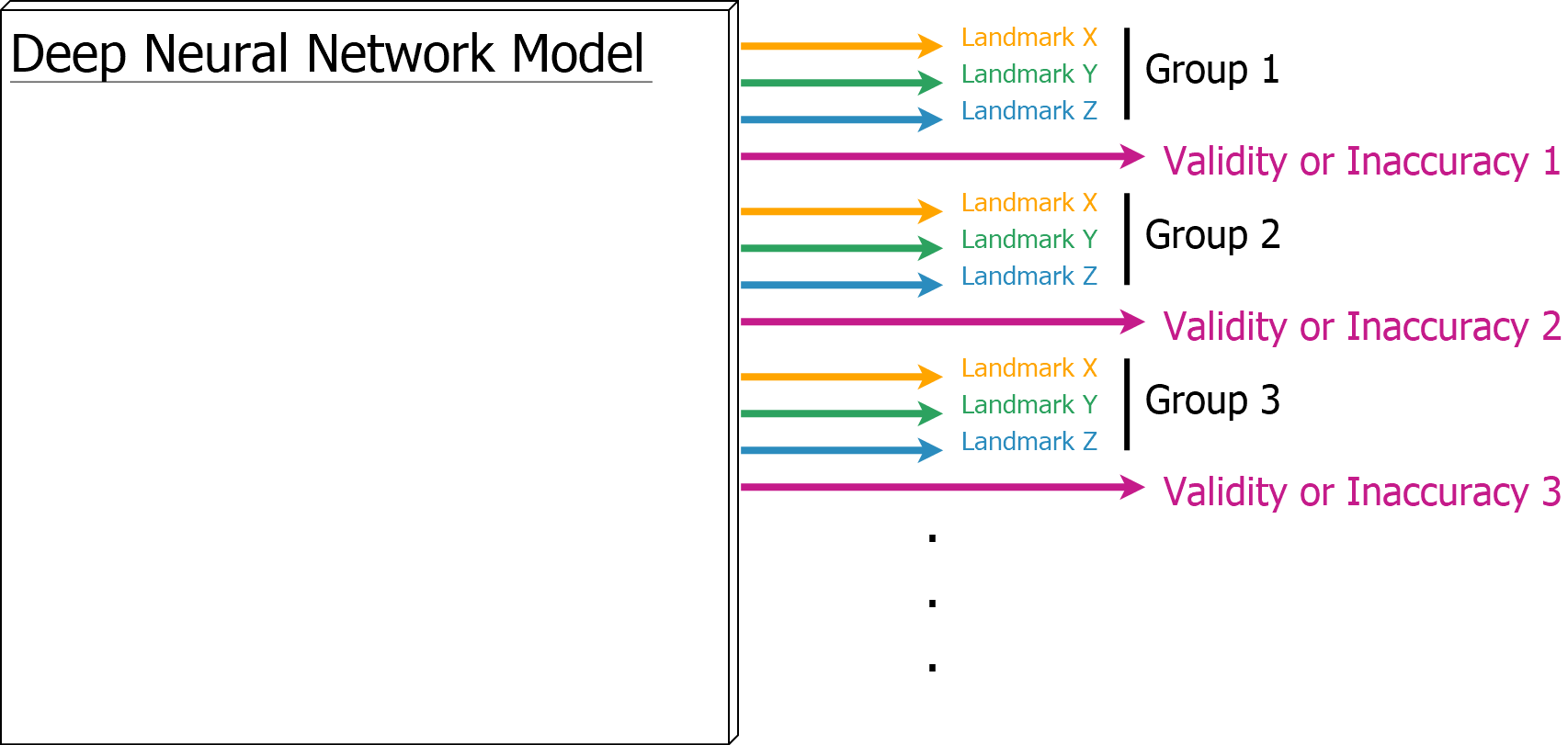
We propose an improvement to the landmark validity loss. Landmark detection is widely used in head pose estimation, eyelid shape extraction, as well as pupil and iris segmentation. There are numerous additional applications where landmark detection is used to estimate the shape of complex objects. One part of this process is the accurate and fine-grained detection of the shape. The other part is the validity or inaccuracy per landmark, which can be used to detect unreliable areas, where the shape possibly does not fit, and to improve the accuracy of the entire shape extraction by excluding inaccurate landmarks. We propose a normalization in the loss formulation, which improves the accuracy of the entire approach due to the numerical balance of the normalized inaccuracy. In addition, we propose a margin for the inaccuracy to reduce the impact of gradients, which are produced by negligible errors close to the ground truth.
Motivation & Objective
- To address the lack of self-assessment in landmark detection models, where networks cannot estimate their own inaccuracy.
- To improve the robustness and accuracy of regression-based eye feature extraction by incorporating inaccuracy estimation into the loss function.
- To enable more reliable shape reconstruction by identifying and downweighting unreliable landmarks through a normalized inaccuracy loss.
- To evaluate the impact of the proposed loss formulation on segmentation accuracy and outlier detection performance.
- To explore generalization potential beyond eye tracking, particularly for other landmark-based applications.
Proposed method
- Introduces an extended joint landmark inaccuracy loss function that normalizes error contributions by the area of the shape being estimated.
- Applies a margin-based approach to suppress gradients from inaccuracy estimates that are very close to the ground truth, reducing noise in backpropagation.
- Uses area normalization via the ratio of the current shape area to the minimum area (AREA/min(AREA)) to balance errors across shapes of varying sizes.
- Employs a Euclidean space-based formulation (Equation 3) to improve stability and performance in landmark inaccuracy estimation.
- Trains multiple deep learning architectures (e.g., ResNet, Hourglass) using the proposed loss and compares performance against baseline and prior formulations.
- Evaluates the inaccuracy signal's utility for outlier detection by measuring improvements in segmentation metrics (MIoU) when inaccurate landmarks are excluded.

Experimental results
Research questions
- RQ1How does normalizing the inaccuracy loss by shape area affect the performance of landmark detection in eye feature extraction?
- RQ2To what extent does applying a margin to small inaccuracy gradients improve model convergence and accuracy?
- RQ3Can the proposed loss formulation enhance the reliability of landmark-based shape reconstruction by enabling better outlier detection?
- RQ4How does the proposed method compare to the original validity loss formulation in terms of segmentation accuracy (MIoU) across pupil, iris, and eyelid regions?
- RQ5Does the normalization of inaccuracy loss lead to more stable and generalizable performance across different shape sizes?
Key findings
- The proposed normalized inaccuracy loss (Equation 3) outperforms both the original formulation and Equation 2, achieving a 0.15, 0.14, and 0.11 improvement in MIoU for pupil, iris, and eyelid segmentation, respectively.
- The normalization factor based on area ratio significantly reduces the dominance of larger shapes in the loss, leading to more balanced error distribution and improved performance on smaller features.
- The margin-based gradient suppression effectively reduces noise from negligible errors, contributing to more stable training and better convergence.
- The inaccuracy signal generated by the model enables effective outlier detection, with the largest performance gains observed in the eyelid and iris regions due to improved reliability of landmark estimates.
- The method demonstrates consistent improvements across multiple architectures and tasks, confirming its robustness and generalization potential in eye feature extraction.
- Despite limitations in evaluating vision transformers and non-eye applications, the approach shows strong potential for broader use in landmark-based computer vision tasks.
Read this paper
Open the full text in the Nubint reader and ask about any passage as you read.
Read this paper on NubintThis review was generated by AI from the original paper. Please check the paper before citing it.