
[Paper Review] Not All Language Model Features Are One-Dimensionally Linear
This paper challenges the linear representation hypothesis in language models by demonstrating that some features—particularly circular representations for cyclical concepts like days of the week and months of the year—are inherently multi-dimensional and irreducible. Using sparse autoencoders, the authors discover and validate these features in GPT-2 and Mistral 7B, showing through intervention experiments that they are fundamental to solving modular arithmetic tasks in Llama 3 8B and Mistral 7B.
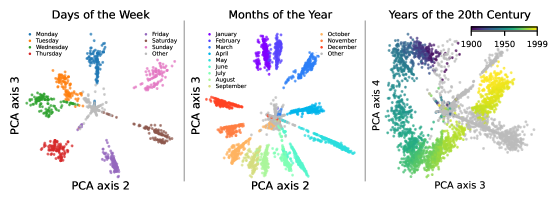
Recent work has proposed that language models perform computation by manipulating one-dimensional representations of concepts ("features") in activation space. In contrast, we explore whether some language model representations may be inherently multi-dimensional. We begin by developing a rigorous definition of irreducible multi-dimensional features based on whether they can be decomposed into either independent or non-co-occurring lower-dimensional features. Motivated by these definitions, we design a scalable method that uses sparse autoencoders to automatically find multi-dimensional features in GPT-2 and Mistral 7B. These auto-discovered features include strikingly interpretable examples, e.g. circular features representing days of the week and months of the year. We identify tasks where these exact circles are used to solve computational problems involving modular arithmetic in days of the week and months of the year. Next, we provide evidence that these circular features are indeed the fundamental unit of computation in these tasks with intervention experiments on Mistral 7B and Llama 3 8B, and we examine the continuity of the days of the week feature in Mistral 7B. Overall, our work argues that understanding multi-dimensional features is necessary to mechanistically decompose some model behaviors.
Motivation & Objective
- To challenge the linear representation hypothesis, which assumes all language model features are one-dimensional.
- To define and identify irreducible multi-dimensional features, particularly circular manifolds, in large language models.
- To demonstrate that such features are not just artifacts but fundamental computational units in tasks involving modular arithmetic.
- To develop and apply a scalable method for discovering multi-dimensional features using sparse autoencoders.
- To validate through intervention experiments that circular features are essential for solving modular addition tasks in days and months.
Proposed method
- Propose a formal definition of irreducible multi-dimensional features based on non-decomposability into independent or non-co-occurring lower-dimensional features.
- Design a scalable method using sparse autoencoders (SAEs) to automatically discover multi-dimensional features in activation space of GPT-2 and Mistral 7B.
- Apply clustering to SAE dictionary elements to identify circular manifolds representing cyclical concepts like days of the week and months of the year.
- Construct two tasks—modular addition over days of the week and months of the year—to probe model behavior and test feature usage.
- Perform intervention experiments on Mistral 7B and Llama 3 8B using activation patching and EVR (Explained Variance Ratio) to assess feature contribution.
- Deconstruct hidden states via iterative decomposition to reveal interpretable circular representations in the model’s internal computations.
Experimental results
Research questions
- RQ1Can language models use irreducible multi-dimensional features, such as circular manifolds, for representing cyclical concepts like days of the week and months of the year?
- RQ2Are these circular features fundamental to solving modular arithmetic tasks, or are they redundant representations?
- RQ3Do intervention experiments confirm that circular features are the primary computational units in modular addition tasks?
- RQ4Can sparse autoencoders reliably discover and isolate such multi-dimensional features in large language models?
- RQ5Do the hidden states of LLMs decompose into interpretable components that include circular representations for cyclical data?
Key findings
- The authors discovered circular representations for days of the week and months of the year in GPT-2-small and Mistral 7B using sparse autoencoders, with points on the circle corresponding to specific tokens.
- Intervention experiments on Mistral 7B and Llama 3 8B show that circular features are essential for solving modular addition tasks, as removing or disrupting them significantly degrades performance.
- EVR analysis confirmed that adding the circular feature γ to explanatory variables increased explained variance from ~0.7 to ~0.99 in key layers, indicating high explanatory power.
- Attention heads were found not to compute or propagate the circular feature γ, as adding γ to explanatory functions provided no additional variance explanation before layer 25.
- The model computes γ in the MLP blocks between layers 20 and 25, with the highest intervention effects observed in these layers, confirming MLPs as the primary computation source.
- Hidden state deconstruction revealed that the model’s internal representations for days and months form coherent circular manifolds, supporting the existence of multi-dimensional computation.
Read this paper
Open the full text in the Nubint reader and ask about any passage as you read.
Read this paper on NubintThis review was generated by AI from the original paper. Please check the paper before citing it.