
[Paper Review] Nucleosynthesis in jet-driven and jet-associated supernovae
This paper investigates nucleosynthesis in jet-driven and jet-associated supernovae, showing that magnetorotational explosion mechanisms in rapidly rotating, strongly magnetized massive stars can produce enhanced 56Ni yields and enable a limited r-process, contributing to early galactic enrichment. These events, including hypernovae and long gamma-ray burst-powered collapsars, offer a viable site for heavy element production due to neutron-rich outflows and relativistic jets.
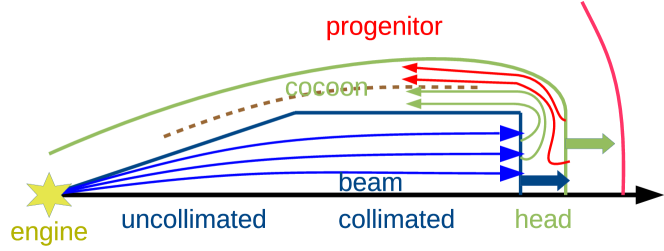
In contrast to regular core-collapse supernovae, explosions of rapidly rotating massive stars can develop jets, fast collimated outflows directed along the rotational axis. Depending on the rate of rotation and the magnetic field strength before collapse as well as on possible mechanisms amplifying the magnetic field, such a core can explode magnetorotationally rather than via the standard supernova mechanism based on neutrino heating. This scenario can explain the highest kinetic energies observed in the class of hypernovae. On longer time scales, rotation and magnetic fields can play an important role in the engine of long gamma-ray burst powered by proto-magnetars or hyperaccreting black holes in collapsars. Both classes of events are characterized by relativistic jets and winds driven by neutrinos or magnetic spin-down of the central objects. The nucleosynthesis in these events includes the production of Fe group elements, including a possibly enhanced synthesis of radioactive 56Ni leading to high peak luminosities. Additionally, these events are, out of all stellar core-collapse events the ones most likely to allow for the formation of the heaviest nuclei via rapid neutron captures. Increasingly sophisticated numerical simulations indicate that at least a limited r-process is possible, though it remains open how robust this result is against variations in the numerical methods and the initial conditions. If so, supernovae with jets could contribute to the observed galactic chemical enrichment, in particular at early times before neutron-star mergers might be able to set in.
Motivation & Objective
- To understand the nucleosynthetic yields in jet-driven and jet-associated core-collapse supernovae, particularly those involving relativistic jets and magnetar-like engines.
- To assess the role of rapid rotation and strong magnetic fields in enabling enhanced 56Ni production and neutron-rich outflows favorable for the r-process.
- To evaluate the contribution of these events to galactic chemical enrichment, especially in the early universe where low-metallicity conditions favor high angular momentum retention.
- To identify the conditions under which a limited r-process can occur in such environments, despite uncertainties in numerical simulations.
- To compare the nucleosynthetic output of jet-driven supernovae with other r-process sites like neutron star mergers, focusing on delay times and event rarity.
Proposed method
- Numerical simulations of core-collapse supernovae with varying initial conditions, including rotation rates, magnetic field strengths, and progenitor masses.
- Modeling of magnetorotational explosion mechanisms where magnetic energy and angular momentum drive jet formation, overcoming neutrino-driven shock stall.
- Incorporation of multi-dimensional hydrodynamics with neutrino transport and equation of state (EOS) models to simulate PNS wind and accretion disk evolution.
- Use of nuclear reaction networks to track isotopic yields, particularly 56Ni and r-process nuclides, in ejecta from jetted and magnetized outflows.
- Analysis of wind and jet properties in collapsar scenarios involving proto-magnetars or hyperaccreting black holes, focusing on electron fraction and neutron richness.
- Comparison of nucleosynthetic outcomes with galactic chemical evolution data and observational constraints from SLSNe and long GRBs.
Experimental results
Research questions
- RQ1Can jet-driven explosions in rapidly rotating, magnetized massive stars produce sufficient 56Ni to explain the high luminosities observed in hypernovae and superluminous SNe?
- RQ2To what extent can the r-process occur in the neutron-rich outflows of jet-driven supernovae, and how robust is this process across different simulation setups?
- RQ3How do the nucleosynthetic yields of jet-associated supernovae compare to those of neutron star mergers in terms of timing, yield, and contribution to early galactic enrichment?
- RQ4What role do magnetic field amplification and rotational energy play in enabling successful explosions and jet formation in massive stars?
- RQ5What observational signatures can distinguish jet-driven supernovae from standard core-collapse supernovae, particularly in terms of elemental abundances and light curves?
Key findings
- Jet-driven explosions in rapidly rotating, magnetized massive stars can produce kinetic energies up to an order of magnitude higher than standard core-collapse supernovae, reaching values consistent with hypernovae.
- These events can synthesize significantly enhanced masses of 56Ni—up to several times the canonical 0.01–0.1 M☉—leading to high peak luminosities observed in superluminous and hypernovae.
- The neutron-rich conditions in jetted and magnetized outflows allow for a limited r-process, enabling the production of heavy nuclei up to the second and third r-peak, though the yield remains uncertain and sensitive to initial conditions.
- The combination of high explosion energy, enhanced 56Ni, and neutron-rich ejecta makes jet-driven supernovae strong candidates for early galactic r-process enrichment, particularly in low-metallicity environments.
- Theoretical models suggest that such events are rare due to the stringent requirements on initial rotation and magnetic fields, but these conditions are more easily met in the early universe due to reduced mass loss.
- Despite the lack of direct observational confirmation, galactic chemical evolution data support the idea that rare, short-delay-time events like jet-driven supernovae played a significant role in early nucleosynthesis.
Better researchstarts right now
From reading papers to final review, dramatically reduce your research time.
No credit card · Free plan available
This review was created by AI and reviewed by human editors.