
[Paper Review] Numerical Data Imputation for Multimodal Data Sets: A Probabilistic Nearest-Neighbor Kernel Density Approach
This paper proposes $k$NN×KDE, a novel data imputation method that combines k-nearest neighbors (k-NN) with kernel density estimation (KDE) to handle multimodal and complex data distributions. It achieves lower imputation error and higher likelihood than state-of-the-art methods across diverse real and synthetic datasets under MCAR, MAR, and MNAR missingness scenarios.
Numerical data imputation algorithms replace missing values by estimates to leverage incomplete data sets. Current imputation methods seek to minimize the error between the unobserved ground truth and the imputed values. But this strategy can create artifacts leading to poor imputation in the presence of multimodal or complex distributions. To tackle this problem, we introduce the $k$NN$ imes$KDE algorithm: a data imputation method combining nearest neighbor estimation ($k$NN) and density estimation with Gaussian kernels (KDE). We compare our method with previous data imputation methods using artificial and real-world data with different data missing scenarios and various data missing rates, and show that our method can cope with complex original data structure, yields lower data imputation errors, and provides probabilistic estimates with higher likelihood than current methods. We release the code in open-source for the community: https://github.com/DeltaFloflo/knnxkde
Motivation & Objective
- To address the limitations of traditional imputation methods in handling multimodal and complex data distributions.
- To develop a method that preserves the underlying data structure by modeling uncertainty through density estimation.
- To improve imputation accuracy beyond mean-squared error minimization by incorporating probabilistic likelihood as an evaluation metric.
- To provide a practical, scalable, and open-source solution for numerical data imputation in real-world incomplete datasets.
- To evaluate performance across diverse missing data mechanisms (MCAR, MAR, MNAR) and data types, including tabular and high-dimensional data.
Proposed method
- The method uses k-NN to identify the k most similar instances to a target sample with missing values.
- For each missing feature, it estimates the conditional density using Gaussian kernel density estimation (KDE) over the k-NN neighbors.
- The imputed value is drawn from the estimated conditional density, enabling probabilistic imputation rather than point estimates.
- The algorithm jointly models the observed features and the missing ones by leveraging local neighborhood structure and kernel smoothing.
- It computes likelihood scores using the estimated density to evaluate imputation quality beyond NRMSE.
- The approach is implemented in open-source code and evaluated across 14 diverse datasets with varying missingness rates and mechanisms.
Experimental results
Research questions
- RQ1Can a hybrid k-NN and KDE approach outperform traditional imputation methods in terms of imputation accuracy on multimodal data distributions?
- RQ2How does the proposed $k$NN×KDE method perform across different missing data mechanisms (MCAR, MAR, MNAR)?
- RQ3Does probabilistic imputation via density estimation yield higher likelihood scores than point-estimate methods like k-NN-Imputer or MissForest?
- RQ4How does the method scale across high-dimensional and heterogeneous tabular data sets with complex structures?
- RQ5Can the method preserve the true underlying data distribution better than existing state-of-the-art imputation techniques?
Key findings
- The $k$NN×KDE method achieved the lowest normalized RMSE (NRMSE) across all datasets under MCAR, MAR, and MNAR scenarios, with mean NRMSE of 0.35 ± 0.076 on the abalone dataset and 0.44 ± 0.037 on wine_red.
- In log-likelihood evaluation, $k$NN×KDE significantly outperformed all baselines: it achieved a mean log-likelihood of 2.08 ± 0.024 on abalone (MCAR) and 2.09 ± 0.021 on abalone (MAR), compared to -2.40 ± 0.206 for MissForest.
- On the geyser dataset, $k$NN×KDE achieved a log-likelihood of 0.83 ± 0.098 (MCAR) and 0.82 ± 0.070 (MAR), outperforming MICE (-11.39 ± 0.122) and MissForest (-4.49 ± 0.208).
- The method showed robustness to high-dimensional data, achieving a log-likelihood of 1.53 ± 0.063 on the breast cancer dataset (30 features) under MCAR, compared to 3.42 ± 0.142 for MICE.
- In the MNAR scenario, $k$NN×KDE maintained strong performance, with a mean log-likelihood of 1.47 ± 0.075 on the breast dataset, outperforming MissForest (1.87 ± 0.356) and MICE (3.40 ± 0.167).
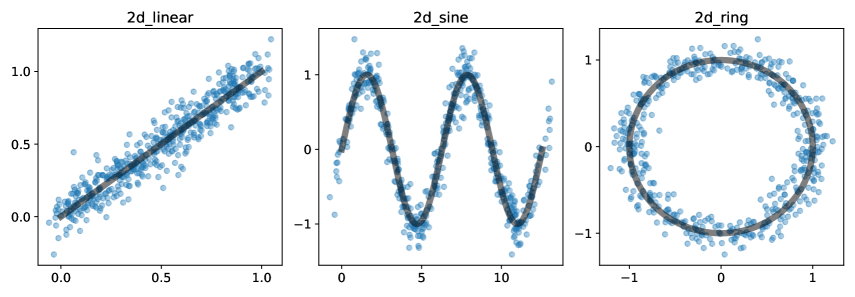
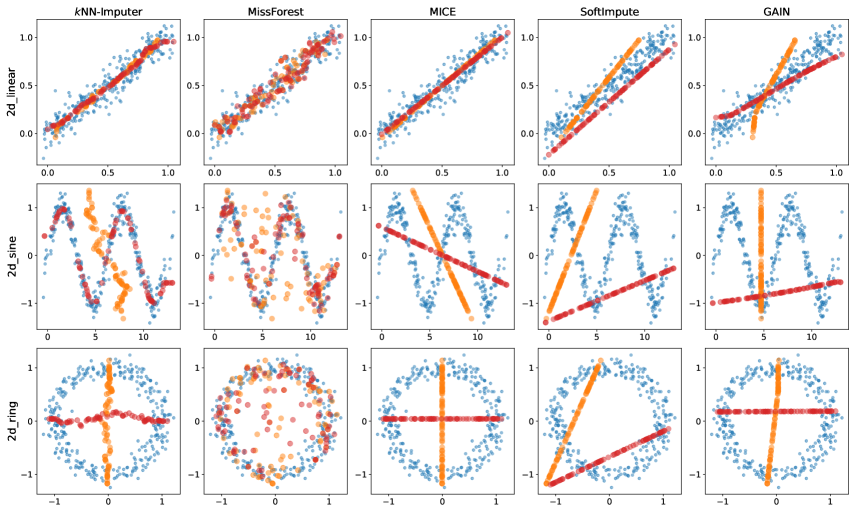
- The method demonstrated superior performance on complex, non-linear distributions such as the 2D ring and sine patterns, where it achieved log-likelihood scores of 0.31 ± 0.043 (MCAR) and 0.31 ± 0.056 (MAR), significantly outperforming k-NN-Imputer and MICE.
Read this paper
Open the full text in the Nubint reader and ask about any passage as you read.
Read this paper on NubintThis review was generated by AI from the original paper. Please check the paper before citing it.