
[Paper Review] OBELICS: An Open Web-Scale Filtered Dataset of Interleaved Image-Text Documents
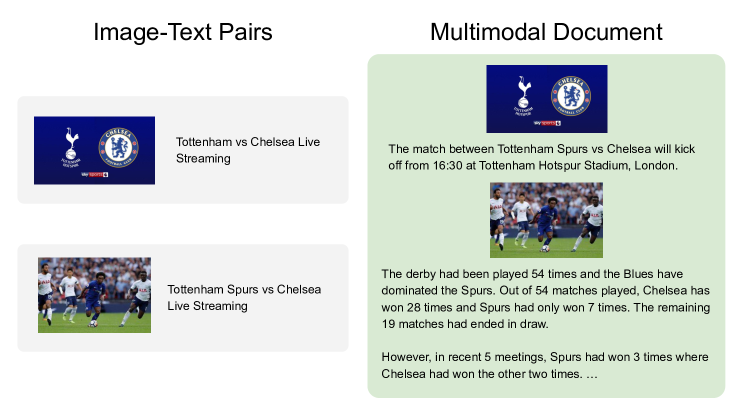
OBELICS is an open, web-scale dataset of interleaved image-text documents with 141M multimodal HTML documents, 353M images, and 115B tokens, plus open-source models (IDEFICS) trained on it showing competitive multimodal benchmarks.
Large multimodal models trained on natural documents, which interleave images and text, outperform models trained on image-text pairs on various multimodal benchmarks. However, the datasets used to train these models have not been released, and the collection process has not been fully specified. We introduce the OBELICS dataset, an open web-scale filtered dataset of interleaved image-text documents comprising 141 million web pages extracted from Common Crawl, 353 million associated images, and 115 billion text tokens. We describe the dataset creation process, present comprehensive filtering rules, and provide an analysis of the dataset's content. To show the viability of OBELICS, we train vision and language models of 9 and 80 billion parameters named IDEFICS, and obtain competitive performance on different multimodal benchmarks. We release our dataset, models and code.
Motivation & Objective
- Provide a large-scale, open, filtered collection of multimodal web documents that preserves page structure and context.
- Describe filtering, deduplication, and privacy/safety measures to curate high-quality data.
- Demonstrate the utility of OBELICS by training a Flamingo-like model (IDEFICS) and comparing against closed datasets.
- Release dataset, models, and code to support open research in multimodal learning.
Proposed method
- Collect English content from the latest Common Crawl snapshots (Feb 2020–Feb 2023)
- Simplify HTML to preserve document structure while removing spam/ads
- Extract interleaved multimodal documents preserving DOM-based line breaks
- Apply node- and paragraph-level filtering, followed by document-level filtering
- Perform responsible filtering including opt-out image removal, image deduplication, NSFW filtering, and multi-level deduplication
- Train Flamingo-like models (IDEFICS) on OBELICS and compare to image-text-pair baselines on multimodal benchmarks
Experimental results
Research questions
- RQ1Can a publicly released, web-scale multimodal dataset of interleaved image-text documents reach quality and diversity comparable to closed datasets?
- RQ2Do models trained on interleaved multimodal web documents (vs. image-text pairs) achieve competitive performance on standard multimodal benchmarks?
- RQ3What is the impact of open data on model performance across VQA, OCR, hate speech detection, and multimodal reasoning tasks?
- RQ4How do filtering, deduplication, and consent-based filtering affect data quality and downstream model outcomes?
Key findings
- OBELICS contains 141 million documents, 353 million images, and 115 billion tokens after filtering and deduplication.
- Images from OBELICS are largely unique (84.3% unique images) and documents show a relatively balanced text-to-image composition (median 1 image per document, median 677 tokens).
- Perplexity analysis shows OBELICS text resembles Wikipedia-like quality more than c4/mmc4/OSCAR and is closer to The Pile in diversity and quality.
- Qualitative inspection indicates majority of images relate to text content (90%), with 46% containing faces and 30% containing images with written content; NSFW content is largely filtered.
- IDEFICS (80B) achieves competitive performance against Flamingo on several multimodal benchmarks when trained on a mixture of OBELICS and other data; at 9B, OBELICS-based models outperform certain baselines like OpenFlamingo-9B on aggregated metrics, highlighting the value of open multimodal web documents.
- Training on multimodal documents can achieve similar or better performance with fewer images compared to image-text-pair-only training, emphasizing longer text context advantages.

Read this paper
Open the full text in the Nubint reader and ask about any passage as you read.
Read this paper on NubintThis review was generated by AI from the original paper. Please check the paper before citing it.