
[Paper Review] Objaverse-XL: A Universe of 10M+ 3D Objects
Objaverse-XL is a web-scale dataset with 10.2M+ deduplicated 3D objects from diverse sources, enabling large-scale 3D pretraining and improved zero-shot novel-view synthesis (Zero123-XL and PixelNeRF).
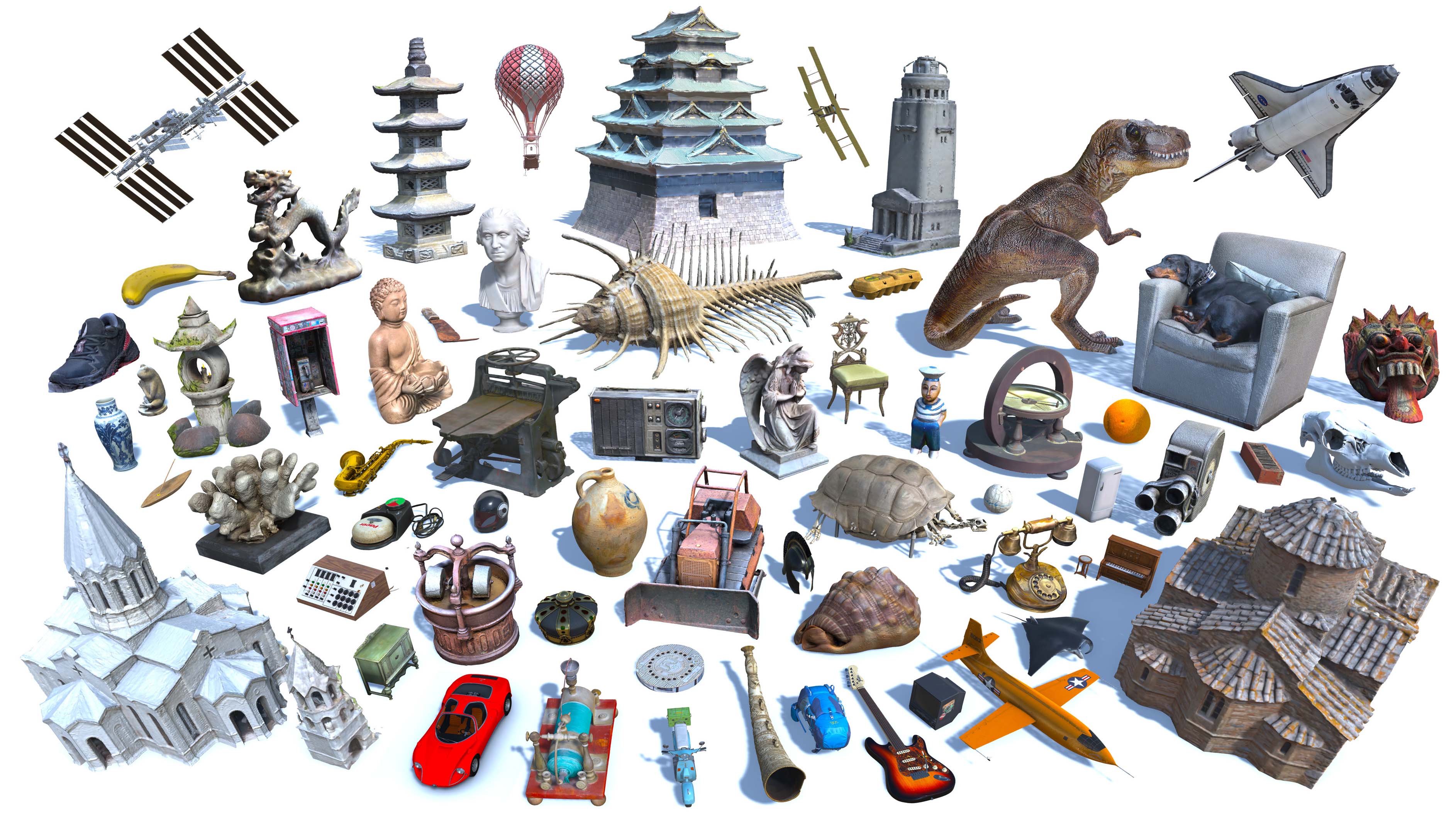
Natural language processing and 2D vision models have attained remarkable proficiency on many tasks primarily by escalating the scale of training data. However, 3D vision tasks have not seen the same progress, in part due to the challenges of acquiring high-quality 3D data. In this work, we present Objaverse-XL, a dataset of over 10 million 3D objects. Our dataset comprises deduplicated 3D objects from a diverse set of sources, including manually designed objects, photogrammetry scans of landmarks and everyday items, and professional scans of historic and antique artifacts. Representing the largest scale and diversity in the realm of 3D datasets, Objaverse-XL enables significant new possibilities for 3D vision. Our experiments demonstrate the improvements enabled with the scale provided by Objaverse-XL. We show that by training Zero123 on novel view synthesis, utilizing over 100 million multi-view rendered images, we achieve strong zero-shot generalization abilities. We hope that releasing Objaverse-XL will enable further innovations in the field of 3D vision at scale.
Motivation & Objective
- Address data scarcity in 3D vision by assembling a large-scale, diverse 3D object corpus from web sources.
- Provide comprehensive metadata and render-derived features to support scalable 3D learning and evaluation.
- Demonstrate the impact of scale on 3D pretraining by training and evaluating state-of-the-art 3D models.
- Assess data quality interventions (e.g., NSFW filtering, alignment finetuning) and their effect on downstream 3D tasks.
Proposed method
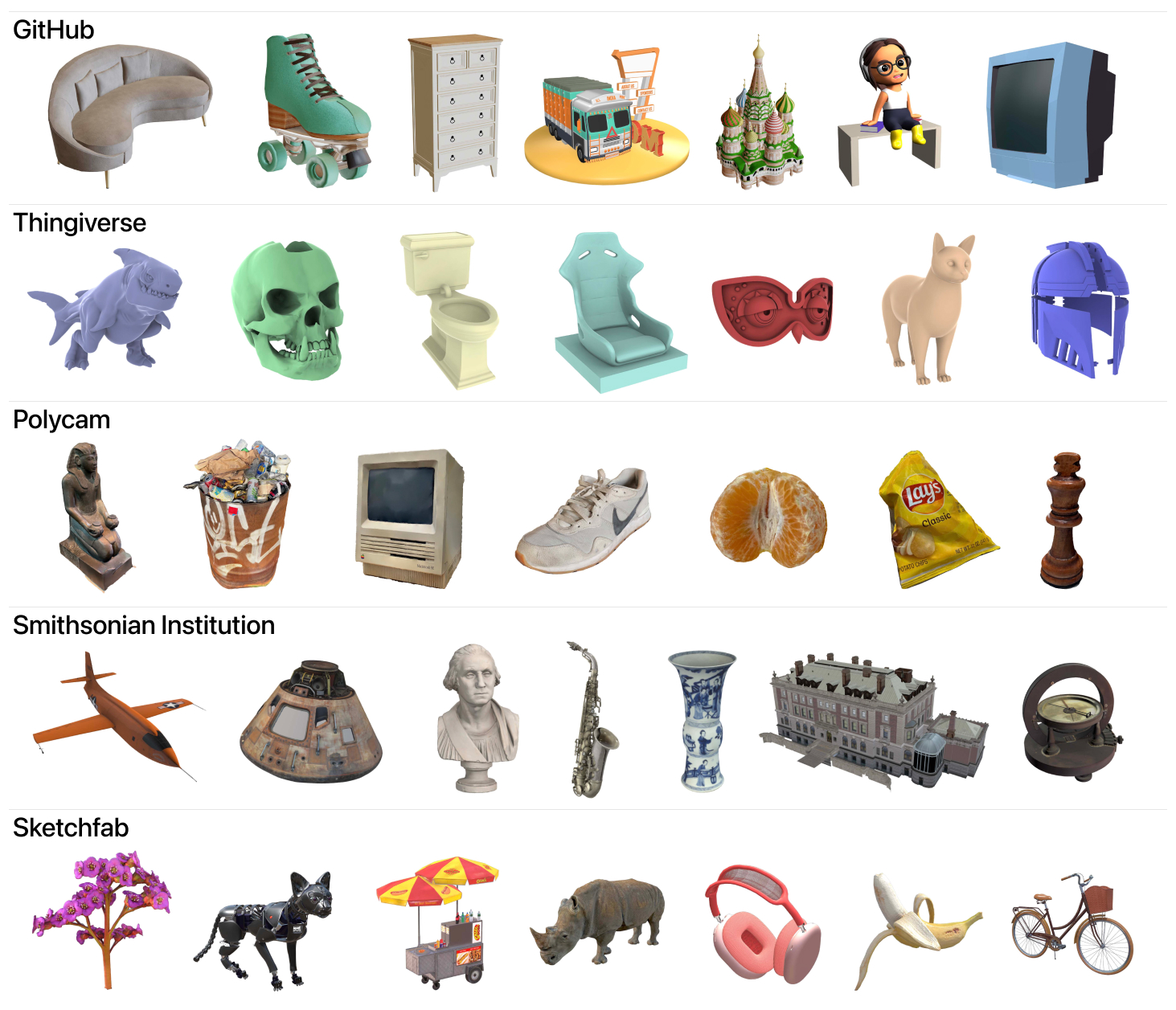
- Crawl and deduplicate 3D objects from GitHub, Thingiverse, Sketchfab, Polycam, Smithsonian, and other sources to construct Objaverse-XL.
- Render 2D views of objects in Blender and extract metadata (polygon/vertex counts, materials, textures, etc.).
- Compute CLIP ViT-L/14 embeddings from multiple renders to derive object-level metadata and quality proxies.
- Apply NSFW filtering using multi-view renders and a CLIP-based classifier; detect faces and assess render quality (holes).
- Train Zero123-XL (view-conditioned diffusion model) on Objaverse-XL and perform alignment finetuning on a high-quality subset to improve zero-shot generalization.
- Train PixelNeRF on Objaverse-XL at scale to evaluate novel-view synthesis generalization across objects and scenes.
Experimental results
Research questions
- RQ1Does scaling to 10.2M 3D objects improve zero-shot generalization for novel-view synthesis compared to smaller Objaverse datasets?
- RQ2What is the impact of finetuning on a high-quality alignment subset on zero-shot view synthesis performance?
- RQ3How does pretraining Objaverse-XL on PixelNeRF affect PSNR/ShapeNet/DTU generalization versus training from scratch?
- RQ4What are the characteristics and quality considerations (NSFW, faces, render holes) observed in Objaverse-XL at scale?
- RQ5To what extent do diverse sources (GitHub, Thingiverse, Sketchfab, Polycam, Smithsonian) contribute to model performance and generalization?
Key findings
- Zero123-XL trained on Objaverse-XL achieves better zero-shot generalization than when trained on Objaverse-1.0, with notable improvements in challenging categories like people, cartoons, and sketches.
- Alignment finetuning on a high-quality 1.3M-object subset yields substantial gains in zero-shot generalization (see table values).
- For Zero123-XL, base metrics: PSNR 18.225, SSIM 0.877, LPIPS 0.088, FID 0.070; with alignment finetuning: PSNR 19.876, SSIM 0.888, LPIPS 0.075, FID 0.056.
- PixelNeRF trained with Objaverse-XL shows improved PSNR on DTU and ShapeNet: DTU 15.32 (base) vs 17.53±0.37 (with Objaverse-XL), ShapeNet 22.71 (base) vs 24.22±0.55 (with Objaverse-XL).
- Objaverse-XL contains 10.2M unique objects after deduplication, rendering 5.5M files successfully from over 500k GitHub repositories (from an initial 37M indexed 3D-object files).
- Objaverse-XL enables improved generalization and scale benefits for 3D tasks such as novel view synthesis and 3D generation without changing architectures, illustrating scaling laws in 3D vision similar to 2D domains.
Read this paper
Open the full text in the Nubint reader and ask about any passage as you read.
Read this paper on NubintThis review was generated by AI from the original paper. Please check the paper before citing it.