
[Paper Review] Observation of non-Hermitian edge burst in quantum dynamics
This paper experimentally observes the non-Hermitian edge burst—a dynamic phenomenon in lossy quantum walks where photon loss sharply accumulates at system boundaries, defying classical intuition. Using photonic quantum walks, the authors demonstrate that loss localization at the edge intensifies with increasing initial distance from the boundary, revealing a novel bulk-edge scaling relation rooted in non-Hermitian topology and spectral gaps.
The non-Hermitian skin effect, by which the eigenstates of Hamiltonian are predominantly localized at the boundary, has revealed a strong sensitivity of non-Hermitian systems to the boundary condition. Here we experimentally observe a striking boundary-induced dynamical phenomenon known as the non-Hermitian edge burst, which is characterized by a sharp boundary accumulation of loss in non-Hermitian time evolutions. In contrast to the eigenstate localization, the edge burst represents a generic non-Hermitian dynamical phenomenon that occurs in real time. Our experiment, based on photonic quantum walks, not only confirms the prediction of the phenomenon, but also unveils its complete space-time dynamics. Our observation of edge burst paves the way for studying the rich real-time dynamics in non-Hermitian topological systems.
Motivation & Objective
- To experimentally observe a non-Hermitian dynamical phenomenon—edge burst—where loss accumulates sharply at boundaries during time evolution.
- To distinguish edge burst from the non-Hermitian skin effect by identifying the additional role of the imaginary gap in enabling the phenomenon.
- To characterize the real-time space-time dynamics of loss in non-Hermitian systems using a photonic quantum walk platform.
- To validate a theoretical bulk-edge scaling relation linking edge burst strength to initial position distance from the boundary.
Proposed method
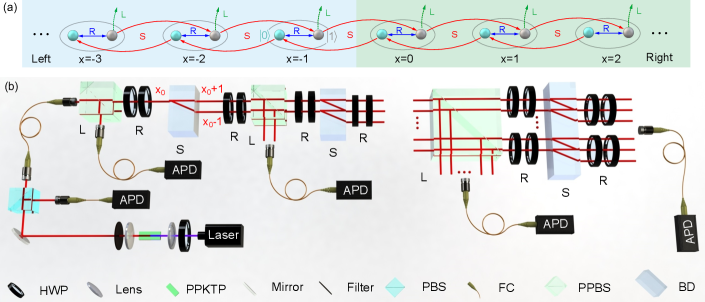
- The experiment uses a discrete-time photonic quantum walk with a Floquet Hamiltonian incorporating non-Hermitian loss via a partially polarizing beam splitter.
- Coin operations are implemented using half-wave plates at specific angles to realize rotation angles θ₁/₂ and γ, controlling the non-Hermitian parameters.
- The system is initialized with a single photon in a spatial mode x₀ and coin state |0⟩, with loss applied selectively to |1⟩ states.
- Space-time-resolved loss probability p(x,t) is measured via coincidence counting between heralded walker photons and trigger photons.
- Survival probability |ψ(x,t)|² is calculated from photon counts to track loss dynamics at each position and time step.
- The relative edge burst strength is quantified as P_domain / P_min, where P_domain is loss at the domain wall and P_min is the minimum loss in the interval from x₀ to x = -1.
Experimental results
Research questions
- RQ1Does a non-Hermitian system exhibit a dynamic boundary effect where loss accumulates at the edge despite initial localization far from it?
- RQ2What conditions beyond the non-Hermitian skin effect are necessary for the emergence of edge burst?
- RQ3How does the strength of the edge burst scale with the initial distance from the boundary?
- RQ4Can a novel bulk-edge scaling relation explain the observed enhancement of edge loss with increasing initial distance?
Key findings
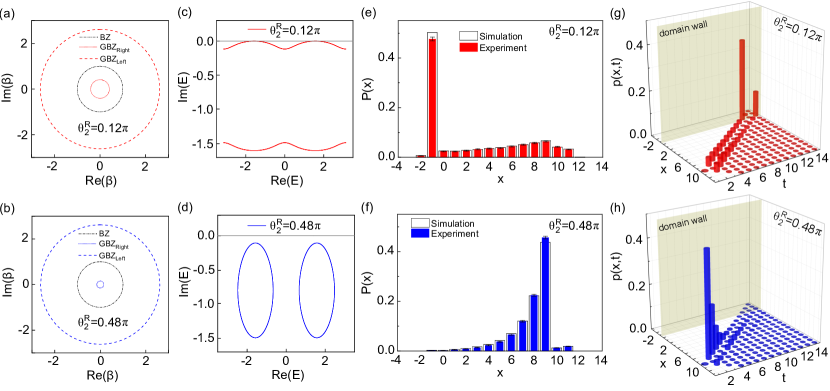
- The edge burst is experimentally observed in a photonic quantum walk, with loss probability at the boundary (x = -1) significantly exceeding that at other positions.
- For θ₂ᴿ = 0.12π, the relative edge burst strength P_domain / P_min increases linearly with initial position x₀, fitting a P_domain / P_min ∼ x₀ relation.
- When the imaginary gap is closed (θ₂ᴿ = 0.48π), the edge burst vanishes, and P_domain / P_min remains near unity, confirming the necessity of the dissipative gap.
- The survival probability |ψ(x = -1, t)|² is markedly higher during edge burst, indicating enhanced localization of loss at the boundary.
- The edge burst persists across varying initial positions, demonstrating robustness and non-trivial dependence on system parameters.
- The experimental data align well with numerical simulations, validating the theoretical prediction of a dynamic bulk-edge scaling relation.
Read this paper
Open the full text in the Nubint reader and ask about any passage as you read.
Read this paper on NubintThis review was generated by AI from the original paper. Please check the paper before citing it.