
[Paper Review] OceanChat: Piloting Autonomous Underwater Vehicles in Natural Language
OceanChat proposes a closed-loop, LLM-guided task and motion planning framework that enables natural language control of Autonomous Underwater Vehicles (AUVs) in complex, dynamic underwater environments. By integrating large language models, task planning with logical constraints, and real-time motion planning using sensor feedback, the system achieves a 30% reduction in computation time compared to LLM-motion planning while maintaining high success rates in canyon navigation tasks.
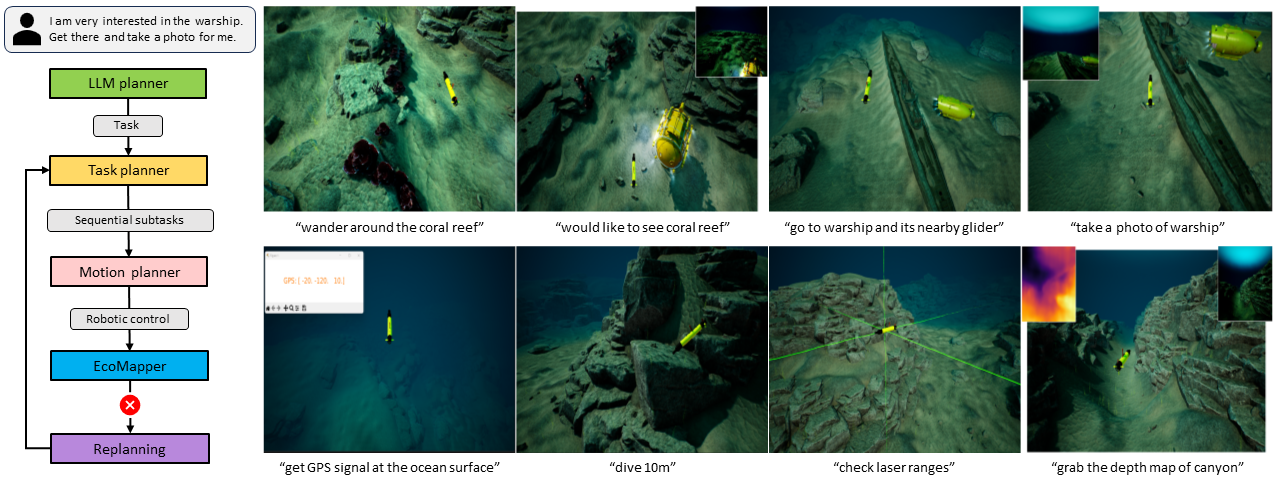
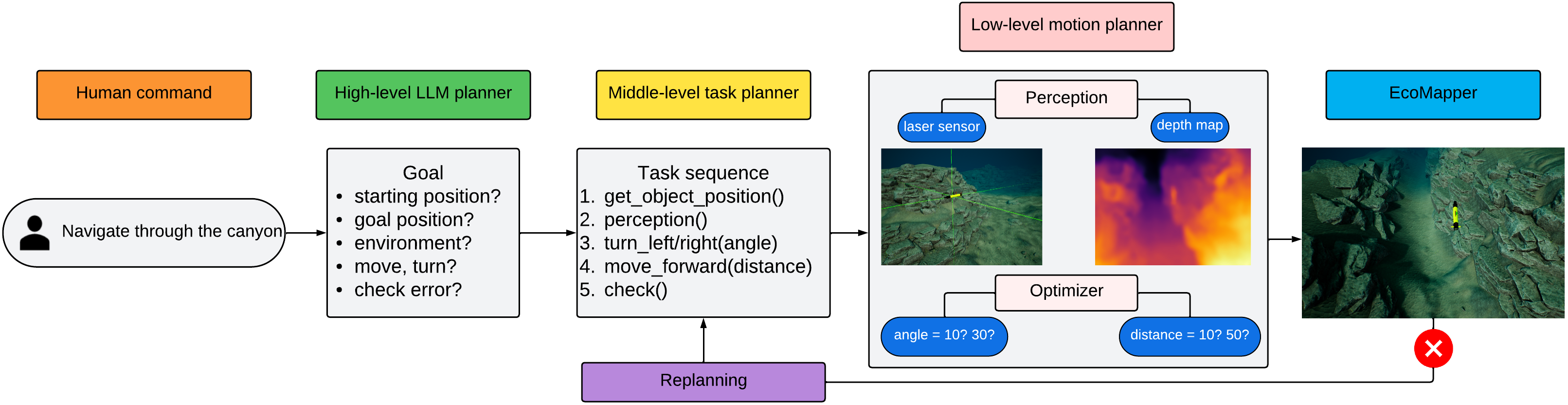
In the trending research of fusing Large Language Models (LLMs) and robotics, we aim to pave the way for innovative development of AI systems that can enable Autonomous Underwater Vehicles (AUVs) to seamlessly interact with humans in an intuitive manner. We propose OceanChat, a system that leverages a closed-loop LLM-guided task and motion planning framework to tackle AUV missions in the wild. LLMs translate an abstract human command into a high-level goal, while a task planner further grounds the goal into a task sequence with logical constraints. To assist the AUV with understanding the task sequence, we utilize a motion planner to incorporate real-time Lagrangian data streams received by the AUV, thus mapping the task sequence into an executable motion plan. Considering the highly dynamic and partially known nature of the underwater environment, an event-triggered replanning scheme is developed to enhance the system's robustness towards uncertainty. We also build a simulation platform HoloEco that generates photo-realistic simulation for a wide range of AUV applications. Experimental evaluation verifies that the proposed system can achieve improved performance in terms of both success rate and computation time. Project website: \url{https://sites.google.com/view/oceanchat}
Motivation & Objective
- To enable non-technical users to pilot AUVs using natural language commands, reducing reliance on specialized engineering knowledge.
- To address the challenge of grounding abstract language instructions into executable robotic actions in partially observable, dynamic underwater environments.
- To enhance system robustness against execution failures through event-triggered replanning using real-time sensor feedback.
- To develop a photo-realistic simulation platform (HoloEco) for evaluating AUV mission performance under diverse conditions.
- To establish a hierarchical, closed-loop planning framework that integrates LLMs, task planners, and motion planners for reliable AUV operation.
Proposed method
- The system uses a three-level framework: LLMs interpret natural language commands into high-level goals, a task planner generates a logically constrained sequence of actions, and a motion planner computes executable trajectories.
- Real-time Lagrangian data streams (e.g., depth maps, laser ranges) are used by the motion planner to generate collision-free, optimal motion plans within a dynamic horizon.
- An event-triggered replanning mechanism uses laser range sensors to detect collisions and trigger plan regeneration when necessary, ensuring robustness.
- The motion planner employs an A*-based heuristic combining distance traveled and proximity to the goal to optimize path selection.
- A custom simulation platform, HoloEco, generates photo-realistic underwater environments with calibrated AUV models (EcoMapper) for evaluation.
- The system integrates PDDL-based task planning with dynamic environmental perception to refine plans based on real-time observations.
Experimental results
Research questions
- RQ1Can large language models effectively translate natural language commands into high-level goals for AUV missions in unstructured underwater environments?
- RQ2How can task planning with logical constraints improve the reliability and executability of LLM-generated plans in robotic systems?
- RQ3To what extent does real-time sensor feedback and event-triggered replanning enhance system robustness in dynamic, partially observable underwater scenarios?
- RQ4What is the trade-off between computational efficiency and success rate when combining LLMs, task planning, and motion planning for AUV navigation?
- RQ5Can a closed-loop planning framework outperform open-loop or LLM-only planning in terms of both success rate and execution time for complex AUV missions?
Key findings
- The proposed LLM-motion-task planning framework achieves a success rate comparable to LLM-motion planning, but with only 30% of the computation time.
- The system successfully navigates EcoMapper through an unknown canyon in simulation, demonstrating autonomous execution from natural language commands.
- Event-triggered replanning significantly improves resilience to unexpected obstacles and sensor errors, enabling recovery from execution failures.
- The integration of task planning reduces the burden on the motion planner by refining the goal into a feasible sequence of actions, improving planning efficiency.
- The HoloEco simulation platform enables realistic evaluation of AUV missions, supporting diverse underwater applications with photo-realistic rendering and sensor modeling.
- Compared to direct LLM planning, the proposed method ensures plan executability by incorporating physical and logical constraints, avoiding infeasible action sequences.
Read this paper
Open the full text in the Nubint reader and ask about any passage as you read.
Read this paper on NubintThis review was generated by AI from the original paper. Please check the paper before citing it.