
[Paper Review] Octo: An Open-Source Generalist Robot Policy
Octo is a large transformer-based, open-source generalist robot policy pretrained on 800k demonstrations that can be finetuned efficiently to new robots, observations, and action spaces, and supports language or goal-image conditioning.
Large policies pretrained on diverse robot datasets have the potential to transform robotic learning: instead of training new policies from scratch, such generalist robot policies may be finetuned with only a little in-domain data, yet generalize broadly. However, to be widely applicable across a range of robotic learning scenarios, environments, and tasks, such policies need to handle diverse sensors and action spaces, accommodate a variety of commonly used robotic platforms, and finetune readily and efficiently to new domains. In this work, we aim to lay the groundwork for developing open-source, widely applicable, generalist policies for robotic manipulation. As a first step, we introduce Octo, a large transformer-based policy trained on 800k trajectories from the Open X-Embodiment dataset, the largest robot manipulation dataset to date. It can be instructed via language commands or goal images and can be effectively finetuned to robot setups with new sensory inputs and action spaces within a few hours on standard consumer GPUs. In experiments across 9 robotic platforms, we demonstrate that Octo serves as a versatile policy initialization that can be effectively finetuned to new observation and action spaces. We also perform detailed ablations of design decisions for the Octo model, from architecture to training data, to guide future research on building generalist robot models.
Motivation & Objective
- Motivate the need for generalist robot policies that generalize across embodiments and tasks.
- Develop an open-source, transformer-based policy that can be finetuned to new sensors, actuators, and domains.
- Demonstrate zero-shot control across multiple robots and language/goal-conditioned tasks.
- Show data-efficient finetuning from a large, diverse dataset to novel robot setups.
- Provide guidance on design decisions for generalist robot policies (architecture, data, objectives, scale).
Proposed method
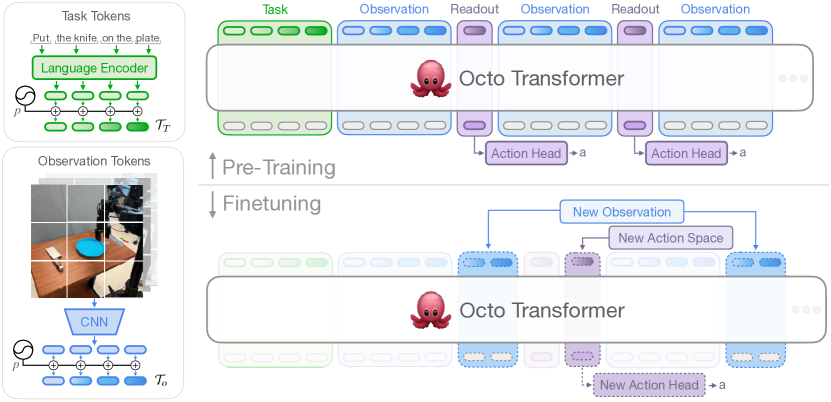
- Transformer-based policy that tokenizes language goals and observations into a common sequence of tokens.
- Input tokenizers: t5-base for language, lightweight CNN patches for images, with position embeddings.
- Block-wise masked transformer backbone with readout tokens that enable flexible addition/removal of inputs during finetuning.
- Diffusion-based action decoding head that predicts a chunk of multiple consecutive actions via a DDPM objective.
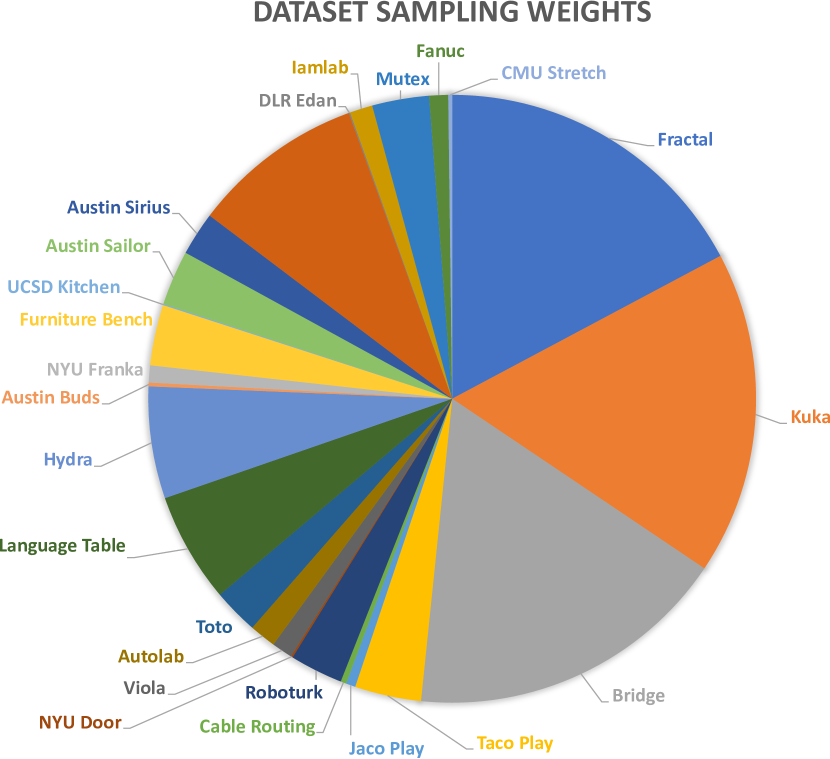
- Training on a diverse Open X-Embodiment data mix (25 datasets, ~800k demonstrations) with zero-padding for missing modalities.
- Fine-tuning: same diffusion objective, ~100 trajectories per target domain, ~50k steps on consumer GPUs; adapters added for new inputs/outputs without reinitializing pretrained weights.
Experimental results
Research questions
- RQ1Can Octo control multiple robots out-of-the-box (zero-shot) with language and goal-image conditioning?
- RQ2Is Octo a good initialization for data-efficient finetuning to unseen robots, observations, and action spaces?
- RQ3Which design choices (architecture, data mixture, objectives) most affect performance of a generalist robot policy?
- RQ4How does Octo scale with model size and data diversity in improving zero-shot and fine-tuned performance?
Key findings
- Octo enables zero-shot control across 9 robots and 4 institutions, outperforming prior openly available generalist policies in language-conditioned tasks.
- Finetuning Octo with ~100 demonstrations per domain yields superior performance vs training from scratch or using pretrained VC-1 visuals, by a notable margin.
- A diffusion-based continuous action head with a broad data mix and transformer-first architecture yields strong results, with larger models showing better zero-shot robustness.
- Architecture with transformer-first design, diffusion action head, and broad data mixture yields best performance in ablations.
- Model scaling shows Octo-Base (93M params) generally improves zero-shot performance and robustness over smaller variants.
Read this paper
Open the full text in the Nubint reader and ask about any passage as you read.
Read this paper on NubintThis review was generated by AI from the original paper. Please check the paper before citing it.