
[Paper Review] Offsite-Tuning: Transfer Learning without Full Model
Offsite-Tuning enables adapting billion-parameter foundation models to downstream data without access to full model weights, using a trainable adapter and a lossy compressed emulator shared with the data owner, achieving privacy-preserving and more efficient fine-tuning with comparable accuracy to full fine-tuning.
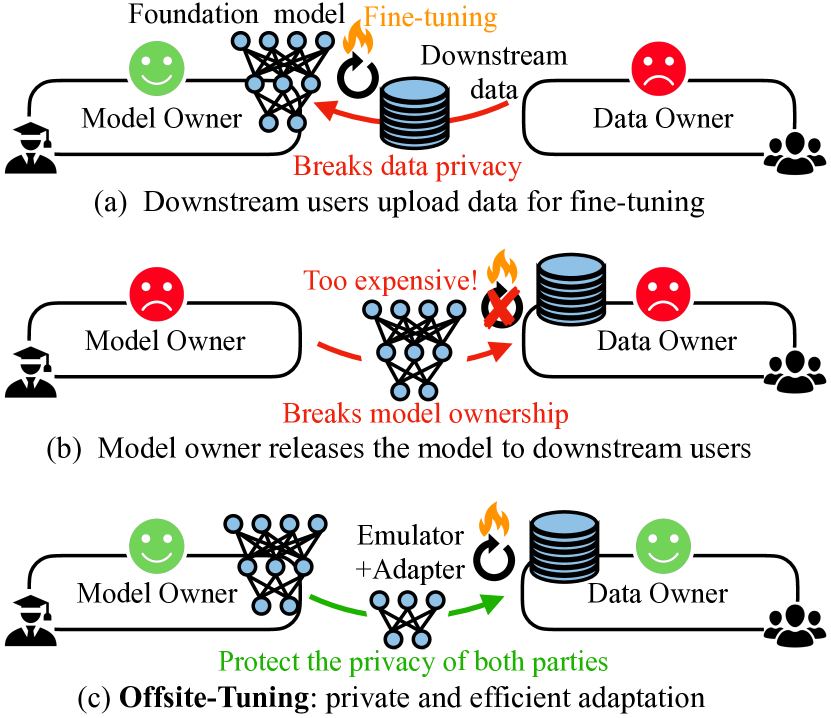
Transfer learning is important for foundation models to adapt to downstream tasks. However, many foundation models are proprietary, so users must share their data with model owners to fine-tune the models, which is costly and raise privacy concerns. Moreover, fine-tuning large foundation models is computation-intensive and impractical for most downstream users. In this paper, we propose Offsite-Tuning, a privacy-preserving and efficient transfer learning framework that can adapt billion-parameter foundation models to downstream data without access to the full model. In offsite-tuning, the model owner sends a light-weight adapter and a lossy compressed emulator to the data owner, who then fine-tunes the adapter on the downstream data with the emulator's assistance. The fine-tuned adapter is then returned to the model owner, who plugs it into the full model to create an adapted foundation model. Offsite-tuning preserves both parties' privacy and is computationally more efficient than the existing fine-tuning methods that require access to the full model weights. We demonstrate the effectiveness of offsite-tuning on various large language and vision foundation models. Offsite-tuning can achieve comparable accuracy as full model fine-tuning while being privacy-preserving and efficient, achieving 6.5x speedup and 5.6x memory reduction. Code is available at https://github.com/mit-han-lab/offsite-tuning.
Motivation & Objective
- Motivate privacy and efficiency challenges in fine-tuning proprietary foundation models for downstream tasks.
- Propose a framework that enables fine-tuning without exposing full model weights or data.
- Demonstrate applicability to both language and vision foundation models across standard benchmarks.
Proposed method
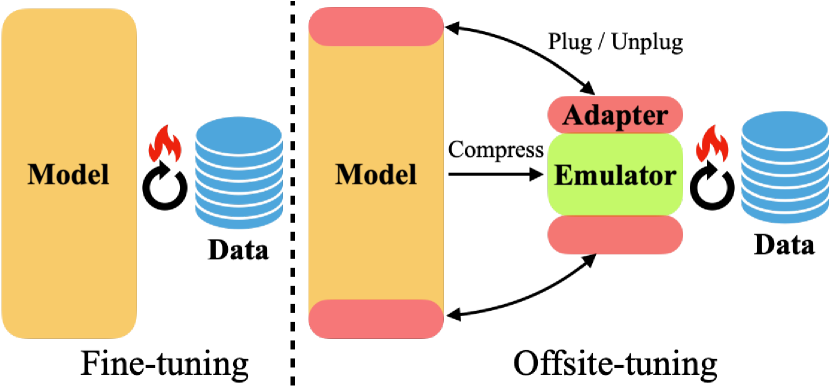
- Split the foundation model into a small trainable adapter (A) and a frozen remainder (E); apply lossy compression to E to create an emulator (E*).
- Supply [A, E*] to the data owner who fine-tunes A using approximate gradients from E*.
- Return the updated adapter A' to the model owner, who injects it into the full model to yield M' = [A', E].
- Explore layer-drop based emulator compression by dropping middle layers of E while retaining first and last layers; optionally distill E* from E when resources permit.
- Design adapters as a sandwich M = A1 ∘ E ∘ A2 to capture both shallow and deep layer updates, improving transfer performance over updating only the top or bottom layers.
- Combine Offsite-Tuning with parameter-efficient fine-tuning techniques (Adapter, LoRA, BitFit) by applying these methods on the adapter layers to further reduce trainable parameters.
Experimental results
Research questions
- RQ1Can a small adapter plus a compressed emulator enable effective fine-tuning of billion-parameter foundation models without sharing full model weights or data?
- RQ2How should the emulator be compressed to balance gradient usefulness for adapters and protection of model ownership?
- RQ3Does the plug-in (adapter-trained on the data owner’s data, then plugged into the full model) approach approach full fine-tuning performance across language and vision tasks?
- RQ4What are the efficiency gains (speed, memory) when using Offsite-Tuning, and how do they scale with model size and compression strategy?
- RQ5How does Offsite-Tuning interact with existing parameter-efficient fine-tuning methods?
Key findings
- Offsite-Tuning achieves comparable plug-in performance to full fine-tuning on several language and vision tasks while preserving privacy (no access to full model weights).
- Layer-drop based emulator compression provides the best balance between performance and privacy, with a visible gap between emulator and plug-in performance that preserves model ownership.
- Distillation of the emulator further improves plug-in performance versus emulator performance, improving outcomes on specific models (e.g., OPT-1.3B and GPT2-XL).
- Combining Offsite-Tuning with parameter-efficient fine-tuning methods (Adapter, LoRA) reduces trainable parameters while maintaining or improving plug-in performance; BitFit tends to underperform relative to full fine-tuning in some cases.
- Efficiency gains are substantial: up to 6.5x throughput speedup and 5.6x memory reduction when combined with LoRA on single-GPU hardware.
Read this paper
Open the full text in the Nubint reader and ask about any passage as you read.
Read this paper on NubintThis review was generated by AI from the original paper. Please check the paper before citing it.