
[Paper Review] OLMo: Accelerating the Science of Language Models
OLMo is a fully open, 1B/7B (and up) decoder-only Transformer language model framework releasing weights, data, training/inference code, and evaluation tools to enable open scientific study of LMs.
Language models (LMs) have become ubiquitous in both NLP research and in commercial product offerings. As their commercial importance has surged, the most powerful models have become closed off, gated behind proprietary interfaces, with important details of their training data, architectures, and development undisclosed. Given the importance of these details in scientifically studying these models, including their biases and potential risks, we believe it is essential for the research community to have access to powerful, truly open LMs. To this end, we have built OLMo, a competitive, truly Open Language Model, to enable the scientific study of language models. Unlike most prior efforts that have only released model weights and inference code, we release OLMo alongside open training data and training and evaluation code. We hope this release will empower the open research community and inspire a new wave of innovation.
Motivation & Objective
- Promote open research by releasing end-to-end LM development artifacts (data, code, models, evaluation) for scientific study of language models.
- Enable rigorous analysis of how pretraining data, architectures, and training choices impact capabilities, biases, and risks.
- Provide a scalable framework to compare open models with state-of-the-art closed models and enable replication of results.
Proposed method
- Adopts a decoder-only Transformer architecture with improvements (no biases, non-parametric layer norm, SwiGLU, RoPE, modified BPE tokenizer).
- Pretrains multiple model sizes (1B and 7B released; 65B in training) on at least 2 trillion tokens using Dolma as the pretraining corpus.
- Uses ZeRO + FSDP distributed training with mixed precision to scale training across AMD/NVIDIA hardware.
- Releases intermediate checkpoints, training logs, and complete data and tooling, including Dolma and WIMBD tools, under Apache 2.0.
- Evaluates with Catwalk for downstream tasks and Paloma for perplexity; performs in-loop training ablations to guide architecture and data choices.
- Demonstrates adaptation via instruction-tuning and Direct Preference Optimization (DPO) using Open Instruct data.
Experimental results
Research questions
- RQ1How does open, fully released LM infrastructure (data, weights, training/evaluation code) enable scientific study of LMs?
- RQ2What are the effects of model design choices (bias terms, layer norm, activations, RoPE) on training stability and throughput?
- RQ3How does a large, open pretraining dataset (Dolma) influence model capabilities and data-domain coverage across tasks and perplexity domains?
- RQ4What is the impact of instruction-tuning and alignment (DPO) on base open models in safety and downstream task performance?
- RQ5How do open models compare to contemporary baselines in zero-shot downstream tasks and intrinsic perplexity assessments when evaluated with decontaminated data?
Key findings
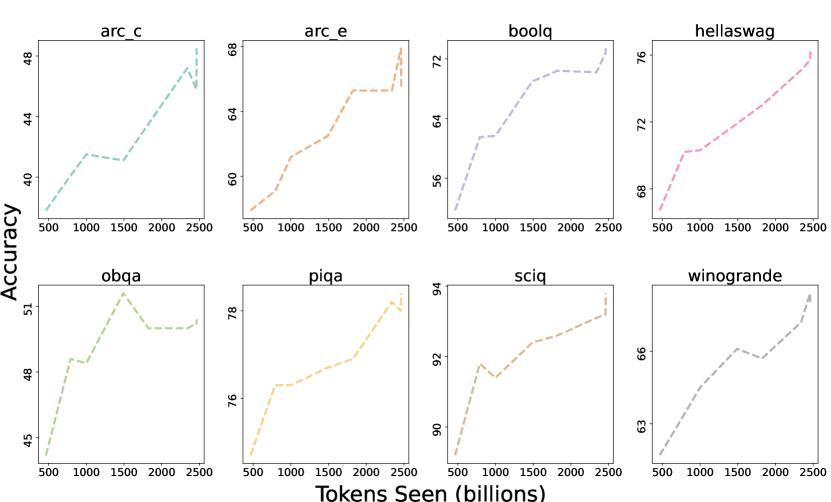
- OLMo-7B is competitive with publicly available 7B-scale models across eight core downstream tasks in zero-shot evaluation.
- OLMo-7B shows improved performance as training tokens increase, with notable gains when learning rate decays to zero in the final steps.
- Instruction-tuning and DPO adaptation substantially improve safety and task metrics, often surpassing other chat variants and showing strong base-model utility.
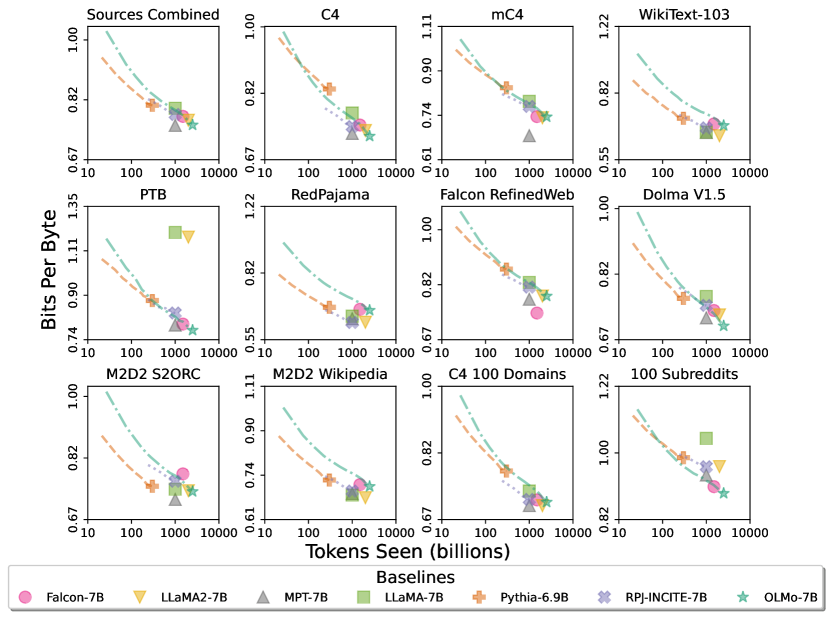
- Paloma-based intrinsic evaluation indicates competitive perplexity fit across 11 data sources when decontaminated from pretraining data.
- Adaptation results reveal gaps relative to some tuned peers (e.g., Tülu 2) potentially due to dataset alignment and test contamination considerations.
- Open release of intermediate checkpoints and data pipelines enables reproducibility and further experimentation by the research community.
Read this paper
Open the full text in the Nubint reader and ask about any passage as you read.
Read this paper on NubintThis review was generated by AI from the original paper. Please check the paper before citing it.