
[Paper Review] On Catastrophic Inheritance of Large Foundation Models
This paper introduces 'Catastrophic Inheritance'—the propagation of biases, noise, and corruption from large-scale pre-training data into large foundation models (LFMs), leading to harmful downstream behaviors. The authors propose UIM, a framework to Understand, Interpret, and Mitigate such inherited flaws, aiming to improve model safety, fairness, and generalization across AI applications.
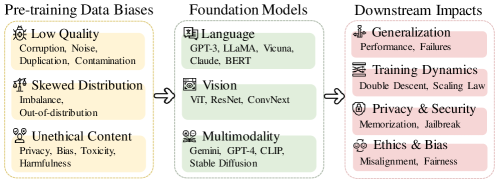
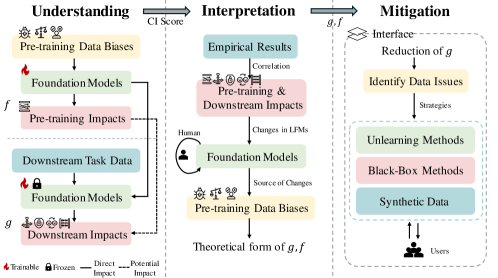
Large foundation models (LFMs) are claiming incredible performances. Yet great concerns have been raised about their mythic and uninterpreted potentials not only in machine learning, but also in various other disciplines. In this position paper, we propose to identify a neglected issue deeply rooted in LFMs: Catastrophic Inheritance, describing the weaknesses and limitations inherited from biased large-scale pre-training data to behaviors of LFMs on the downstream tasks, including samples that are corrupted, long-tailed, noisy, out-of-distributed, to name a few. Such inheritance can potentially cause catastrophes to downstream applications, such as bias, lack of generalization, deteriorated performance, security vulnerability, privacy leakage, and value misalignment. We discuss the challenges behind this issue and propose UIM, a framework to Understand the catastrophic inheritance of LFMs from both pre-training and downstream adaptation, Interpret the implications of catastrophic inheritance on downstream tasks, and how to Mitigate it. UIM aims to unite both the machine learning and social sciences communities for more responsible and promising AI development and deployment.
Motivation & Objective
- Address the growing concern that large foundation models (LFMs) inherit harmful biases, noise, and corruption from large-scale, uncurated pre-training datasets.
- Highlight the risk of these inherited flaws causing catastrophic failures in downstream applications, including bias, security vulnerabilities, and privacy leaks.
- Expose the challenge that biases may remain undetected after fine-tuning, concealing risks in real-world deployments.
- Propose a unified research framework to analyze and address the root causes of such inherited limitations in LFMs.
- Bridge machine learning and social sciences to enable more responsible and robust AI development and deployment.
Proposed method
- Introduce the concept of 'Catastrophic Inheritance' to describe how biases in pre-training data lead to severe downstream consequences in LFMs.
- Propose UIM—a three-pronged framework: Understand the inheritance from pre-training data, Interpret its impact on downstream tasks, and Mitigate the effects.
- Use empirical analysis to trace how data-level issues (e.g., corrupted, noisy, biased samples) propagate through LFM training and fine-tuning.
- Leverage existing benchmarks and case studies (e.g., LAION-5B containing CSAM) to demonstrate real-world inheritance of harmful content.
- Integrate insights from both ML and social sciences to evaluate ethical, security, and generalization impacts of inherited data biases.
- Advocate for cross-disciplinary collaboration to detect, interpret, and reduce the risk of catastrophic inheritance in LFM deployment.
Experimental results
Research questions
- RQ1To what extent do biases in large-scale pre-training data lead to catastrophic failures in downstream LFM applications?
- RQ2How do corrupted, noisy, or out-of-distribution samples in pre-training data affect the generalization and behavior of LFMs?
- RQ3Why do biases in pre-training data often remain undetected after fine-tuning, posing hidden risks in real-world deployment?
- RQ4What mechanisms can effectively detect and interpret the inheritance of data-level flaws in large foundation models?
- RQ5How can a unified framework like UIM help mitigate catastrophic inheritance across diverse AI applications and domains?
Key findings
- Large foundation models inherit harmful biases, noise, and corruption from pre-training data, leading to downstream failures such as generating child sexual abuse material (CSAM) in diffusion models.
- Biases in datasets like LAION-5B are directly inherited by models such as Stable Diffusion, resulting in the generation of harmful content despite no explicit instruction.
- Even after fine-tuning, biases may persist undetected, creating hidden security and ethical risks in deployed systems.
- The black-box nature and massive scale of pre-training data make it infeasible to manually curate or fully audit, increasing the risk of catastrophic inheritance.
- UIM provides a structured approach to trace, interpret, and mitigate inherited flaws, offering a path toward safer and more responsible LFM deployment.
- The study underscores the urgent need for cross-disciplinary collaboration between machine learning and social sciences to address systemic risks in foundation models.
Read this paper
Open the full text in the Nubint reader and ask about any passage as you read.
Read this paper on NubintThis review was generated by AI from the original paper. Please check the paper before citing it.