
[Paper Review] On Efficient Training of Large-Scale Deep Learning Models: A Literature Review
A task-free, model-free survey that categorizes general techniques for accelerating training of large-scale deep learning models across data-, model-, optimization-, budget-, and system-centric perspectives.
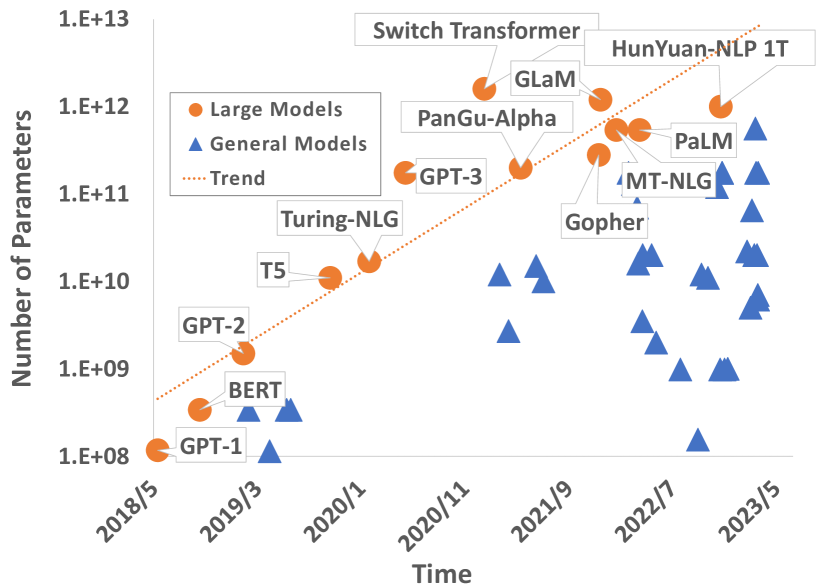
The field of deep learning has witnessed significant progress, particularly in computer vision (CV), natural language processing (NLP), and speech. The use of large-scale models trained on vast amounts of data holds immense promise for practical applications, enhancing industrial productivity and facilitating social development. With the increasing demands on computational capacity, though numerous studies have explored the efficient training, a comprehensive summarization on acceleration techniques of training deep learning models is still much anticipated. In this survey, we present a detailed review for training acceleration. We consider the fundamental update formulation and split its basic components into five main perspectives: (1) data-centric: including dataset regularization, data sampling, and data-centric curriculum learning techniques, which can significantly reduce the computational complexity of the data samples; (2) model-centric, including acceleration of basic modules, compression training, model initialization and model-centric curriculum learning techniques, which focus on accelerating the training via reducing the calculations on parameters; (3) optimization-centric, including the selection of learning rate, the employment of large batchsize, the designs of efficient objectives, and model average techniques, which pay attention to the training policy and improving the generality for the large-scale models; (4) budgeted training, including some distinctive acceleration methods on source-constrained situations; (5) system-centric, including some efficient open-source distributed libraries/systems which provide adequate hardware support for the implementation of acceleration algorithms. By presenting this comprehensive taxonomy, our survey presents a comprehensive review to understand the general mechanisms within each component and their joint interaction.
Motivation & Objective
- Summarize general acceleration techniques for large-scale model training independent of task or architecture.
- Provide a taxonomy that decomposes the training process into data-centric, model-centric, optimization-centric, budgeted, and system-centric components.
- Analyze interactions among components and discuss future directions for efficient training paradigms.
Proposed method
- Decompose the generic gradient-based update formulation into five components (data, model, optimization, budget, system).
- Propose a five-way taxonomy to categorize existing acceleration techniques under data-centric, model-centric, optimization-centric, budgeted training, and system-centric viewpoints.
- Review and synthesize techniques such as data regularization, data sampling, curriculum learning, architectural compression, initialization, learning-rate and batch-size strategies, and distributed systems frameworks.
- Discuss practical considerations, strengths, weaknesses, and interactions between components.
- Outline future research directions and the potential for general acceleration paradigms applicable across architectures and domains.
Experimental results
Research questions
- RQ1What general, architecture- and task-agnostic techniques exist to accelerate training of large-scale deep learning models?
- RQ2How can the training process be decomposed into data-, model-, optimization-, budget-, and system-centric components to guide acceleration strategies?
- RQ3What are the trade-offs and interactions among these components in practical settings?
- RQ4What future directions can sustain efficient training as model and dataset scales continue to grow?
Key findings
- A comprehensive taxonomy of training acceleration techniques across five perspectives (data, model, optimization, budgeted, system).
- Data-centric methods focus on data augmentation, regularization, sampling, and curriculum learning to reduce computation while maintaining accuracy.
- Model-centric methods target architectural efficiency, compression, and better initialization to reduce training cost.
- Optimization-centric strategies emphasize learning-rate schedules, large-batch training, and robust objectives to improve efficiency and generalization.
- Budgeted training addresses resource-constrained scenarios to maximize performance under limits.
- System-centric approaches discuss distributed frameworks and hardware-aware implementations that enable scalable training.
Read this paper
Open the full text in the Nubint reader and ask about any passage as you read.
Read this paper on NubintThis review was generated by AI from the original paper. Please check the paper before citing it.