
[Paper Review] On Evaluation Protocols for Data Augmentation in a Limited Data Scenario
This paper challenges the efficacy of classical data augmentation (DA) in NLP, showing that its performance gains in small-data text classification are largely due to inadequate baseline fine-tuning rather than DA itself. Instead, zero- and few-shot generation using large language models (e.g., ChatGPT, Llama2) significantly improves performance by simulating external data, while traditional DA methods offer no benefit when baselines are properly tuned.
Textual data augmentation (DA) is a prolific field of study where novel techniques to create artificial data are regularly proposed, and that has demonstrated great efficiency on small data settings, at least for text classification tasks. In this paper, we challenge those results, showing that classical data augmentation (which modify sentences) is simply a way of performing better fine-tuning, and that spending more time doing so before applying data augmentation negates its effect. This is a significant contribution as it answers several questions that were left open in recent years, namely~: which DA technique performs best (all of them as long as they generate data close enough to the training set, as to not impair training) and why did DA show positive results (facilitates training of network). We further show that zero- and few-shot DA via conversational agents such as ChatGPT or LLama2 can increase performances, confirming that this form of data augmentation is preferable to classical methods.
Motivation & Objective
- To investigate why classical data augmentation (DA) has shown consistent performance gains in small-data NLP settings despite questionable mechanisms.
- To challenge the assumption that DA improves model generalization, arguing instead that it primarily facilitates better fine-tuning.
- To evaluate the effectiveness of modern large language models (e.g., ChatGPT, Llama2) in generating high-quality, diverse data for data augmentation.
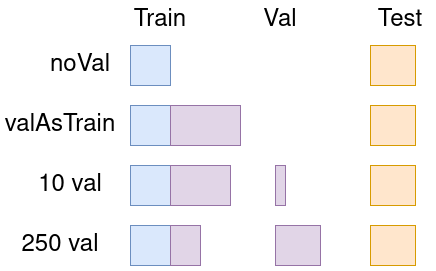
- To propose more realistic evaluation protocols by redefining train/validation splits to reflect real-world data scarcity.
- To assess whether DA remains effective when validation data is limited or repurposed for training.
Proposed method
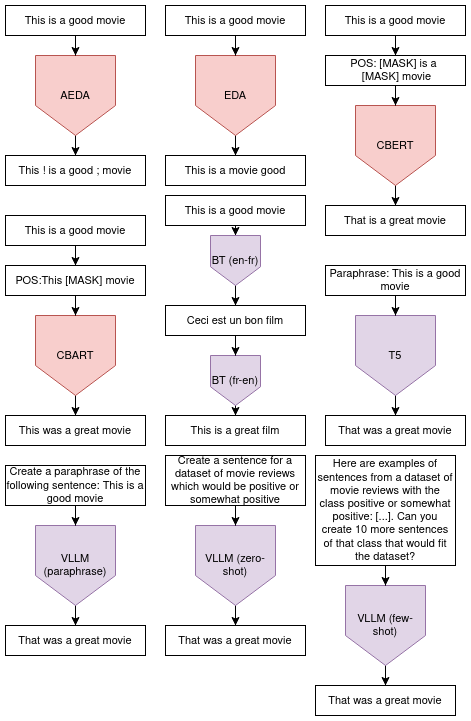
- Re-evaluated classical DA techniques (e.g., EDA, AEDA, BERT-based substitution) under standardized, optimal fine-tuning protocols with patience scheduling and label smoothing.
- Compared zero-shot and few-shot (3-shot) prompting strategies using LLMs (ChatGPT, Llama2) to generate new training examples from task descriptions or few examples.
- Used BERT-based classifiers on standard text classification benchmarks (e.g., IMDB, AG’s News, DBPedia) with controlled data splits to simulate real-world low-resource settings.
- Redesigned training/validation splits to reflect realistic data scarcity—reducing validation sets and increasing training data from a few dozen to hundreds of examples.
- Applied jackknife-style evaluation to assess stability and generalization under limited data, replacing standard validation-based protocols.
- Conducted ablation-like comparisons across hyperparameters and model variants (e.g., Llama2-13B-Chat vs. ChatGPT) to isolate the impact of generation strategy and model choice.
Experimental results
Research questions
- RQ1Why have classical data augmentation methods shown consistent performance gains in small-data text classification, despite limited theoretical justification?
- RQ2To what extent do performance gains from DA stem from improved fine-tuning rather than data diversity or regularization?
- RQ3Can large language models (e.g., ChatGPT, Llama2) generate data that improves model performance more effectively than classical DA techniques?
- RQ4How do zero-shot and few-shot prompting strategies compare in generating informative, distributionally relevant training data?
- RQ5How do realistic data splits—where validation data is minimal or repurposed—impact the evaluation and perceived effectiveness of data augmentation?
Key findings
- Classical data augmentation methods (e.g., EDA, AEDA) provide no performance benefit when the baseline model is properly fine-tuned with patience scheduling and label smoothing.
- The observed gains from DA in prior studies are largely attributable to suboptimal baseline training protocols, not to data augmentation per se.
- LLM-based data generation via zero-shot and few-shot prompting significantly improves classification performance, especially when generating data resembling external, out-of-distribution examples.
- The 3-shot prompting strategy outperforms zero-shot prompting, as it produces sentences with more task-relevant features (e.g., hashtags, emojis), suggesting better alignment with training distribution.
- ChatGPT consistently outperforms Llama2 in generating effective data for augmentation, though the difference may vary with model size and configuration.
- Reconfiguring training/validation splits to reflect real-world data scarcity (e.g., fewer validation examples) reveals that standard validation-based protocols overestimate DA’s utility, calling for more robust evaluation methods like jackknife.
Read this paper
Open the full text in the Nubint reader and ask about any passage as you read.
Read this paper on NubintThis review was generated by AI from the original paper. Please check the paper before citing it.