
[Paper Review] On the Connection between Pre-training Data Diversity and Fine-tuning Robustness
This paper investigates how pre-training data diversity affects fine-tuning robustness, finding that data quantity and label granularity are the primary drivers of robust generalization to distribution shifts. Using iWildCam-WILDS as a benchmark, it shows that increasing pre-training data size boosts robustness significantly, while label semantics, image diversity, and data source have minimal impact when data quantity is held constant.
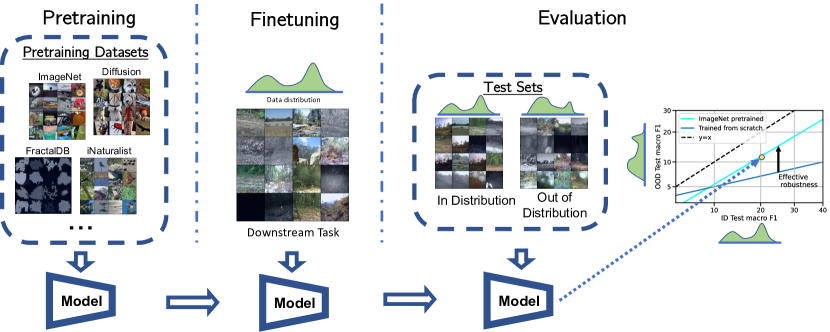
Pre-training has been widely adopted in deep learning to improve model performance, especially when the training data for a target task is limited. In our work, we seek to understand the implications of this training strategy on the generalization properties of downstream models. More specifically, we ask the following question: how do properties of the pre-training distribution affect the robustness of a fine-tuned model? The properties we explore include the label space, label semantics, image diversity, data domains, and data quantity of the pre-training distribution. We find that the primary factor influencing downstream effective robustness (Taori et al., 2020) is data quantity, while other factors have limited significance. For example, reducing the number of ImageNet pre-training classes by 4x while increasing the number of images per class by 4x (that is, keeping total data quantity fixed) does not impact the robustness of fine-tuned models. We demonstrate our findings on pre-training distributions drawn from various natural and synthetic data sources, primarily using the iWildCam-WILDS distribution shift as a test for downstream robustness.
Motivation & Objective
- To understand how properties of pre-training data influence downstream model robustness under natural distribution shifts.
- To isolate the effects of data quantity, label granularity, label semantics, image diversity, and data sources on fine-tuned model performance.
- To evaluate whether synthetic or natural data sources yield comparable robustness gains when pre-training data quantity is controlled.
- To determine whether robustness generalization is driven more by data distribution characteristics or by model architecture and training method.
- To provide data-centric guidelines for constructing effective pre-training datasets that enhance robustness to real-world distribution shifts.
Proposed method
- Pre-train vision models on controlled subsets of ImageNet, iNaturalist, and synthetic data (e.g., fractal images, Stable Diffusion-generated images), varying one property at a time while holding others constant.
- Fine-tune all models on the iWildCam-WILDS dataset, a benchmark for natural distribution shift, and evaluate robustness using F1 scores on out-of-distribution (OOD) splits.
- Systematically ablate five axes: data quantity, label granularity (coarse vs. fine), label semantics (animal vs. inanimate classes), image diversity (per-class subclass variation), and data sources (ImageNet, iNaturalist, synthetic data).
- Use self-supervised CLIP models pre-trained on YFCC-15M and LAION-15M to validate findings across different pre-training objectives and data scales.
- Compare results to training from scratch and to ImageNet pre-training to establish a baseline linear trend for robustness as a function of data quantity.
- Analyze results across multiple model architectures and pre-training methods to assess generalizability of findings.
Experimental results
Research questions
- RQ1How does the quantity of pre-training data affect the robustness of fine-tuned models on downstream tasks with distribution shifts?
- RQ2To what extent does label granularity (coarse vs. fine) influence downstream robustness, independent of data quantity?
- RQ3Does the semantic similarity of pre-training classes (e.g., animals vs. inanimate objects) affect transfer robustness to a downstream task?
- RQ4How does increasing per-class image diversity (e.g., including more subclasses) impact fine-tuned model robustness?
- RQ5Can synthetic data sources (fractal or Stable Diffusion-generated) achieve robustness comparable to natural data when pre-training data quantity is controlled?
Key findings
- Pre-training with more data significantly improves downstream robustness, and even 25K images from ImageNet or iNaturalist—six times smaller than the fine-tuning dataset—yields noticeable robustness gains.
- Reducing label granularity from 1000 to 5 classes has a measurable negative effect on robustness, but the impact is less severe than reducing data quantity.
- Pre-training on 600 inanimate object categories from ImageNet yields the same effective robustness as pre-training on 400 animal categories, despite the downstream task being animal-focused.
- Increasing per-class image diversity (e.g., by including more subclasses) has no significant effect on fine-tuned model robustness when data quantity and label set are fixed.
- The trade-off between having more classes and more images per class is negligible when total data quantity is held constant, indicating that data quantity dominates over class diversity.
- Synthetic fractal data is less effective than natural data at the same data quantity, but Stable Diffusion-generated images close the gap significantly and perform comparably to natural data when data quantity is high.

Read this paper
Open the full text in the Nubint reader and ask about any passage as you read.
Read this paper on NubintThis review was generated by AI from the original paper. Please check the paper before citing it.