
[Paper Review] On the Metrics for Evaluating Monocular Depth Estimation
This paper evaluates whether standard monocular depth estimation (MDE) metrics predict real-world performance in downstream 3D perception tasks. By converting MDE depth maps into Pseudo-LiDAR point clouds and testing state-of-the-art 3D object detectors, the authors find that the absolute relative (abs-rel) error metric best aligns with 3D object detection performance, suggesting it is the most reliable metric for MDE model selection in autonomous driving contexts.
Monocular Depth Estimation (MDE) is performed to produce 3D information that can be used in downstream tasks such as those related to on-board perception for Autonomous Vehicles (AVs) or driver assistance. Therefore, a relevant arising question is whether the standard metrics for MDE assessment are a good indicator of the accuracy of future MDE-based driving-related perception tasks. We address this question in this paper. In particular, we take the task of 3D object detection on point clouds as a proxy of on-board perception. We train and test state-of-the-art 3D object detectors using 3D point clouds coming from MDE models. We confront the ranking of object detection results with the ranking given by the depth estimation metrics of the MDE models. We conclude that, indeed, MDE evaluation metrics give rise to a ranking of methods that reflects relatively well the 3D object detection results we may expect. Among the different metrics, the absolute relative (abs-rel) error seems to be the best for that purpose.
Motivation & Objective
- To assess whether standard MDE evaluation metrics reliably predict performance in downstream 3D perception tasks.
- To investigate whether the small differences in MDE metrics across state-of-the-art models translate into meaningful differences in real-world perception performance.
- To determine if 3D object detection can serve as a more relevant evaluation benchmark for MDE models than traditional metrics alone.
- To examine the impact of Pseudo-LiDAR sampling strategies on 3D object detection performance when using MDE-generated depth maps.
Proposed method
- Trained and evaluated eight state-of-the-art MDE models on the KITTI benchmark using standard depth estimation metrics (abs-rel, rms, δ<1.25).
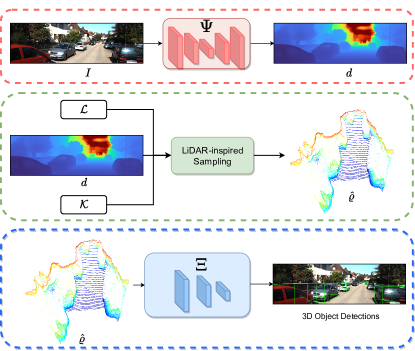
- Converted predicted depth maps from each MDE model into Pseudo-LiDAR point clouds using a consistent sampling strategy.
- Trained and tested three 3D object detection architectures (Point R-CNN, Voxel R-CNN, CenterPoint) on the Pseudo-LiDar point clouds.
- Compared the ranking of MDE models based on their depth estimation metrics (abs-rel, rms, δ<1.25) against their performance in 3D object detection using AP_BEV (moderate) as the primary metric.
- Used visualizations and arrow-based ranking comparisons to assess alignment between MDE metric rankings and 3D detection performance rankings.
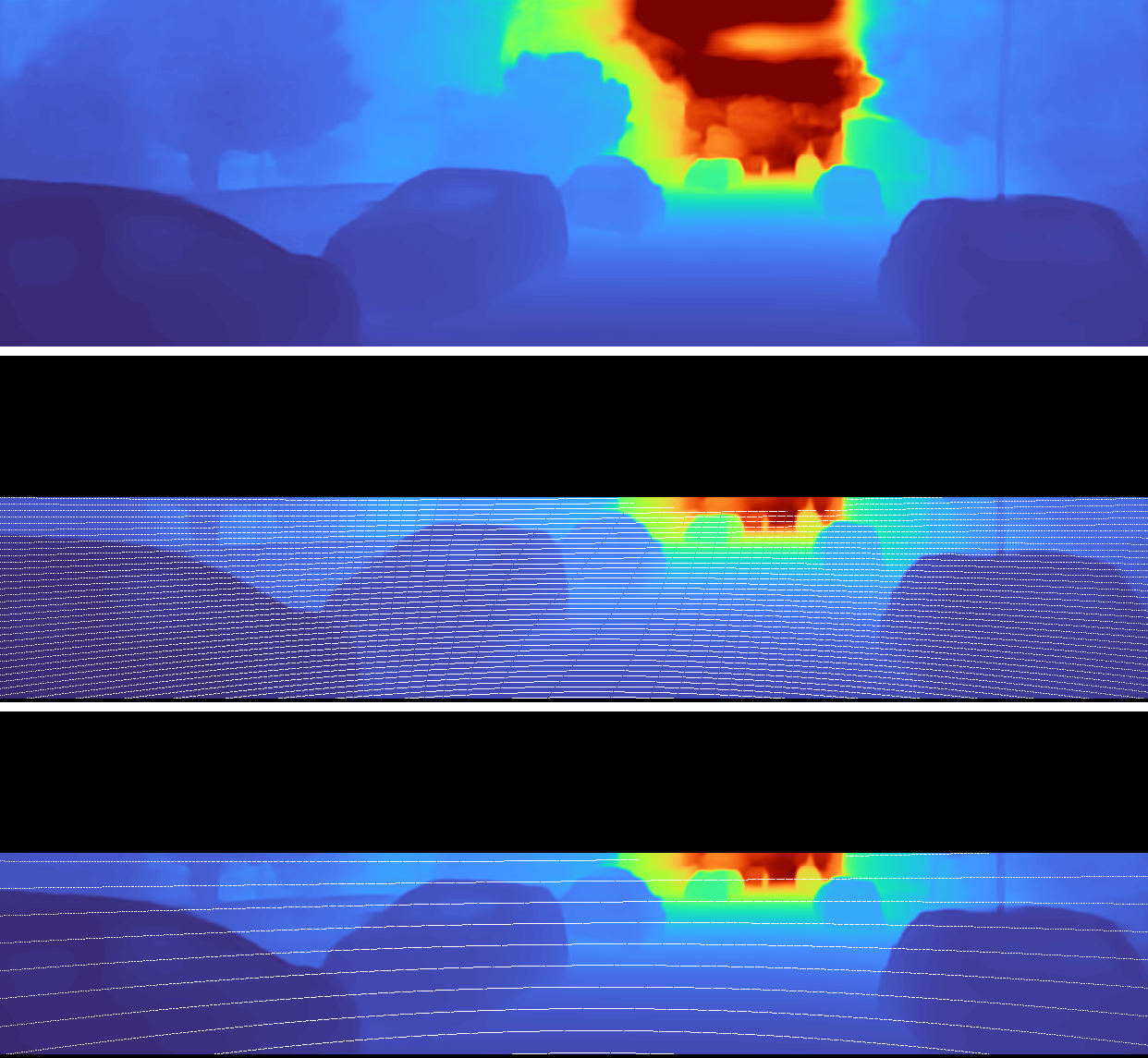
- Analyzed the sensitivity of 3D detection performance to the way depth maps are sampled into Pseudo-LiDAR point clouds.
Experimental results
Research questions
- RQ1Do standard MDE evaluation metrics like abs-rel, rms, and δ<1.25 correlate with downstream 3D object detection performance?
- RQ2Which MDE metric best predicts the relative performance of MDE models when used in a 3D object detection pipeline?
- RQ3Is the performance gap observed in MDE metrics (e.g., 0.077 vs. 0.090 abs-rel) meaningful when translated into real-world 3D detection accuracy?
- RQ4Does incorporating 3D object detection into the evaluation pipeline provide a more reliable assessment of MDE model quality than traditional metrics alone?
Key findings
- The abs-rel metric shows the strongest alignment with 3D object detection performance rankings across all tested 3D detectors (Point R-CNN, Voxel R-CNN, CenterPoint).
- The δ<1.25 metric exhibits a less consistent ranking correlation with 3D detection results, showing higher variability and more conflicting rankings.
- The rms metric performs moderately between abs-rel and δ<1.25, showing a partial but less reliable alignment with 3D detection performance.
- Despite small differences in MDE metrics (e.g., 0.077 vs. 0.090 abs-rel), these differences are reflected in measurable performance differences in 3D object detection, validating the relevance of the metrics.
- The sampling strategy used to generate Pseudo-LiDAR from depth maps significantly affects 3D object detection performance, indicating that implementation details matter.
- The study suggests that incorporating 3D object detection as part of the evaluation pipeline could be more informative than relying solely on traditional MDE metrics.
Read this paper
Open the full text in the Nubint reader and ask about any passage as you read.
Read this paper on NubintThis review was generated by AI from the original paper. Please check the paper before citing it.